Zing Forum

Reading

capstone-pattern-surfacer: Practice of Integrating n8n Workflow with Gemini AI Agent

An n8n-based workflow automation project demonstrating how to receive data via Webhook, store it in Google Sheets, and integrate Gemini AI Agent for intelligent processing

n8n工作流自动化Gemini AIWebhookGoogle Sheets无代码AI Agent数据管道
Published 2026-05-29 20:44Recent activity 2026-05-29 21:29Estimated read 9 min
capstone-pattern-surfacer: Practice of Integrating n8n Workflow with Gemini AI Agent
1

Section 01

[Introduction] Core Overview of the capstone-pattern-surfacer Project

capstone-pattern-surfacer is an n8n-based workflow automation practice project that demonstrates the complete process of receiving data via Webhook, storing it in Google Sheets, and integrating Gemini AI Agent for intelligent processing. As a capstone project, it covers core elements of modern automation such as no-code/low-code platforms, data pipelines, and AI capability integration, providing a concise and complete reference case for learning workflow automation and AI application development.


2

Section 02

Project Background and Source Information

Original Author and Source

As a capstone project, this project aims to demonstrate the core elements of modern automation workflows.

3

Section 03

Analysis of Core Workflow and Technical Architecture

Data Flow Architecture

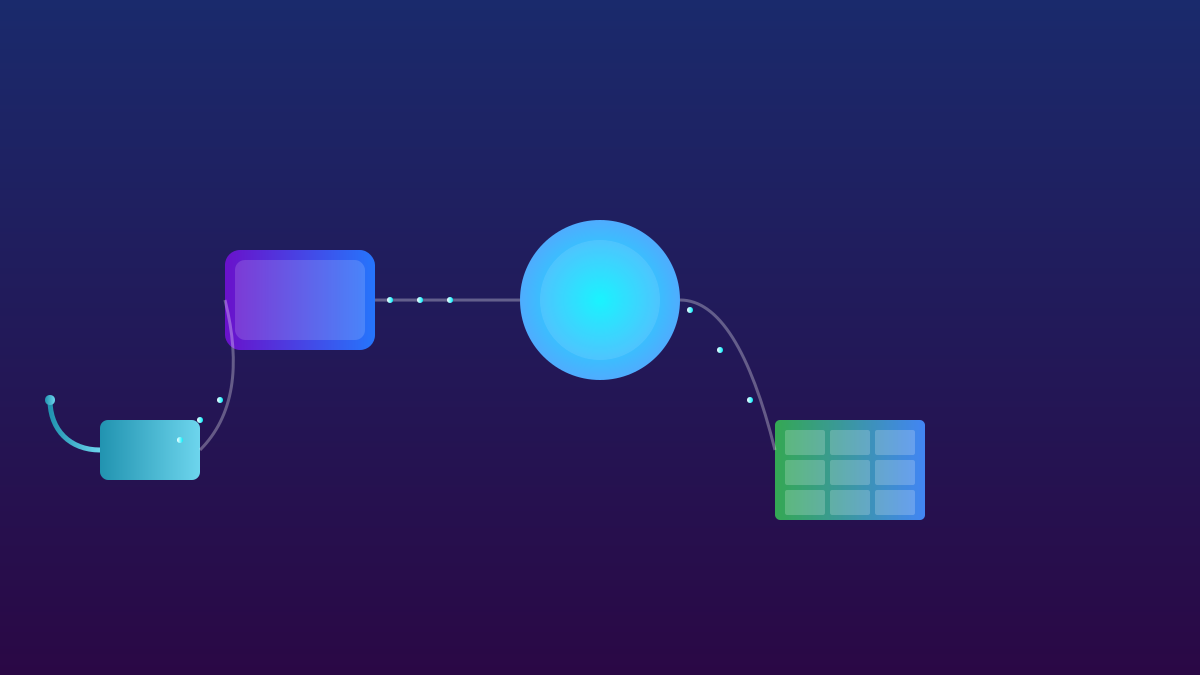
The project's core is a three-stage data pipeline: Webhook → Google Sheets → Gemini AI Agent, embodying the typical pattern of data collection, storage, and intelligent processing.

Webhook Receiver

  • External System Integration: Supports form submission, third-party callbacks, IoT data reporting, and scheduled triggers
  • Data Validation and Cleaning: Format validation, field extraction, transformation, error handling
  • Security Considerations: Authentication mechanisms, rate limiting, input filtering, HTTPS transmission

Google Sheets Storage

  • Advantages: User-friendly visualization, convenient collaboration, zero operation and maintenance, mature API, Google ecosystem integration
  • Applicable Scenarios: Small data volume, manual intervention processes, prototype verification, internal team tools
  • Data Structure: Clear column structure, validation rules, archiving strategy

Gemini AI Agent Integration

  • Model Capabilities: Natural language understanding/generation, multi-modal support, long context, Google service integration
  • Application Scenarios: Content classification, sentiment analysis, information extraction, content generation, data validation
  • Integration Method: n8n node configuration (API key, model selection, prompt template, output format, retry mechanism)
4

Section 04

Features and Advantages of the n8n Platform

What is n8n

An open-source workflow automation tool with a fair-code license, enabling visual construction of complex workflows and connecting various application services.

Core Features

  • Visual Editor: Drag-and-drop nodes, real-time preview, support for complex logic
  • Integration Ecosystem: 400+ pre-built nodes, HTTP requests, custom nodes
  • Flexible Deployment: Self-hosted (Docker/npm/source code), n8n Cloud
  • Coding Capability: Function nodes support JS/TS, custom logic, and npm package integration

Advantages

Compared to Zapier/Make, n8n has advantages such as data privacy (self-hosted), controllable costs, scalability, and an active community.

5

Section 05

Technical Value and Learning Significance of the Project

Learning Entry Case

  • Demonstrates complete data flow (input → processing → output)
  • Covers three major components: Webhook, database, and AI
  • Moderate complexity, easy to understand and reproduce

AI Application Reference Pattern

  • Standard way to embed AI capabilities into business processes
  • Data flow to AI models and output usage

No-Code Practice Manifestation

  • Reduces repetitive coding
  • Implements functions through configuration
  • Rapid prototype iteration
6

Section 06

Extended Application Scenarios and Practice Directions

Scenarios expandable based on the basic architecture:

  • Customer Feedback Processing: Receive form → Store in Sheets → Gemini classification → Route to team
  • Content Moderation: User content → Gemini safety detection → Automatic/manual review → Log recording
  • Intelligent Customer Service: Receive consultation → Gemini reply suggestion → Manual review and send → Model optimization
  • Data Entry Automation: Unstructured data → Gemini extracts structured information → Fill database → Manual verification
7

Section 07

Implementation Suggestions and Best Practice Guidelines

Error Handling Design

  • Node timeout retry
  • Error notification for key steps
  • Temporary storage and reprocessing of failed data

Data Security

  • Avoid sensitive information in logs
  • Secure management of API keys
  • Data encryption and access control

Performance Optimization

  • Batch processing
  • Cache usage
  • Monitor execution time and resources

Maintainability

  • Naming conventions and documentation
  • Version control and change records
  • Regular review and optimization
8

Section 08

Project Summary and Future Outlook

Although capstone-pattern-surfacer is a concise demonstration project, it covers core elements of modern automation: data collection, storage, and AI processing. Similar workflows can be quickly built via n8n without extensive coding.

The project's value lies in demonstrating the organic combination of different technical components (Webhook, Google Sheets, Gemini), making it a good starting point for learning workflow automation and AI applications.

In the future, such automation solutions that 'connect data and intelligence' will be applied in more business scenarios, helping enterprises improve efficiency and reduce costs.

