Zing Forum

Reading

Bioinfor-Claw: A Modular AI Agent Skill Library for Bioinformatics

A bioinformatics agent platform with 50 specialized skills, supporting standalone operation, OpenClaw and Claude Code integration, covering 10 major application scenarios including public data access, multi-omics analysis, CRISPR design, gene analysis, protein structure, machine learning, and literature retrieval.

bioinformaticsAI agentCRISPRgenomicsproteomicssingle-cellTCGADepMapmulti-omicsClaude Code
Published 2026-04-16 03:16Recent activity 2026-04-16 03:21Estimated read 6 min
Bioinfor-Claw: A Modular AI Agent Skill Library for Bioinformatics
1

Section 01

Introduction / Main Floor: Bioinfor-Claw: A Modular AI Agent Skill Library for Bioinformatics

A bioinformatics agent platform with 50 specialized skills, supporting standalone operation, OpenClaw and Claude Code integration, covering 10 major application scenarios including public data access, multi-omics analysis, CRISPR design, gene analysis, protein structure, machine learning, and literature retrieval.

2

Section 02

Dual Positioning: Standalone Agent and Skill Library

Bioinfor-Claw has unique dual attributes that allow it to adapt to different usage scenarios:

As a standalone bioinformatics agent: After cloning the repository and running a single command, you get a browser-based chat interface powered by an autonomous agent that can independently select tools, run analyses, remember context across rounds, and return publication-ready charts and tables. No external agent framework required.

As a modular skill library: All 50 analytical capabilities are packaged as self-contained, agent-friendly skills (each includes SKILL.md, available Python implementation, and clear input/output contracts), which can be plugged into OpenClaw, Claude Code, or any custom agent that scans SKILL.md files.

This dual feature is deliberately designed. You can use Bioinfor-Claw as an independent "desktop AI lab scientist", embed it into a larger agent platform you're already running, or directly call individual skills from scripts and pipelines— the same skills work in all three modes.
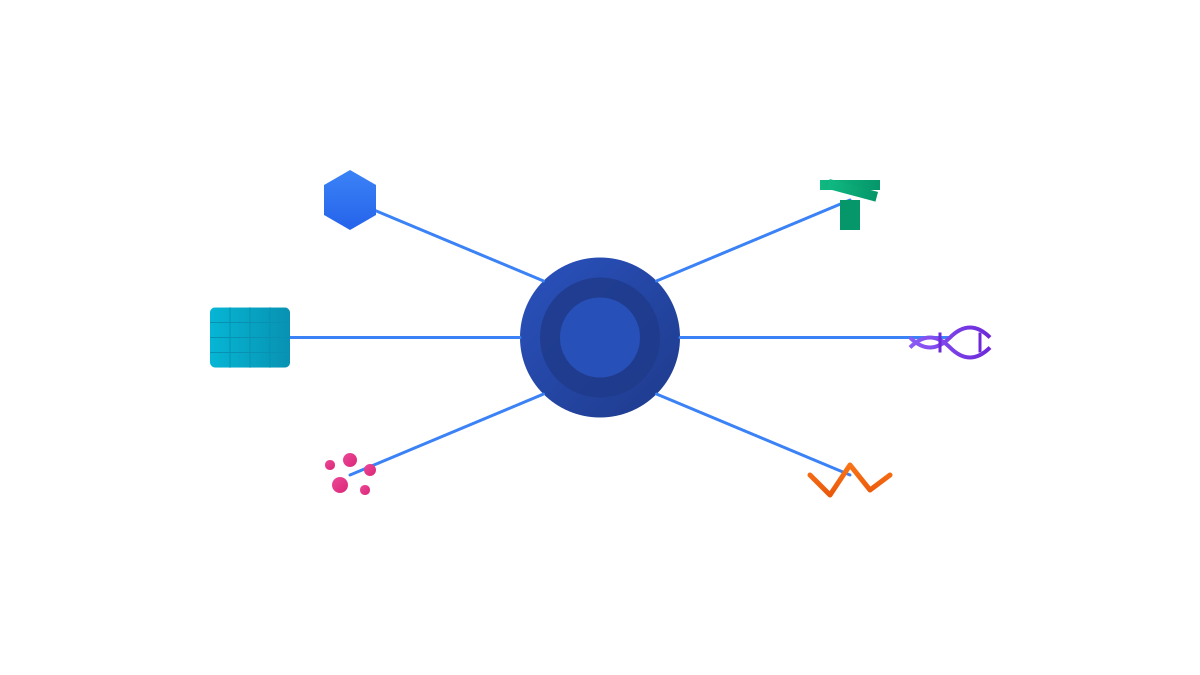

3

Section 03

Autonomous Agent Features

  • Auto-routing agent loop: Reads SKILL.md files, selects the correct skill from plain English requests, fills in required parameters, executes, and recovers from errors
  • Multi-LLM backend support: Anthropic, OpenAI, Google, Mistral, MiniMax, plus custom options supporting any OpenAI-compatible endpoint
  • Cross-round memory: Tracks discussed entities (genes, cancers, UniProt IDs), recent analyses, and user preferences
  • Configurable step budget: Defaults to 30 tool calls per request; automatically increases to over 45 rounds when modular/multi-dataset workflows are detected
  • File handling: Supports drag-and-drop upload of CSV/TSV/VCF/FASTA/JSON/BED files; server paths are automatically integrated into run_script calls
  • Result rendering: Inline chart previews, integrated download cards, collapsible error tracking
4

Section 04

Skill Library Architecture

Feature Description
50 specialized skills Covers data access, multi-omics, CRISPR, gene lists, gene centers, structure, machine learning, plotting, literature, lab tracking
Standardized SKILL.md Each skill declares purpose, input, output, execution strategy, and trigger phrases
Pure Python implementation Based on numpy/pandas/matplotlib/scipy/lifelines tech stack; no R dependency
Independent requirements.txt per skill Installs only required dependencies
Stable file naming and TSV/PNG/SVG output Designed for downstream chaining
5

Section 05

Ten Major Application Scenarios

Bioinfor-Claw currently covers 10 application scenarios with a total of 50 skills:

6

Section 06

1. Public Dataset Access and Download (4 skills)

Discover, query, download, cache, and organize public biological datasets from NCBI GEO, TCGA/GDC, GTEx, and DepMap.

7

Section 07

2. Multi-omics Data Analysis (5 skills)

Transcriptomics, genomics, epigenomics, proteomics, and single-cell data analysis, including RNA-seq differential expression, ATAC-seq/ChIP-seq downstream analysis, DNA methylation analysis, mass spectrometry proteomics, and basic single-cell RNA-seq analysis.

8

Section 08

3. CRISPR Design and Analysis (6 skills)

Covers SpCas9/Cas12 sgRNA design, base editor sgRNA design (CBE/ABE/dual editors, 13 editor presets), prime editor pegRNA design, pooled screening analysis (MAGeCK RRA/MLE), screening QC, and pooled library design.


