Zing Forum

Reading

Hands-On Guide to Production-Grade LLM Inference Infrastructure on AWS: Complete Deployment from Terraform to vLLM

This article provides an in-depth analysis of an open-source LLM inference infrastructure project, demonstrating how to build a scalable production-grade LLM service architecture using Terraform and Amazon EKS, integrating the vLLM inference engine with Prometheus/Grafana monitoring systems.

LLM推理AWSEKSvLLMTerraformKubernetesGPU生产部署可观测性云原生
Published 2026-05-01 19:15Recent activity 2026-05-01 19:19Estimated read 6 min
Hands-On Guide to Production-Grade LLM Inference Infrastructure on AWS: Complete Deployment from Terraform to vLLM
1

Section 01

Introduction: Core Overview of the Hands-On Production-Grade LLM Inference Infrastructure Project on AWS

This article introduces the open-source project "llm-serving-infra", which provides a complete LLM inference infrastructure solution based on AWS cloud-native services. It implements Infrastructure as Code (IaC) via Terraform, uses Amazon EKS to build the container orchestration layer, integrates the vLLM inference engine with Prometheus/Grafana monitoring systems, addresses issues like high concurrency, stability, and cost control in traditional deployment models, and helps teams quickly set up a production-grade LLM service environment.


2

Section 02

Project Background and Motivation

As LLMs become widely adopted in enterprise applications, traditional single-machine deployments struggle to handle high-concurrency requests. Self-built clusters involve complex issues like container orchestration, auto-scaling, and monitoring alerts. This project aims to provide stable, scalable, and cost-controllable inference infrastructure, enabling teams to set up a production-level model service environment within hours.

3

Section 03

Overall Architecture Design

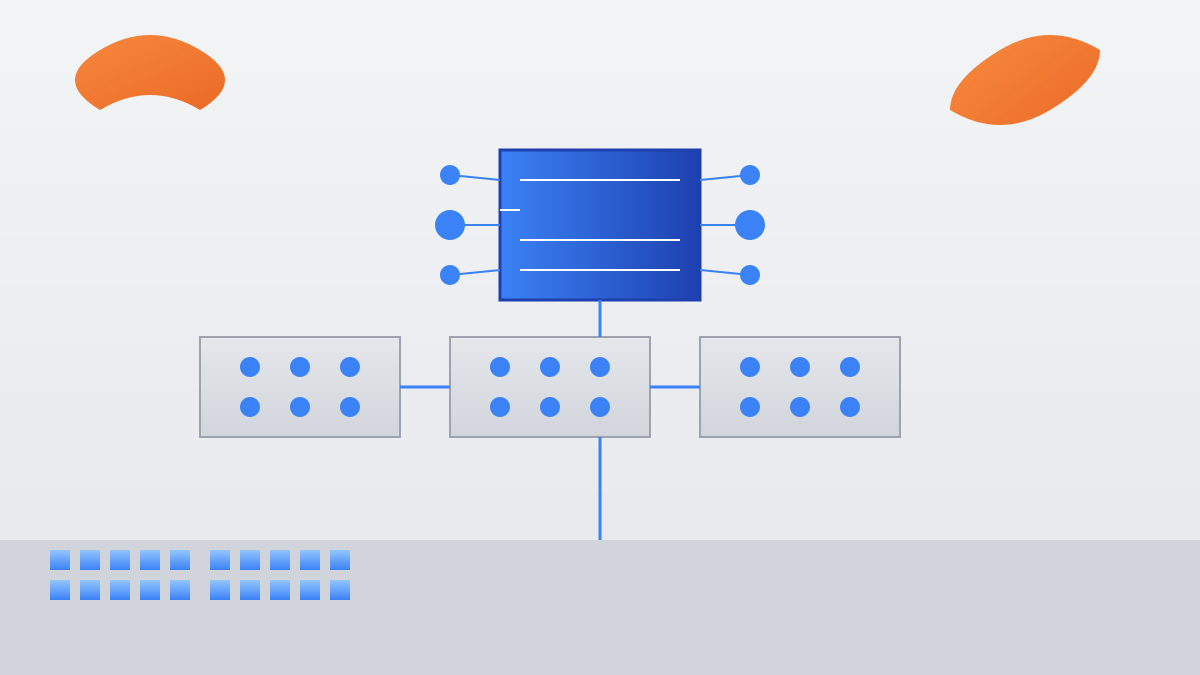
The core architecture centers around Amazon EKS and is divided into three layers:

  1. Infrastructure Layer: Uses Terraform to manage resources like VPC, subnets, and security groups, ensuring environment consistency and repeatability;
  2. Container Orchestration Layer: EKS-optimized node groups (GPU instances), auto-scaling (Cluster Autoscaler), GPU resource scheduling (NVIDIA plugins);
  3. Inference Service Layer: Adopts the vLLM engine (PagedAttention algorithm, Continuous Batching, multi-model support), uses K8s Deployment/Service and HPA to handle traffic fluctuations.
4

Section 04

Observability System Construction

Integrates Prometheus, Grafana, and Alertmanager:

  • Prometheus collects metrics from infrastructure (node CPU/GPU, network), K8s (Pod status, scheduling latency), and application layer (vLLM inference latency, throughput);
  • Grafana provides preset dashboards for cluster overview, GPU monitoring, inference services, cost analysis, etc.;
  • Alertmanager configures alert rules to automatically notify when key metrics exceed thresholds.
5

Section 05

Detailed Deployment Process

Deployment Steps:

  1. Environment Preparation: Configure AWS CLI credentials, install Terraform and kubectl;
  2. Infrastructure Creation: Execute Terraform apply to create the EKS cluster and associated resources;
  3. Cluster Configuration: Deploy NVIDIA GPU Operator and Cluster Autoscaler;
  4. Monitoring Deployment: Install Prometheus Stack and Grafana, import preset dashboards;
  5. Model Service Deployment: Build vLLM image, create Deployment and Service;
  6. Validation Testing: Perform load testing to verify performance and stability.
6

Section 06

Key Points for Production Practice

Key Considerations for Production Deployment:

  • Cost Control: Hybrid On-Demand/Spot instances, intelligent scaling, model quantization (AWQ/GPTQ);
  • High Availability: Multi-AZ deployment, model hot update, health checks and self-healing;
  • Security Hardening: Network isolation, secret management (AWS Secrets Manager), image security scanning.
7

Section 07

Applicable Scenarios and Expansion Directions

Applicable Scenarios: Enterprise knowledge base Q&A (RAG), intelligent customer service, content generation, model evaluation/A/B testing; Expansion Directions: Integrate Triton Inference Server to support multiple frameworks, add LangServe to implement Agent workflows, connect to AWS SageMaker for model fine-tuning.

8

Section 08

Summary and Outlook

This project provides a validated reference for quickly building production-grade LLM inference infrastructure, balancing ease of use and flexibility, making it suitable for learning or as a starting point for enterprise deployment. Future expectations include optimizations for specific model architectures, intelligent scaling algorithms, and more comprehensive MLOps integration solutions.

