Zing Forum

Reading

AWS Distributed LLM Inference System: Practice of Secure Multi-VM Architecture

A distributed large language model (LLM) inference system based on AWS, using private subnet Python ML worker nodes, public subnet Bun API gateway, and iii RPC orchestration to achieve secure and efficient multi-VM LLM service deployment.

分布式推理AWS安全架构私有子网API网关Gemma-3RPCTerraform
Published 2026-05-26 23:08Recent activity 2026-05-26 23:21Estimated read 8 min
AWS Distributed LLM Inference System: Practice of Secure Multi-VM Architecture
1

Section 01

Introduction: AWS Distributed LLM Inference System Secure Multi-VM Architecture Practice

Introduces a distributed LLM inference system based on AWS, which core uses private subnet Python ML worker nodes, public subnet Bun API gateway, and iii RPC orchestration to achieve secure and efficient multi-VM LLM service deployment. Original author/maintainer: daschinmoy21, project source: GitHub (link: https://github.com/daschinmoy21/infra), published at 2026-05-26T15:08:14Z.


2

Section 02

Project Background and Architecture Objectives

With the expansion of LLM application scenarios, how to deploy inference services securely and efficiently in production environments has become a key challenge. Traditional single-node deployment methods are difficult to meet high availability and high concurrency requirements, while simple multi-node expansion brings network security and operation and maintenance management complexities. This project demonstrates a distributed LLM inference architecture based on AWS, with the core design concept of "secure isolation, flexible orchestration". The system uses a multi-VM architecture, deploying model inference workloads in private subnets for isolation and protection, providing external services through the API gateway in the public subnet, and using the iii orchestration tool to implement RPC communication and task scheduling.

3

Section 03

Overall Architecture Design

Network Topology

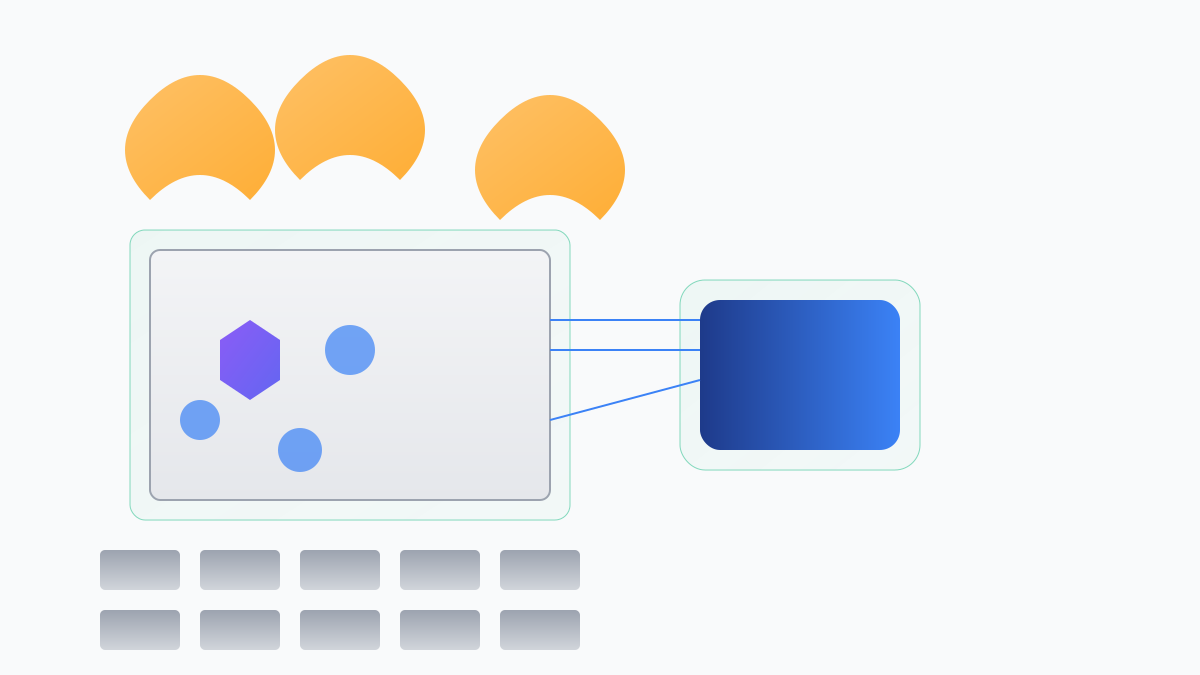
The system adopts a classic public-private subnet layered architecture: Public Subnet: Deploys the API gateway service built with Bun runtime, which is the only external entry point of the system and has a public IP. Private Subnet: Deploys Python ML worker nodes to run Gemma-3 model inference, no public IP, only communicates via internal routing. VPC Network: Dedicated AWS VPC, with fine-grained access control via security groups and ACLs.

Component Responsibility Division

Bun API Gateway: Receives and validates requests, distributes tasks, aggregates results, etc. Python ML Worker Nodes: Load models, execute inference, manage cache. iii Orchestration Tool: Service discovery, RPC communication, task scheduling and failover.

4

Section 04

Security Design Considerations

Network Isolation

Place ML worker nodes in private subnets to minimize attack surface, protect data leakage, and support compliance requirements.

Access Control

Security Groups: Public subnet only opens HTTPS ports; private subnet only accepts traffic from public subnet. IAM Roles: Assign least-privilege roles. API Authentication: Implement API Key/JWT verification, request signature, IP whitelist.

Data Protection

Transmission encryption (TLS), static encryption (S3+KMS), audit log recording.

5

Section 05

Deployment and Operation Practice

Infrastructure as Code

Use Terraform to manage AWS resources, including VPC, computing resources, security settings, etc., to achieve standardized deployment.

Containerized Deployment

Worker nodes and gateways are containerized, packaged with Docker, and images stored in ECR.

Configuration Management

Provide multi-environment configuration files (development/production/iii worker nodes).

Monitoring and Alerts

Can integrate CloudWatch (metrics logs), X-Ray (distributed tracing), SNS (alert notifications) to monitor key metrics such as latency, throughput, etc.

6

Section 06

Technology Selection Analysis

Why Choose Bun Over Node.js?

Superior performance (fast startup, low memory), rich built-in features (TypeScript/JSX support), standard compliance.

Why Choose iii Over Kubernetes?

Simple and lightweight, low resource consumption, native RPC mechanism suitable for two-layer architecture.

Why Choose Gemma-3?

Open-source license, hardware-friendly, balanced performance, ecological support.

7

Section 07

Practical Insights and Improvement Directions

Practical Insights

Security first, layered architecture, appropriate technology selection, infrastructure as code.

Limitations and Improvement Space

High availability (multi-AZ deployment), persistent storage, streaming response, multi-model support need optimization.

8

Section 08

Summary

This project demonstrates a complete AWS distributed LLM inference system architecture, which reflects production environment considerations from network isolation, security design to component selection. For teams hoping to push LLM services from prototype to production, this is a reference-worthy implementation plan. The value of the project lies not only in the technical implementation itself but also in the thinking behind its architectural decisions—how to balance security, performance, cost, and complexity. These experiences are valuable references for production deployments of any scale.

