Zing Forum

Reading

Awesome-LLM-Datasets: A Data Treasure Trove for Large Language Model Trainers

A comprehensively curated resource library of large language model datasets, covering multiple key areas such as medical AI, natural language processing, multimodal learning, instruction fine-tuning, reasoning ability, code generation, and evaluation benchmarks.

LLM数据集训练数据大语言模型医疗AI多模态指令微调GitHub
Published 2026-05-15 23:16Recent activity 2026-05-15 23:17Estimated read 5 min
Awesome-LLM-Datasets: A Data Treasure Trove for Large Language Model Trainers
1

Section 01

Introduction: Awesome-LLM-Datasets—A Data Navigation Tool for Large Language Model Trainers

In today's booming era of large language models (LLMs), data quality often determines the final outcome more than model architecture. The Awesome-LLM-Datasets resource list on GitHub provides a systematic data navigation tool for LLM trainers, addressing the pain point of scattered data being hard to find across the internet, covering seven core areas such as medical AI, natural language processing, and multimodal learning.


2

Section 02

Background: The Necessity of Organizing LLM Training Data

LLM training is a data-intensive project; different stages like pre-training, fine-tuning, and instruction alignment require different types of data support. Traditional practices require researchers to search and filter on their own, which is time-consuming and labor-intensive, and easy to miss key resources. Many high-quality datasets are hidden in paper appendices or within institutions and are hard to find. The emergence of Awesome-LLM-Datasets is precisely to solve this pain point.

3

Section 03

Methodology: Classification System for Seven Core Areas

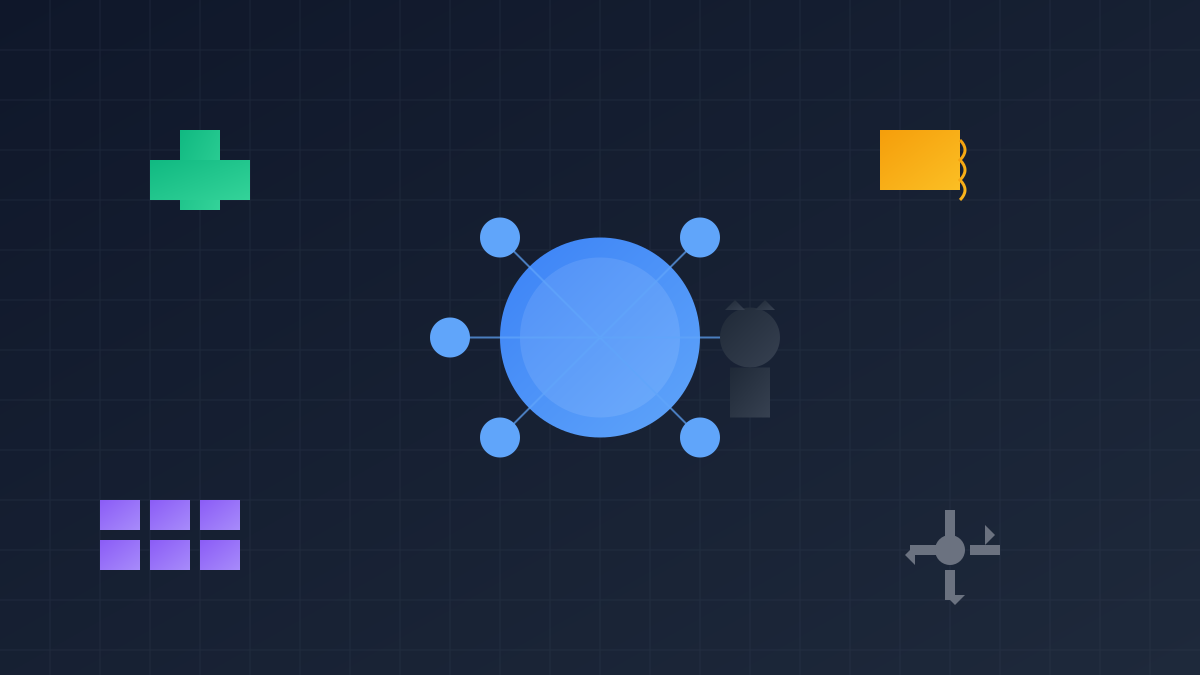
The resource library is classified by application scenarios and technical types, covering seven key areas:

  • Medical AI Datasets: Desensitized medical Q&A, medical record understanding, and other data that meet privacy compliance requirements;
  • NLP Basic Datasets: Core pre-training data for text classification, sentiment analysis, etc.;
  • Multimodal Learning Datasets: Image-text paired data supporting tasks like image captioning and visual question answering;
  • Instruction Fine-tuning Datasets: "Instruction-response" format data such as Alpaca and Dolly, helping models align with human instructions;
  • Reasoning Ability Datasets: Arithmetic problems, math competition questions, etc., to train models' logical thinking;
  • Code Generation Datasets: GitHub code, programming tutorials, etc., supporting code completion and bug fixing;
  • Evaluation Benchmarks: Classic evaluation sets like GLUE and SuperGLUE to test model capabilities.
4

Section 04

Evidence: Practical Application Value of the Resource Library

Users of different roles can gain different values:

  • Researchers: Quickly understand the current state of data in the field and avoid reinventing the wheel;
  • Industrial Developers: Find the data starting point for vertical domain models (e.g., medical consultation, code generation);
  • Data Engineers: Reference the characteristics of existing datasets to plan new data collection and annotation.
5

Section 05

Suggestions: Notes for Using the Resource Library

When using it, you need to pay attention to:

  1. Data Licensing: Different datasets have different agreements; you need to read the license terms carefully;
  2. Data Quality: Datasets come from various sources; you need to sample, check, and clean them before use;
  3. Domain Adaptation: General datasets perform poorly in specific domains; you need to select relevant domain data for fine-tuning.
6

Section 06

Conclusion: Future and Value Summary of the Resource Library

With the evolution of LLM technology, new directions such as multimodal fusion and long-context understanding have spawned new data demands. As an open-source project, Awesome-LLM-Datasets is expected to keep up. For researchers and developers in the LLM field, it is a tool worth collecting, saving time in data search and providing a clear framework for understanding the LLM data ecosystem.

