Zing Forum

Reading

Avtomatika: A High-Performance State Machine-Based AI Agent Orchestration Framework

This article introduces Avtomatika, an innovative state machine-driven AI agent orchestrator that provides a high-performance solution for managing complex asynchronous workflows through an architecture design separating blueprints from execution.

AI智能体工作流编排状态机异步处理LLM应用开源框架高性能架构设计
Published 2026-05-18 07:14Recent activity 2026-05-18 07:24Estimated read 5 min
Avtomatika: A High-Performance State Machine-Based AI Agent Orchestration Framework
1

Section 01

Avtomatika Framework Overview: A State Machine-Driven High-Performance AI Agent Orchestration Solution

Avtomatika is an innovative state machine-driven AI agent orchestrator that provides a high-performance solution for managing complex asynchronous workflows through an architecture design separating blueprints from execution. Its core advantages include reliable state management, efficient asynchronous processing, high performance, and scalability, making it suitable for various AI application scenarios.


2

Section 02

Architectural Challenges in AI Agent Orchestration

With the improvement of large language model capabilities, AI applications have shifted from single-turn conversations to complex autonomous decision-making processes. Traditional script-based or callback-based orchestration struggles to handle the complexity of state management, error recovery, and concurrency control in large-scale scenarios. The Avtomatika project was born to address this problem.

3

Section 03

Core Design: Separation of Blueprints and Execution + State Machine-Driven Model

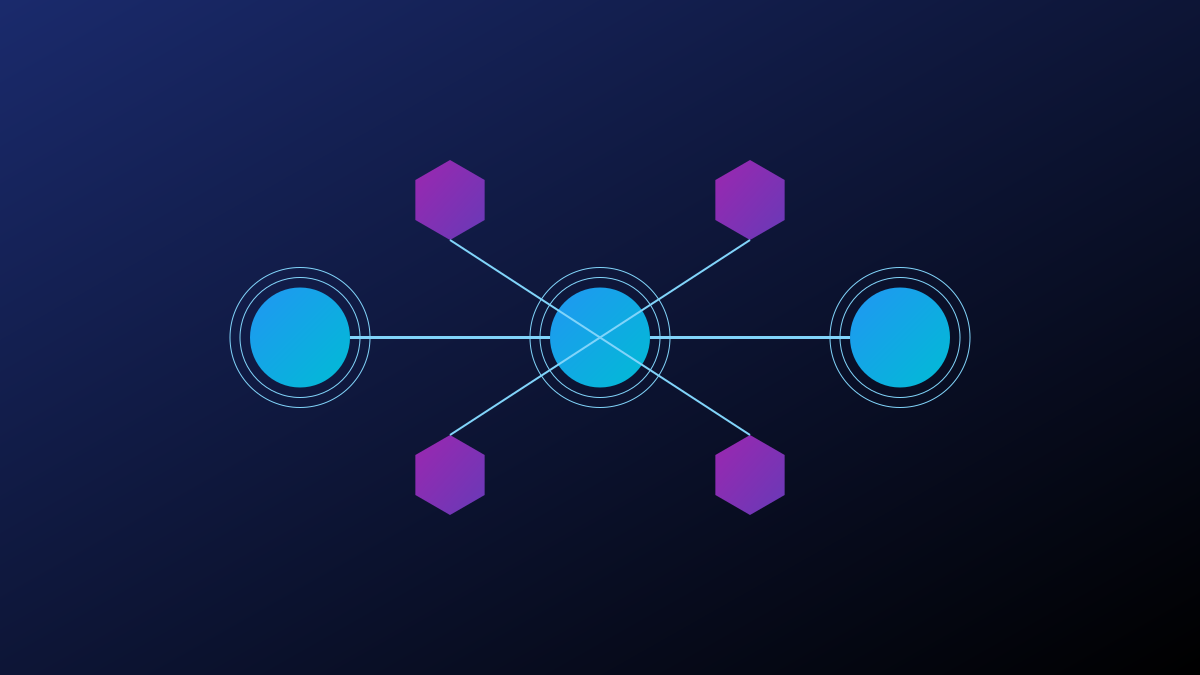
Avtomatika adopts a layered architecture that clearly separates process logic (Blueprints) from the execution layer (Workers), making process definitions declarative and easy to understand while allowing independent extension and optimization of the execution layer. It uses state machines as the core execution model, where each agent task is modeled as state transitions (Initialization → Execution → Waiting → Completion/Failure), ensuring predictable and observable behavior and supporting complex control flows such as branching, looping, parallelism, and timeouts.

4

Section 04

Technical Features: Asynchronous Support and High-Performance Implementation

Avtomatika natively supports asynchronous workflows and manages large numbers of concurrent tasks via an event-driven architecture to avoid blocking. High-performance optimizations include a tuned state transition engine (tens of thousands of state changes per second), memory pooling to reduce GC pauses, and an asynchronous network library to improve I/O throughput. It supports distributed deployment, where multiple Workers collaborate to achieve horizontal scaling.

5

Section 05

Application Scenarios and Comparison with Existing Solutions

Avtomatika is practical in fields like customer service automation (multi-turn conversation processes), data processing pipelines (collaboration of multiple AI models), and autonomous research agents (information retrieval and analysis reports). Compared to other frameworks, its uniqueness lies in emphasizing determinism and reliability—providing stronger behavioral guarantees through the state machine model while maintaining sufficient expressive power.

6

Section 06

Practical Recommendations and Future Outlook

For getting started, it’s recommended to begin with simple blueprint definitions and refer to official examples. For production deployment, boundary cases and fault recovery mechanisms need testing. Future versions will enhance multi-modal agent support, introduce visualization tools, optimize LLM integration, and build a plugin ecosystem. Avtomatika provides controllability and maintainability for complex AI applications and is worth evaluating by teams.

