Zing Forum

Reading

AVA-VLA: A New Paradigm for Visual-Language-Action Models Enabling Robots to Think Less and Act Faster

The AVA-VLA project, accepted by ICML 2026, proposes an innovative visual-language-action (VLA) model architecture. Through latent reasoning, reinforcement learning denoising, and adaptive early exit mechanisms, it significantly reduces inference steps while ensuring robot control accuracy.

VLA视觉语言动作模型机器人学习强化学习潜在推理ICML 2026多模态早退机制
Published 2026-05-15 18:46Recent activity 2026-05-15 18:48Estimated read 5 min
AVA-VLA: A New Paradigm for Visual-Language-Action Models Enabling Robots to Think Less and Act Faster
1

Section 01

AVA-VLA: A New Paradigm for Visual-Language-Action Models Enabling Robots to Think Less and Act Faster

The AVA-VLA project, accepted by ICML 2026, proposes an innovative visual-language-action (VLA) model architecture. Addressing the dilemma of traditional VLA models—"the more you think, the slower you act; the less you think, the more errors you make"—it achieves a dynamic balance between efficiency and accuracy through three key mechanisms: latent reasoning, reinforcement learning denoising, and adaptive early exit. This allows robots to significantly reduce inference steps while ensuring control accuracy, which is of great significance for real-time robot control scenarios.


2

Section 02

Research Background: The Inference Efficiency Dilemma of VLA Models

Visual-language-action (VLA) models are an important bridge connecting multimodal perception and robot control. However, traditional models face a dilemma: more explicit reasoning chains lead to high latency, while compressing steps reduces action quality. This contradiction is particularly prominent in real-time robot control scenarios (such as grasping, placing, and navigation), requiring a balance between perception accuracy and response speed.

3

Section 03

Core Innovative Mechanisms of AVA-VLA

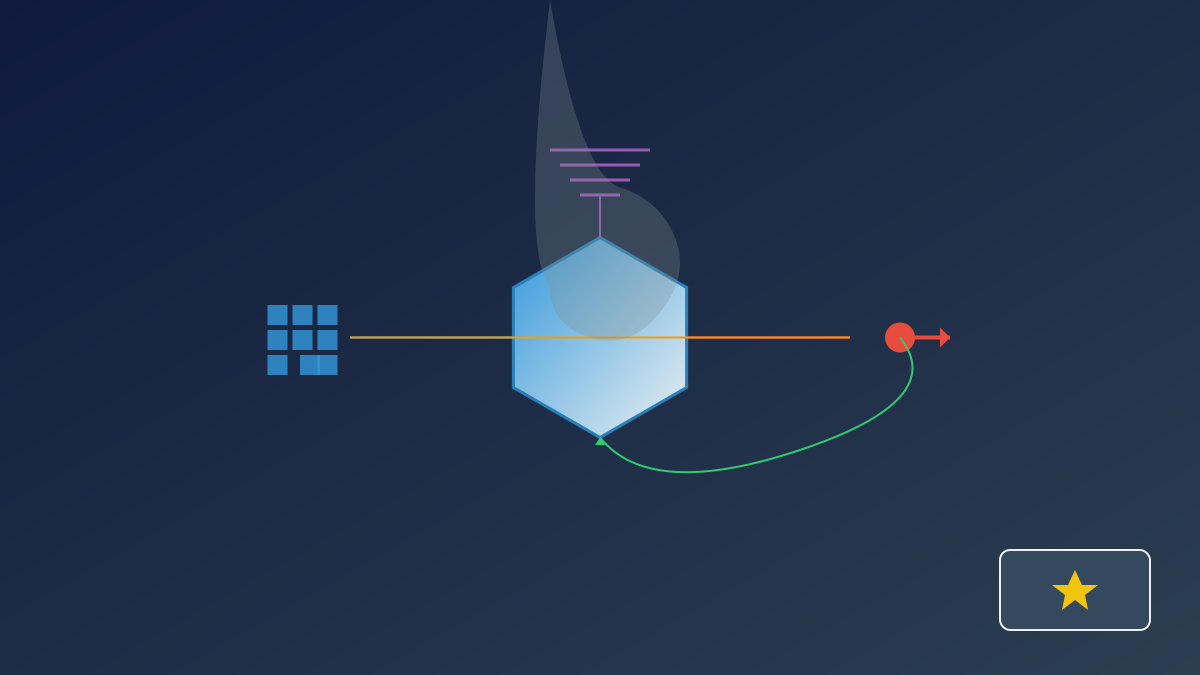
AVA-VLA reconstructs the reasoning mechanism from three dimensions: 1. Latent Reasoning: Models intermediate reasoning as continuous latent state evolution, replacing explicit text reasoning chains; 2. Reinforcement Learning Denoising: Uses the PPO algorithm to optimize latent reasoning trajectories, with key hyperparameters including --ppo_clip_ratio 0.2, --gae_lambda 0.95, etc.; 3. Adaptive Early Exit: The exit gate dynamically evaluates the confidence of latent states and terminates reasoning on demand, enabling "think less, act earlier".

4

Section 04

Technical Implementation and Training Process

Based on the OpenVLA architecture, code modules include the core model (prismatic/models/vlas/avavla.py), fine-tuning script (vla-scripts/finetune_avavla.py), etc. The training is divided into two stages: first, behavior cloning for warm-up, then reinforcement learning optimization, with an example of the LIBERO benchmark training command attached.

5

Section 05

Experimental Validation and Performance

Evaluated on benchmarks such as LIBERO and CALVIN, including offline action error and online robot rollout modes. Examples of LIBERO evaluation commands and inference deployment commands are attached, supporting flexible calls to trained models.

6

Section 06

Practical Significance and Application Prospects

In scenarios such as industrial automation and service robots, the adaptive early exit mechanism can reduce inference latency to a fraction of traditional methods while ensuring task success rates. The latent reasoning paradigm opens up a new direction for the interpretability research of VLA models (gated confidence quantifies the "degree of thinking").

7

Section 07

Summary and Outlook

AVA-VLA solves the contradiction between efficiency and accuracy of traditional VLA models. Its open-source implementation based on the OpenVLA toolchain lowers the entry barrier. As an important infrastructure in the field of embodied intelligence, it provides a worthy technical route for researchers in robot learning and multimodal cross-disciplines to explore.

