Zing Forum

Reading

autoflow: A Four-Agent Collaborative Workflow for Building Intelligent Office Automation Systems

autoflow is a multi-agent workflow system that uses four specialized AI agents to handle email replies, meeting summaries, task management, and calendar management respectively, providing comprehensive office automation solutions for individuals and teams.

办公自动化多代理系统邮件自动化会议摘要任务管理日历AI智能助理
Published 2026-06-06 12:15Recent activity 2026-06-06 12:25Estimated read 5 min
autoflow: A Four-Agent Collaborative Workflow for Building Intelligent Office Automation Systems
1

Section 01

autoflow: Introduction to the Four-Agent Collaborative Intelligent Office Automation System

autoflow is a multi-agent workflow system developed by faisalaiagent on GitHub. It uses four specialized AI agents (email reply, meeting summary, task management, and calendar management) to work collaboratively, providing comprehensive office automation solutions for individuals and teams. The project aims to leverage the advantages of Large Language Models (LLMs) to address the shortcomings of traditional office automation tools in handling complex contexts, natural language generation, etc., and improve office efficiency.


2

Section 02

Background: The New AI Era of Office Automation

The field of office automation has evolved from early email rules to modern RPA tools, but traditional tools struggle to handle complex tasks that require context understanding, judgment, and natural language generation. The emergence of LLMs has brought the possibility of qualitative change to this field, and the autoflow project is an embodiment of this trend—building a multi-agent system where each agent focuses on specific scenarios, leveraging LLM capabilities while ensuring controllability through division of labor.

3

Section 03

Methodology: Four-Agent Collaborative Architecture and Cooperation Mechanism

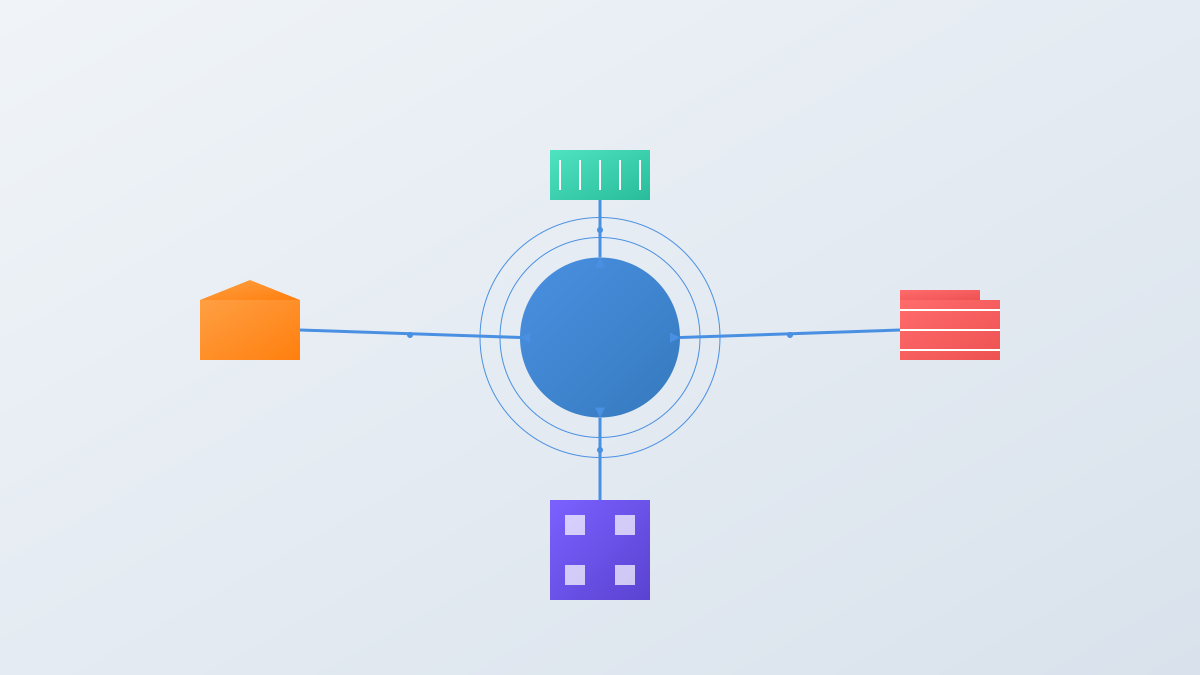
autoflow's core consists of four AI agents:

  1. Email Reply Agent: Understands email content, generates style-matched replies, and can link with the task agent to create to-do items;
  2. Meeting Summary Agent: Processes recordings/subtitles/audio streams, extracts decision points and action items, and labels responsible persons and deadlines;
  3. Task Agent: Extracts tasks from multiple sources, adds context, judges priorities, and alerts for conflicts;
  4. Calendar AI: Optimizes schedule planning and collaborates with the task agent to reserve execution time. The agents achieve collaboration through event-driven cooperation, context sharing, and conflict coordination mechanisms.
4

Section 04

Application Scenarios: Practical Value of autoflow

autoflow is suitable for various scenarios:

  • Executives/managers: Reduce administrative burden and focus on strategy;
  • Sales/customer teams: Accelerate communication and track customer interactions;
  • Remote teams: Compensate for information loss and coordinate cross-timezone meetings;
  • Individual users: Act as a personal assistant to manage projects or activities.
5

Section 05

Technical Points and Limitations: Implementation and Areas for Improvement of autoflow

Key technical implementation points include multi-agent coordination, external system integration (email/calendar APIs), context management (long-term memory and privacy protection), and LLM call cost control (caching/batch processing). Limitations include the need for technical capabilities for deployment and maintenance, intelligence level depending on the underlying LLM, and the need for a more user-friendly configuration interface for non-technical users.

6

Section 06

Conclusion and Outlook: Value and Future Directions of autoflow

autoflow demonstrates the in-depth application path of LLMs in the office automation field, providing an open-source solution to improve efficiency. In the future, it can expand to more professional agents (such as document processing, data analysis) and deepen integration with enterprise systems to become a workflow hub.

