Zing Forum

Reading

AStats: An Agentic AI System for Applied Statistical Workflows — Analysis of the GSoC 2026 Innovative Project

AStats, an INCF GSoC 2026 project, is an open-source system integrating Agentic AI with statistical analysis, bringing a new intelligent paradigm to scientific research data analysis.

Agentic AI统计分析GSoC 2026INCF数据科学自动化分析开源项目神经科学R语言Python
Published 2026-04-23 22:44Recent activity 2026-04-23 22:53Estimated read 8 min
AStats: An Agentic AI System for Applied Statistical Workflows — Analysis of the GSoC 2026 Innovative Project
1

Section 01

Introduction: AStats — Analysis of the GSoC 2026 Innovative Project

AStats is a Google Summer of Code 2026 project supported by the International Neuroinformatics Coordinating Facility (INCF), with project number #33. This project deeply integrates Agentic AI with statistical analysis to build an open-source system, aiming to lower the barrier to scientific research data analysis. It enables end-to-end intelligent processing from data import, cleaning, exploratory analysis to statistical modeling and result visualization, supports mainstream R/Python statistical ecosystems, and promotes open science and reproducible research.


2

Section 02

Project Background: Barriers to Statistical Analysis and the Trend of AI Integration

In the data-driven era, traditional statistical analysis requires profound statistical knowledge and programming skills, which poses a barrier for domain experts. The rise of large language models has brought possibilities for automated analysis, leading to the emergence of AStats. As an authoritative institution for neuroscience data standardization, INCF promotes the application of Agentic AI through this project, lowering the threshold for data analysis and facilitating interdisciplinary collaboration.

3

Section 03

Core Functions and Technical Architecture: Intelligent Statistical Workflow

End-to-End Workflow Orchestration

The system enables end-to-end automation of data import, cleaning, EDA, modeling, and visualization.

Key Functional Modules

  • Data Preprocessing: Automatically identify data types, handle missing values/outliers, and generate quality reports
  • Enhanced EDA: Intelligently generate descriptive statistics, recommend charts, and detect variable correlations
  • Intelligent Model Selection: Recommend optimal models based on data features, automatically perform hypothesis testing and multiple comparison correction
  • Result Interpretation: Generate natural language reports, ensure analysis reproducibility (record steps and generate code)

Multi-Agent Collaboration Architecture

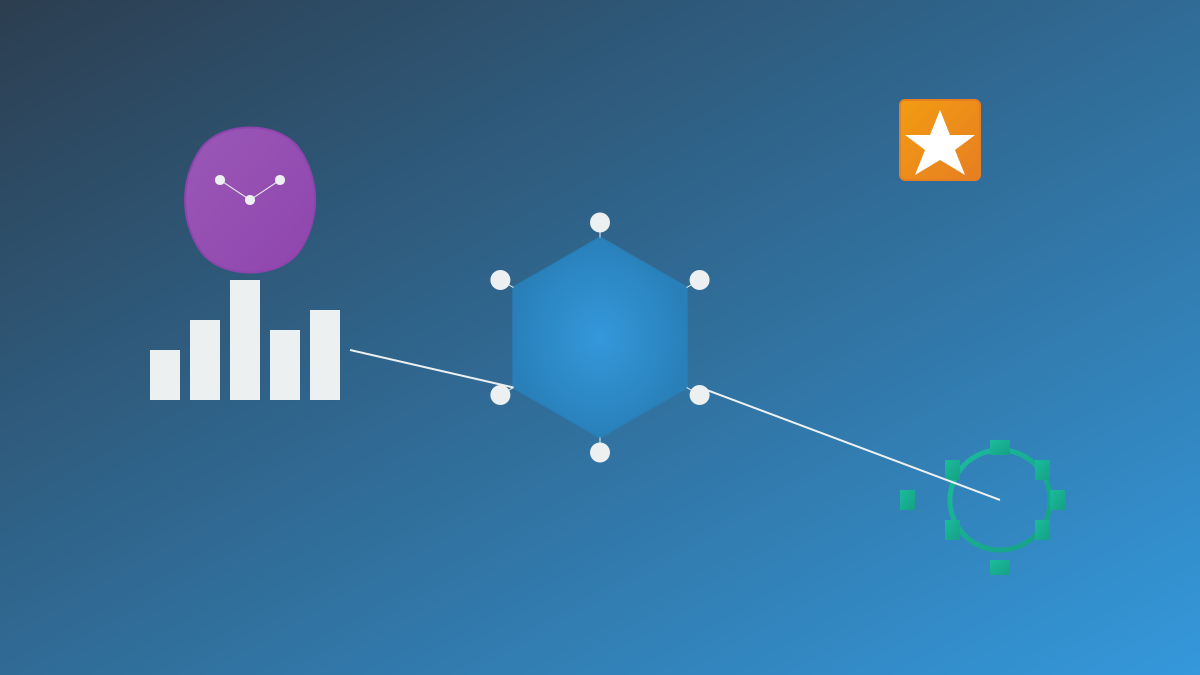
It includes four collaborative roles: data engineer, statistical analyst, visualization expert, and report writing agent, deeply integrating the R (dplyr, ggplot2, etc.) and Python (pandas, scikit-learn, etc.) ecosystems.

4

Section 04

Application Scenarios: Cross-Domain Value Manifestation

  • Biomedicine: Automated analysis of clinical trial data, neuroimaging processing, differential expression analysis in genomics
  • Social Sciences: Questionnaire reliability and validity testing, complex sampling weight processing, application of multi-level models
  • Business Data: Execution and interpretation of A/B tests, customer segmentation, prototype construction of predictive models
  • Education and Training: Assist in understanding statistical concepts, provide instant feedback, generate personalized learning materials
5

Section 05

Open-Source Community and Future Development Plan

GSoC 2026 Development Focus

  • Stabilization and optimization of the core Agent architecture
  • Expansion of the statistical method library
  • Improvement of user interface and interaction experience
  • Establishment of testing and documentation systems

Community Ecosystem Construction

  • Guidance from INCF neuroscience experts
  • Collaborative development with open-source statistical communities
  • Case validation by academic institutions
  • Compatibility with standards like BIDS

Long-Term Vision

  • Support for causal inference and Bayesian statistics
  • Development of domain-specific Agents (neuroimaging, genomics)
  • Establishment of a knowledge base for statistical best practices
  • Promotion of reproducibility standards for open science
6

Section 06

Limitations and Challenges: Dual Considerations of Technology and Ethics

Technical Limitations

  • Complex statistical methods require human supervision
  • Need to deepen understanding of domain-specific assumptions
  • Performance optimization for large-scale datasets
  • Insufficient support for multilingual documentation

Ethical Considerations

  • Definition of responsibility for statistical conclusions
  • Identification and mitigation of algorithmic bias
  • Data privacy and security protection
  • Impact of over-reliance on AI on statistical literacy
7

Section 07

Summary and Outlook: Promoting the Democratization of Scientific Discovery

AStats represents a cutting-edge exploration of the integration of AI and statistics. By lowering the analysis threshold through Agentic AI, it allows researchers to focus on scientific problems. As an intelligent assistant, it complements rather than replaces professional judgment, building a bridge of statistical knowledge for domain experts. Its open-source nature ensures transparency, and it is expected to become a benchmark in the intersection of Agentic AI and scientific computing in the future, promoting the democratization of scientific discovery.

