Zing Forum

Reading

animus-cli: A Multi-Model AI Agent Orchestrator Built with Rust

animus-cli is a 100% Rust-written autonomous AI agent orchestration tool that supports multi-model collaboration (Claude, Gemini, GPT, etc.), defines development tasks via YAML workflows, and supports daemon scheduling and MCP protocol integration.

AI智能体编排Rust多模型协作ClaudeGeminiGPTYAML工作流MCP协议animus-cli
Published 2026-05-06 00:15Recent activity 2026-05-06 00:23Estimated read 8 min
animus-cli: A Multi-Model AI Agent Orchestrator Built with Rust
1

Section 01

animus-cli: Introduction to the Multi-Model AI Agent Orchestrator Built with Rust

animus-cli is a 100% Rust-written autonomous AI agent orchestration tool that supports multi-model collaboration (Claude, Gemini, GPT, etc.). It defines development tasks via YAML workflows, has daemon scheduling capabilities and MCP protocol integration, aiming to solve the standardization problem of collaborative work among different models and provide an efficient and reliable orchestration framework for multi-model AI workflows.


2

Section 02

Trends in Multi-Model Collaboration and the Birth Background of animus-cli

With the development of the large language model ecosystem, developers face the dilemma of choosing collaborative work among different models—Claude excels in long-context reasoning, Gemini is outstanding in multimodal processing, and the GPT series leads in general tasks, but there is a lack of standardized collaboration solutions. animus-cli was born to address this need, providing a unified framework to define and schedule multi-model collaborative workflows, supporting everything from simple single-model tasks to complex multi-agent collaborative development processes.

3

Section 03

Core Advantages of Rust Implementation

animus-cli is implemented 100% in Rust, with three key engineering considerations behind it: 1. Performance: Zero-cost abstractions and efficient memory management result in low resource consumption when handling concurrent requests, state management, and I/O operations; 2. Reliability: The ownership system and compile-time memory safety eliminate runtime errors such as null pointers and data races; 3. Cross-platform support: Friendly binary output allows easy deployment to local machines, servers, containers, or edge devices.

4

Section 04

YAML-Driven Declarative Workflow Architecture

animus-cli uses declarative workflow definitions; users describe processes via YAML files, lowering the barrier to use and improving readability. A typical workflow includes: Task definition (specify model, input prompt, output format, timeout, supporting multi-models like Claude/Gemini/GPT), dependency relationships (forming a DAG, automatically executing independent tasks in parallel), conditional branching (dynamically controlling the process based on previous outputs), and error handling (retry strategies, failure rollback, error propagation rules).

5

Section 05

Multi-Model Collaboration Capabilities and Daemon Mode

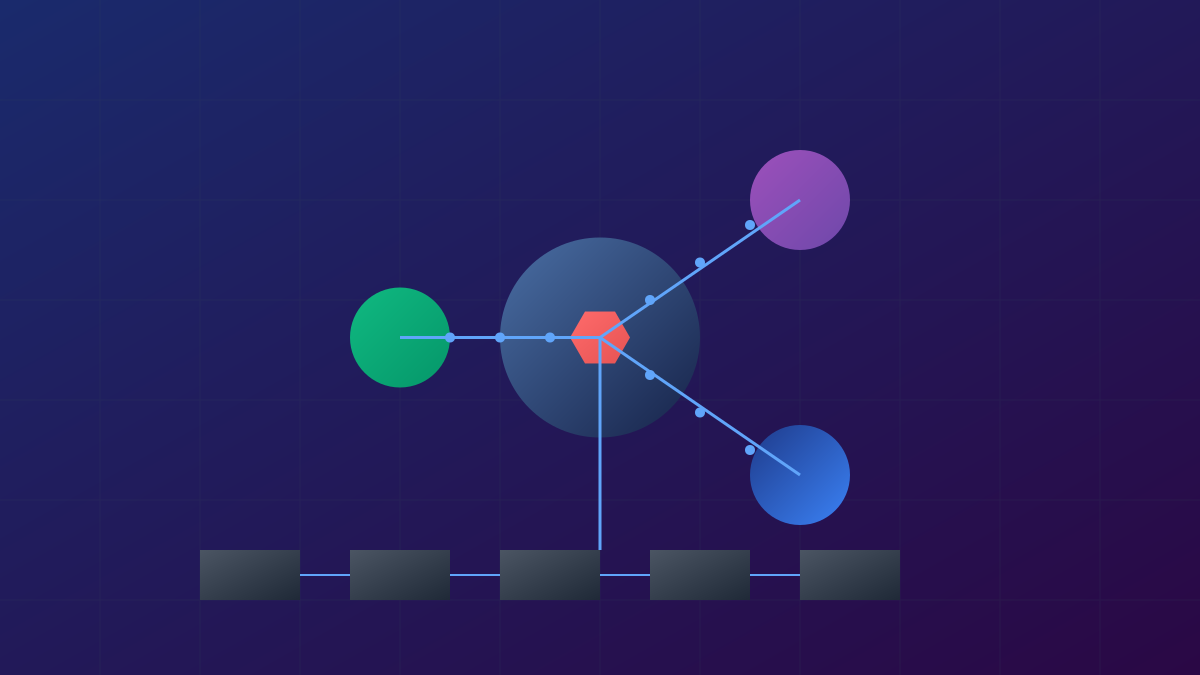
animus-cli natively supports multi-model collaboration; different tasks can use different models to leverage their strengths (e.g., Claude for architecture design, Gemini for multimodal processing, GPT-4 for code generation). It also provides model routing and load balancing (automatically switching to backup models, distributing requests to avoid bottlenecks). Additionally, it supports daemon mode: continuously monitoring event sources (such as code repository commits, ticket systems) to automatically start workflows, and can also schedule maintenance tasks periodically using Cron expressions.

6

Section 06

MCP Protocol Integration and Application Scenarios

animus-cli implements Anthropic's MCP (Model Context Protocol), supporting seamless collaboration between AI agents and external tools (file operations, database queries, API calls, etc.), and MCP supports bidirectional communication (external tools actively push events). Practical application scenarios include: automated development workflows (full process from requirements to code), intelligent customer service systems (multi-agent division of labor to handle requests), content generation pipelines (from research to editing), and data processing and analysis (multi-step model division of labor).

7

Section 07

Performance Data and Community Future Development

The Rust implementation brings excellent performance and resource efficiency: benchmark tests show that memory usage during concurrent workflows is 60-80% lower than similar Python tools, with stable CPU utilization and small latency jitter. animus-cli is an open-source project, and its community ecosystem is under construction. Future plans include: enriching the preset workflow template library, visual editor, distributed execution support, improving observation and debugging tools, and integrating more models and tools.

8

Section 08

animus-cli: A New Choice for AI Orchestration Infrastructure

animus-cli represents a new direction for AI agent orchestration tools—high performance, reliability, and declarative. Although the Rust implementation increases the development threshold, it brings significant runtime advantages. For teams deploying multi-model AI workflows in production environments, it provides a choice of low complexity (YAML configuration) and high reliability. As the AI ecosystem flourishes, such orchestration tools will become key infrastructure for connecting AI capabilities and building complex intelligent systems.