Zing Forum

Reading

Amux: A Terminal Multiplexer and Agent API Framework for Human-AI Collaboration

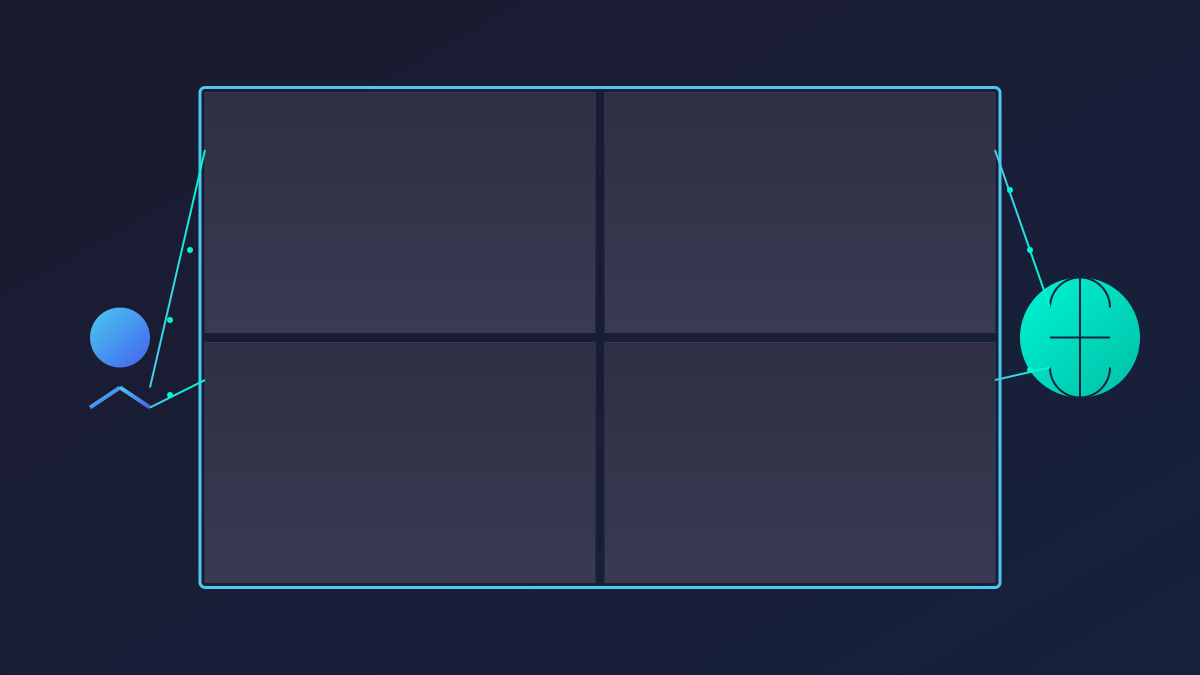
Amux, launched by Weill Labs, redefines the concept of terminal multiplexers. It supports shared terminal sessions between humans and AI agents via native Agent API, opening up a new paradigm for human-AI collaboration.

终端多路复用器Agent API人机协作AI编程助手tmux终端共享开发工具
Published 2026-04-02 23:13Recent activity 2026-04-02 23:20Estimated read 5 min
Amux: A Terminal Multiplexer and Agent API Framework for Human-AI Collaboration
1

Section 01

Amux: Introduction to the Terminal Multiplexer and Agent API Framework for Human-AI Collaboration

Amux, launched by Weill Labs, redefines the concept of terminal multiplexers. It supports shared terminal sessions between humans and AI agents via native Agent API, addressing the pain points of traditional terminal tools in AI collaboration and opening up a new paradigm for human-AI collaboration. Its core idea is to build a shared terminal workspace for humans and AI, designing Agent API as a first-class citizen of the terminal to provide a more natural and efficient interaction mode for human-AI collaboration.


2

Section 02

Evolution Dilemma of Terminal Tools: Pain Points in AI Collaboration

Terminal multiplexers (such as tmux and screen) are core daily tools for developers. However, with the popularity of AI programming assistants and automated agents, traditional tools face new challenges: how to enable efficient collaboration between AI and humans in the same terminal? Existing solutions mostly adopt the "agent observation" mode (indirectly observing terminal status via screenshots or logs), which is both inefficient and error-prone. Amux proposes a native approach of treating Agent API as a first-class citizen of the terminal.

3

Section 03

Core Design Principles of Amux and Agent API Architecture

Amux's core design revolves around three principles: 1. Shared state space (humans and AI see the same terminal state, eliminating ambiguity and delay); 2. Bidirectional interaction channel (AI can execute commands and send inputs, transforming from an observer to a collaborator); 3. Security boundary control (fine-grained permission management balances efficiency and security). The Agent API provides core capabilities such as session discovery, content reading, command execution, input injection, and event subscription, without relying on fragile solutions like OCR or keyboard simulation.

4

Section 04

Typical Application Scenarios of Amux

The target scenarios of Amux include: AI-assisted programming (AI directly accesses terminal feedback such as compilation errors and test outputs during pair programming); automated operation and maintenance (operation and maintenance agents execute diagnostic commands, with humans intervening in real time); remote collaboration (distributed teams share remote terminal sessions); CI/CD debugging (AI connects to build terminals for preliminary diagnosis).

5

Section 05

Relationship Between Amux and Existing Tools & Open Source Community

Amux does not replace mature tools like tmux; instead, it explores new possibilities for terminal collaboration. Traditional tools are still suitable for stable production environments, while Amux provides a testbed for experimenting with new human-AI collaboration models. The project uses the MIT open source license, with code hosted on GitHub, and is in the early development stage, encouraging community participation in discussions. Some design concepts may be fed back to the tmux community in the form of plugins in the future.

6

Section 06

Summary: Future Trends of Agent-Native Tools

Amux addresses the fundamental problem of toolchain adaptation when AI becomes a formal member of the development team. By building terminal infrastructure with Agent API, it provides a more natural and efficient human-AI collaboration mode. As AI capabilities improve, similar "agent-native" design ideas may appear in more development tools, reshaping software engineering workflows.

