Zing Forum

Reading

AIRA: An Autonomous Multi-Agent Research and Execution Platform Based on LangGraph

AIRA is an autonomous multi-agent AI research and execution platform that combines LangGraph workflow orchestration, RAG (Retrieval-Augmented Generation), and web intelligence capabilities to automate complex tasks.

AIRA多智能体LangGraphRAG工作流编排自主AI智能体协作网络情报
Published 2026-05-15 20:45Recent activity 2026-05-15 20:49Estimated read 8 min
AIRA: An Autonomous Multi-Agent Research and Execution Platform Based on LangGraph
1

Section 01

[Introduction] AIRA: Core Introduction to the Autonomous Multi-Agent Research and Execution Platform Based on LangGraph

AIRA (Autonomous multi-agent AI Research and Execution platform) is an open-source autonomous multi-agent AI research and execution platform developed by the catonlsd team. It integrates cutting-edge technologies such as LangGraph workflow orchestration, RAG (Retrieval-Augmented Generation), and web intelligence collection. Through multi-agent collaboration, it automates complex tasks, representing an important direction in the evolution of AI applications from single large models to multi-agent collaborative systems.


2

Section 02

Background: The Evolution of AI from Single Agents to Multi-Agent Collaboration

The development of large language models is evolving from single conversational modes to multi-agent collaboration. Although single models are powerful, they often struggle with complex tasks. Multi-agent systems decompose tasks into specialized agents, each responsible for a specific domain, and achieve complex goals through collaboration—this model is closer to the way human teams work.

3

Section 03

Core Tech Stack: Analysis of Key Components Like LangGraph and RAG

AIRA's technical architecture integrates multiple mature open-source components:

LangGraph: A framework launched by the LangChain team for building complex agent workflows with loops and conditional branches. It supports state machine-driven loops, parallel execution, and conditional execution, enabling handling of complex tasks involving multiple iterations and decisions.

RAG: Integrates Retrieval-Augmented Generation capabilities, which can retrieve relevant information from local knowledge bases to enhance answer quality. It supports vector database integration for semantic search and contextual retrieval.

Web Intelligence Collection: Has the ability to actively search for web information, crawl webpage content, and analyze online data, breaking through the time limitations of training data to obtain real-time information.

Workflow Orchestration Engine: As the core component, it coordinates multi-agent collaboration, including task decomposition, agent scheduling, result aggregation, and error handling.

4

Section 04

System Architecture: Workflow Design for Multi-Agent Collaboration

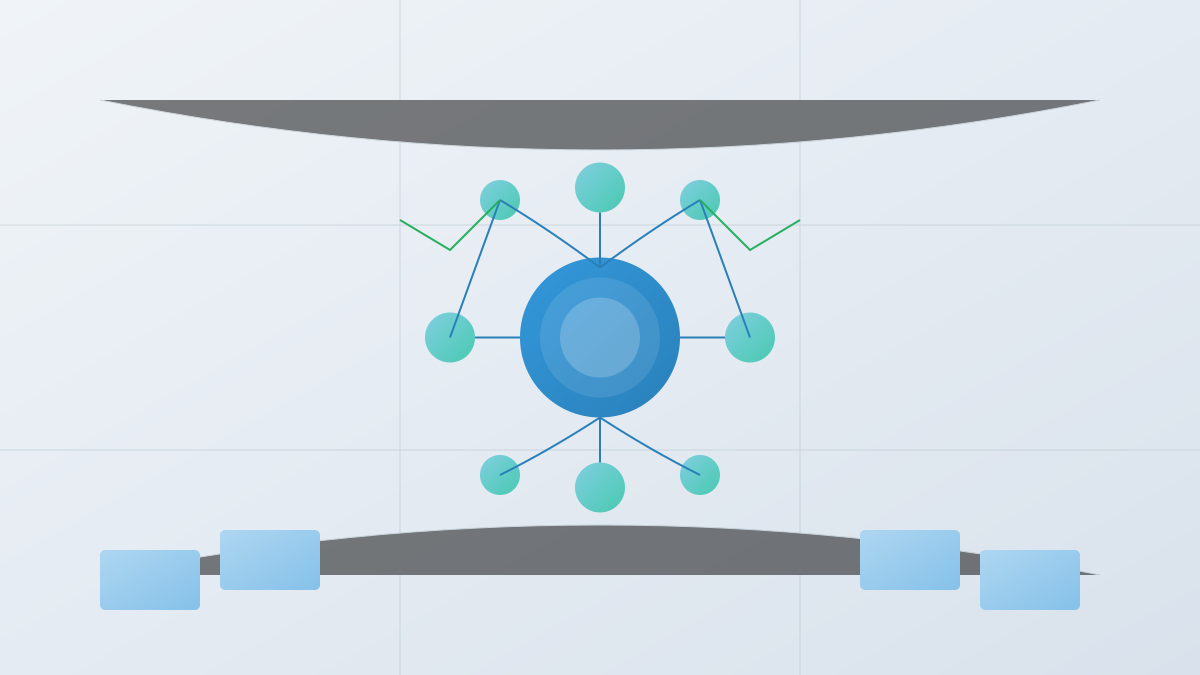
AIRA adopts a multi-agent architecture, and its typical workflow involves the following agents:

Task Analysis Agent: Receives user input, analyzes task type and complexity, and determines the required specialized agents.

Research Agent: Responsible for information collection, including retrieving from local knowledge bases, searching web resources, and analyzing document content.

Execution Agent: Performs specific operations based on research results (e.g., generating code, writing reports, sending emails, etc.).

Verification Agent: Checks the quality of results and triggers re-execution or supplementary research if necessary.

Coordination Agent: Acts as the central controller, managing communication and state synchronization between agents.

5

Section 05

Application Scenarios: Task Types AIRA Is Suitable For and Its Capability Boundaries

AIRA is suitable for handling the following types of tasks:

Complex Research Tasks: In-depth research requiring integration of multi-source information (e.g., market research, competitor analysis, technical research).

Multi-step Execution Work: Business processes involving multiple links (e.g., content creation: research → outline → writing → editing; code development: requirements → design → implementation → testing).

Real-time Information Tasks: Handling time-sensitive queries by combining web search capabilities.

Knowledge-intensive Work: Using RAG capabilities to answer professional questions based on private knowledge bases.

6

Section 06

Technical Challenges and Solutions: Addressing Core Issues of Multi-Agent Systems

Core challenges faced by multi-agent systems and AIRA's solutions:

Agent Communication: Shared context through LangGraph's state management mechanism to avoid information silos.

Task Decomposition: Adopts a hierarchical decomposition strategy—first coarse-grained division, then gradual refinement.

Error Recovery: Has retry, alternative solution, and graceful degradation capabilities; failure of a single agent does not cause overall task failure.

Cost Control: Controls the cost of multi-model calls through intelligent invocation strategies.

7

Section 07

Project Significance and Industry Trends: Future Direction of Multi-Agent Architecture

AIRA represents an important direction in AI application architecture—evolution from single large models to multi-agent collaborative systems. The advantages of this architecture include:

  • Modularity: Different agents can be developed, tested, and optimized independently
  • Scalability: New functions can be implemented by adding specialized agents
  • Robustness: Failure of a part of the system does not cause overall collapse
  • Transparency: Workflow visualization facilitates understanding and debugging

As frameworks like LangGraph mature, multi-agent systems are moving from proof-of-concept to practical applications, and AIRA provides developers with a starting point for quickly building multi-agent applications.
