Zing Forum

Reading

AI Toolkit: A Framework for Rules, Skills, and Workflows for Multimodal Models

AI Toolkit is a toolkit specifically designed for multimodal AI models, offering rule definition, skill orchestration, and workflow management functions to help developers build complex multimodal applications more efficiently.

AI Toolkit多模态模型工作流编排技能抽象提示词工程开源工具视觉理解
Published 2026-04-17 10:37Recent activity 2026-04-17 10:53Estimated read 6 min
AI Toolkit: A Framework for Rules, Skills, and Workflows for Multimodal Models
1

Section 01

AI Toolkit: Introduction to the Rules, Skills, and Workflow Framework for Multimodal Models

AI Toolkit is a toolkit specifically designed for multimodal AI models, providing rule definition, skill orchestration, and workflow management functions. It aims to address challenges in multimodal development such as cross-modal prompt organization, hybrid input workflow design, and business rule constraints, helping developers efficiently build complex multimodal applications.


2

Section 02

Background and Challenges in the Multimodal AI Era

Since 2024, multimodal large model technology has experienced explosive growth, and visual understanding capabilities have become a standard feature of top AI models. However, compared to pure text models, multimodal model development faces unique challenges: How to effectively organize cross-modal prompts? How to design workflows that handle mixed image and text inputs? How to ensure outputs comply with business rules? The AI Toolkit project was born to address these issues.

3

Section 03

Core Concepts and Three-Layer Architecture of AI Toolkit

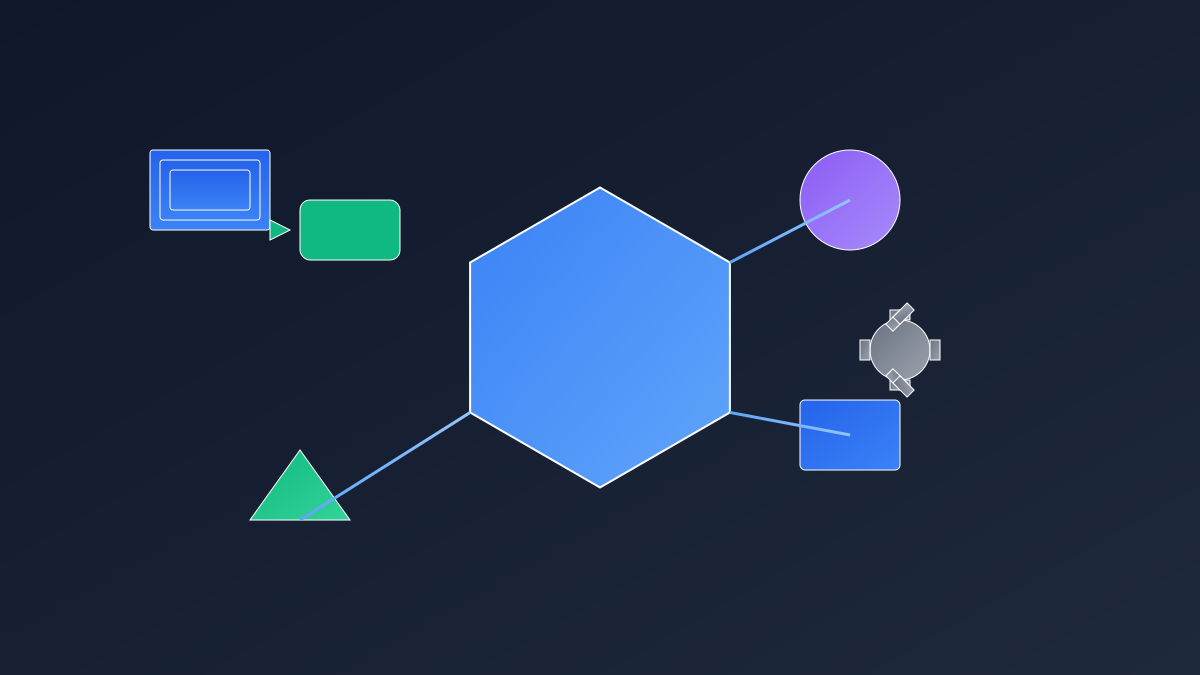
AI Toolkit is positioned as a pragmatic toolkit, providing components that can be used on demand. Its core concepts form a hierarchical capability system:

  • Rule Layer: Defines the boundaries of model behavior (image size, input format, safety filtering, etc.) and adjusts behavior declaratively;
  • Skill Layer: Encapsulates reusable multimodal capability units (e.g., image description, image-text matching) and supports modular development and sharing;
  • Workflow Layer: Combines skills into business processes, supporting modes such as serial, parallel, and conditional judgment.
4

Section 04

Key Technical Implementation Points of AI Toolkit

Multimodal Prompt Engineering

Supports template variables, multimodal placeholders, few-shot example management, version control, and A/B testing.

Model Adaptation and Abstraction

Shields API differences between different multimodal models (GPT-4V, Gemini, LLaVA, etc.) through an abstraction layer, providing a unified interface.

Output Parsing and Validation

Ensures model outputs conform to expected formats, triggering error handling or retry logic.

5

Section 05

Typical Application Scenarios of AI Toolkit

  • Intelligent Document Processing: Understand text and visual elements such as charts and seals, e.g., key field extraction from invoices;
  • Content Audit and Compliance: Coordinate pre-review, re-review, and manual sampling of multimodal content;
  • E-commerce Product Information Extraction: Automatically identify categories, extract attributes, and generate standardized descriptions;
  • Educational Auxiliary Tools: Image-based Q&A, homework correction, formula derivation.
6

Section 06

Ecosystem and Extensibility of AI Toolkit

The design emphasizes openness:

  • Skill Market: Community-shared pre-built skill library;
  • Plugin Mechanism: Integrate custom models or logic;
  • Configuration as Code: Define rules and workflows using YAML/JSON;
  • Debugging Tools: Visualize execution processes and view intermediate results.
7

Section 07

Comparison with Related Technologies and Future Outlook of AI Toolkit

Comparison

  • vs. LangChain/LlamaIndex: More focused on multimodal scenarios;
  • vs. Prompt Flow: Lightweight and flexible, not tied to cloud platforms;
  • vs. ComfyUI: Oriented towards application development, emphasizing rules and reliability.

Future Directions

Video modality support, real-time interaction optimization, Agent framework integration, enterprise-level audit/access control/cost tracking functions.

8

Section 08

Value and Conclusion of AI Toolkit

AI Toolkit represents the evolution direction of multimodal application development tools: from API encapsulation to systematic capability orchestration. In today's era of powerful models, the engineering problem of efficiently utilizing capabilities is more critical. Its three-layer architecture (rules-skills-workflow) provides a structured solution, which is worthy of developers' attention.

