Zing Forum

Reading

AI Smart Recruitment Assistant: Resume Semantic Matching and Interpretable Ranking System Based on RAG and LLM

An end-to-end AI recruitment system combining Sentence-BERT semantic retrieval, cross-encoder re-ranking, and structured feature scoring, enabling a complete process from natural language queries to interpretable candidate recommendations and reducing resume screening time from hours to seconds.

RAGLLM招聘简历匹配语义搜索Sentence-BERT交叉编码器可解释AIFAISS人才筛选
Published 2026-04-05 04:14Recent activity 2026-04-05 04:19Estimated read 6 min
AI Smart Recruitment Assistant: Resume Semantic Matching and Interpretable Ranking System Based on RAG and LLM
1

Section 01

Core Guide to the AI Smart Recruitment Assistant

This article introduces an end-to-end AI recruitment system based on RAG and LLM, combining Sentence-BERT semantic retrieval, cross-encoder re-ranking, and structured feature scoring to achieve resume semantic matching and interpretable ranking. The system can reduce resume screening time from hours to seconds, addressing the limitations of traditional ATS systems.


2

Section 02

Limitations of Traditional ATS Systems and Demand Background

Traditional Applicant Tracking Systems (ATS) rely on keyword matching and have issues such as insufficient semantic understanding (missing candidates with similar expressions), opaque ranking mechanisms, and low efficiency of manual screening. These pain points have spurred the demand for more intelligent and interpretable recruitment assistance tools.

3

Section 03

Core Technical Architecture of the System (Three-Stage Pipeline)

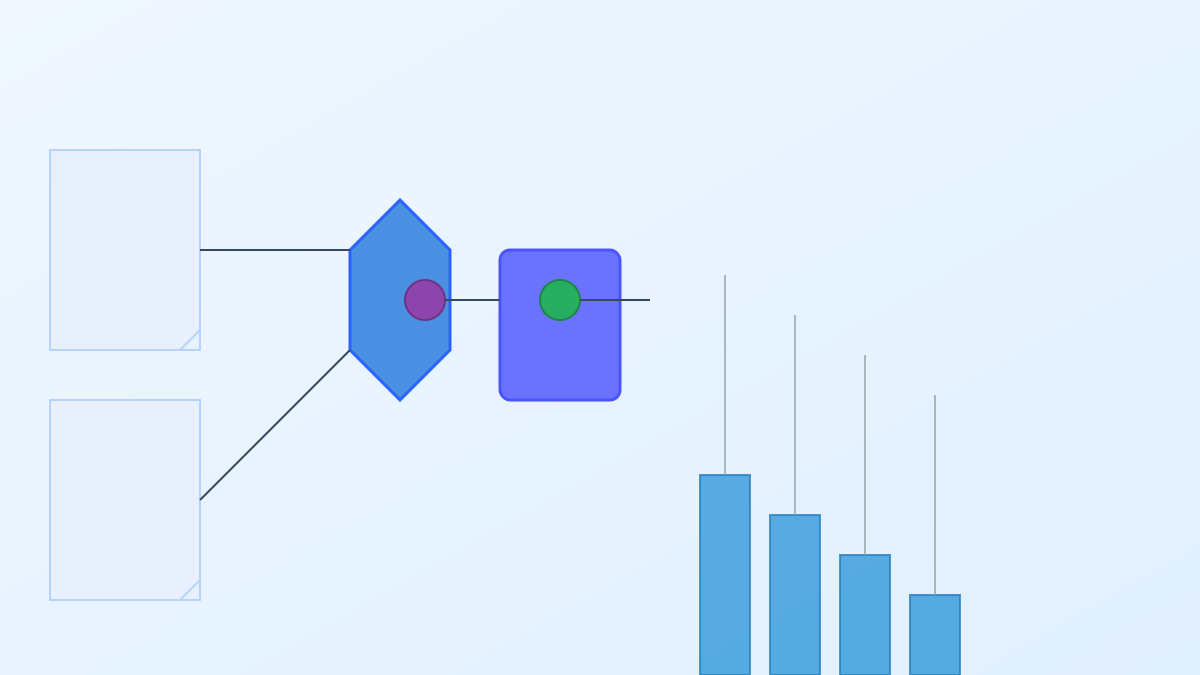
The system adopts a three-stage design: 1. Offline processing: Resume extraction (pdfplumber), cleaning, intelligent chunking (chapter identification), entity extraction (spaCy/NLTK) and normalization (skill synonym mapping), with data stored in Delta Live Tables; 2. Semantic embedding and indexing: Sentence-BERT generates chapter-level embeddings, stored in FAISS vector database to support fast retrieval; 3. Online process: Query embedding → FAISS recall → Resume-level aggregation → Feature scoring (skills/experience/domain, etc.) → Cross-encoder re-ranking → Controlled LLM summary generation.

4

Section 04

Interpretability Design: Transparent AI Decision-Making

The system allows recruiters to understand the basis of rankings by displaying the contribution of each feature to the ranking (e.g., skill matching degree, experience alignment degree, etc.). Summaries are generated based on resume paragraph evidence using controlled templates, reducing the risk of hallucinations and ensuring information traceability.

5

Section 05

Business Value and Effectiveness Evaluation

The system delivers significant value: efficiency improvement (screening time from hours to seconds), quality enhancement (discovering candidates missed by keyword matching), scale expansion (processing thousands of resumes), and decision support (enhancing human judgment). Evaluation metrics include latency, Precision@K/Recall@K, consistency, and hallucination checks, etc.

6

Section 06

Technology Stack and Implementation Details

The project is developed using Python3.10, with core technology stack: vector retrieval (FAISS), semantic models (Sentence-Transformers, MiniLM cross-encoder), front-end (Streamlit), local LLM (Ollama Llama3), data storage (Databricks Delta Lake), NLP tools (spaCy/NLTK). The code structure includes modules such as app.py (Streamlit application), preprocessing.py (resume processing), build_index.py (index construction), etc.

7

Section 07

Current Status and Future Plans

The project is in the prototype stage, with core components implemented but the complete pipeline not fully packaged. Future plans: Compare the performance of RAG/cross-encoder/hybrid methods, integrate MLflow experiment tracking, customize job prompt templates, and introduce responsible AI measures (bias checks, prompt injection protection).

8

Section 08

Summary and Insights

This system demonstrates the value of combining RAG architecture with structured feature engineering to build an intelligent and interpretable recruitment assistance system. Its design ideas are referenceable for unstructured document retrieval and reasoning scenarios, and the method of balancing technological innovation and practicality is worth promoting.

