Zing Forum

Reading

AI QA Agent: A Production-Grade Solution for Automated Test Case Generation Based on Multi-Layer LLM Pipeline

A production-grade AI QA agent system that automatically converts business requirements into structured, validated test cases. It adopts a multi-layer pipeline architecture of generation-review-control-validation-evaluation and supports multiple output formats such as Gherkin, JSON, and Excel.

AI测试测试用例生成LLM流水线FastAPIReactGherkin自动化测试语义覆盖
Published 2026-06-04 09:45Recent activity 2026-06-04 09:52Estimated read 5 min
AI QA Agent: A Production-Grade Solution for Automated Test Case Generation Based on Multi-Layer LLM Pipeline
1

Section 01

[Introduction] AI QA Agent: Automated Test Case Generation Solution Based on Multi-Layer LLM Pipeline

This article introduces the open-source project AI-TESTCASE-AGENT. Through its multi-layer LLM pipeline architecture of generation-review-control-validation-evaluation, it addresses the pain points of traditional test case writing, enabling automated generation and validation of structured test cases from business requirements. It supports multiple output formats and interfaces, improving testing efficiency and quality.


2

Section 02

Project Background: Pain Points of Traditional Test Case Writing and Demand for Solutions

Traditional test case writing relies on manual analysis of requirement documents, which has issues such as missing boundary/exception scenarios, high maintenance costs for requirement changes, and inconsistent style and quality of test cases. AI-TESTCASE-AGENT addresses these pain points by providing a complete pipeline system with multi-layer quality control mechanisms.

3

Section 03

System Architecture: Design and Responsibility Division of Multi-Layer LLM Pipeline

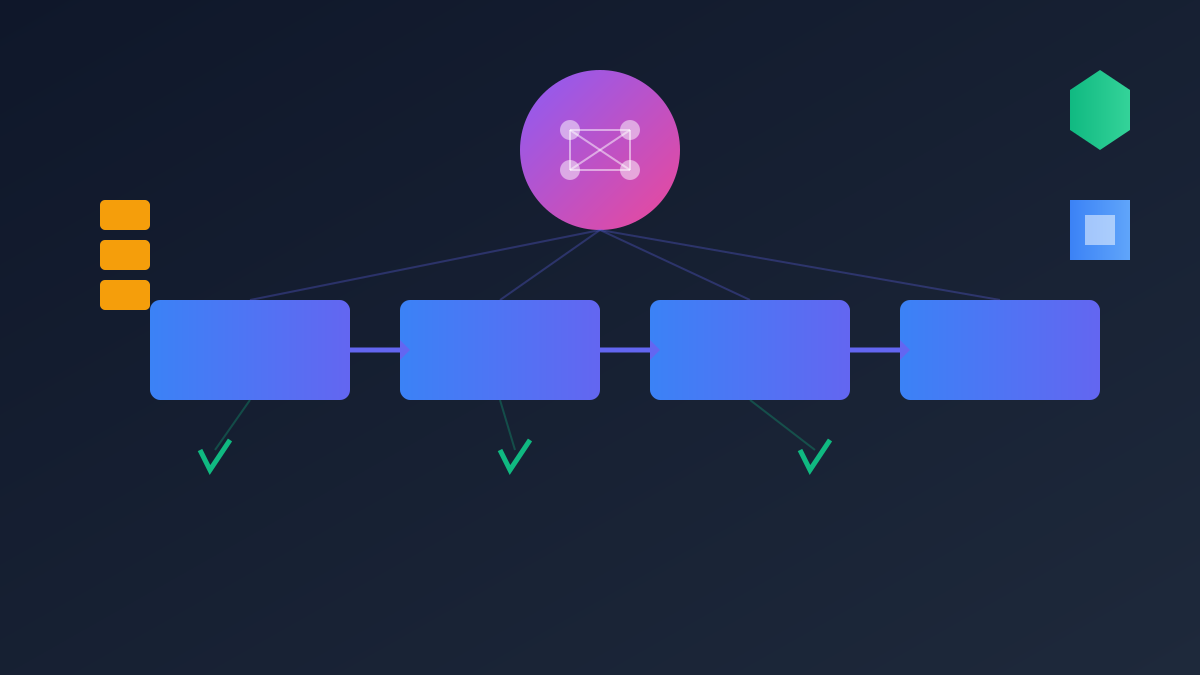
The core architecture follows the "generation-review-control-validation-evaluation" model, with responsibilities of each layer:

  1. Preprocessing layer: Enrich requirements (identify entities, extract implicit conditions) + Memory enhancement (retrieve historical cases to inject into context)
  2. LLM generation engine: Supports multi-model backends (GPT/Gemini), uses prompt templates to ensure structural standardization
  3. Review layer: Check for missing scenarios, fix structural issues, supplement incomplete sections
  4. Control layer: Restrict over-generation, remove noise, ensure maintainability
  5. Structural validation layer: Verify numbering errors, enforce format rules (e.g., Gherkin)
  6. Coverage evaluation engine: Calculate similarity between requirements and test cases using semantic embedding, identify test gaps and score
4

Section 04

Multiple Interfaces and Output Formats: Flexible Usage Methods and Scenario Coverage

Interface support: Web interface (React), CLI tool, VS Code extension, FastAPI interface Deployment method: Docker containerization Output formats: Gherkin (BDD), JSON, Excel Test scenario coverage: Positive/negative/boundary/system-level scenarios (rate limiting, concurrency, etc.), dual validation of API and UI

5

Section 05

Application Value and Limitations: Positioning and Boundaries of AI-Assisted Testing

Value: Encapsulate AI capabilities into a controllable and auditable production-grade system; multi-layer pipeline ensures stable quality; memory mechanism supports continuous learning; coverage evaluation provides quantitative indicators Limitations: Cannot completely replace humans; complex business rules, domain expertise scenarios, and end-to-end testing of multi-system interactions still require human judgment; suitable as an efficiency multiplier to generate basic frameworks

6

Section 06

Conclusion: The Future of AI in Software Testing and the Significance of the Project

AI-TESTCASE-AGENT demonstrates the systematic application of LLM in the testing field, and its multi-layer pipeline architecture provides a reference paradigm. With the development of LLM, such tools will become more important in quality assurance, and it is an open-source solution worth trying for teams looking to improve testing efficiency.

