Zing Forum

Reading

AI Agent Workflow: Telegram Business Automation Solution Based on n8n

This article introduces an autonomous AI agent built using the n8n workflow platform, integrating Groq and Gemini large models, Gmail API, and Telegram Bot to implement a business automation system for intelligent email processing, bidirectional communication, and real-time image analysis.

智能体自动化n8nTelegram BotGroqGemini商业自动化邮件处理多模态AI
Published 2026-05-02 01:15Recent activity 2026-05-02 01:26Estimated read 9 min
AI Agent Workflow: Telegram Business Automation Solution Based on n8n
1

Section 01

Introduction: Core Overview of Telegram AI Agent Business Automation Solution Based on n8n

This article introduces an autonomous AI agent system built using the n8n workflow platform, integrating Groq and Gemini large models, Gmail API, and Telegram Bot to achieve business automation functions such as intelligent email processing, bidirectional communication, and real-time image analysis. This solution aims to address the limitations of traditional rule-based automation in handling unstructured inputs, and improve enterprise operational efficiency through the natural language understanding and autonomous decision-making capabilities of AI agents.


2

Section 02

Background of Business Automation: From Rule-Driven to Agent Paradigm

There are a large number of repetitive tasks in enterprise operations (such as processing customer emails, replying to inquiries, etc.). Traditional automation tools rely on preset rules and struggle to handle unstructured inputs. The rise of the AI agent paradigm has changed this situation—unlike traditional automation that passively executes fixed processes, AI agents can understand natural language, reason about complex intentions, and independently decide action sequences. This project demonstrates how to apply this paradigm to daily business scenarios and build an interactive AI assistant through Telegram.

3

Section 03

System Architecture: A Collaborative Automation Closed Loop with Multiple Components

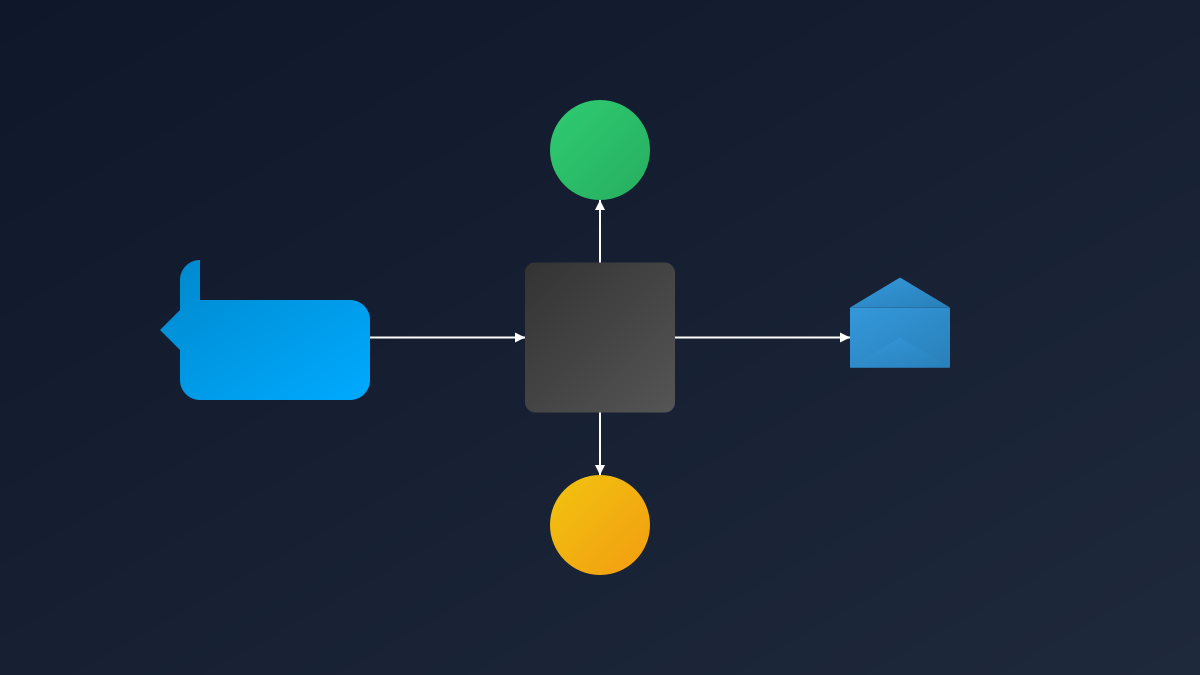
The system consists of four core components forming a complete closed loop:

  1. n8n: An open-source workflow orchestration engine that acts as the "nervous system" responsible for receiving events, calling AI services, executing actions, and maintaining states. Docker self-hosting is used to ensure data privacy and cost control.
  2. Groq and Gemini dual LLM strategy: Groq is suitable for fast interaction scenarios due to its fast inference speed; Gemini supports multimodal (text + image) analysis. The dual-model strategy provides flexibility and redundancy.
  3. Gmail API: Enables email retrieval, intelligent summarization (LLM generates key points in Markdown tables), and bidirectional control (direct reply/send emails via Telegram).
  4. Telegram Bot: Serves as the interactive front end, supporting cross-platform, rich media, and native Bot API. Users can complete operations through natural conversations.
4

Section 04

Detailed Explanation of Core Functions: Email Processing, Bidirectional Communication, and Visual Analysis

The core functions of the system include:

  • Intelligent email processing: Periodically poll unread Gmail emails → extract content → LLM generates structured summaries (sender, core demands, urgency level, reply suggestions) → push via Telegram. Users can quickly browse, reply directly, or mark for follow-up.
  • Bidirectional communication control: Supports quick replies (Telegram messages converted to emails), active email sending (triggered by commands), and template calls, enabling efficient email processing in mobile scenarios.
  • AI visual analysis: Users send images → Gemini Vision API analyzes → returns descriptions/recognition results/OCR. Application scenarios include receipt reimbursement records, product inventory queries, chart data extraction, etc.
5

Section 05

Key Technical Implementation Points: Workflow, Error Handling, and Security

Key technical implementations:

  • Workflow design: Event-driven architecture, including trigger nodes (Webhook, Schedule, Gmail Trigger) → processing nodes (HTTP Request, Function, Gmail operations) → output nodes (Telegram, Gmail).
  • Error handling: Exponential backoff retries for API rate limits, fallback for LLM format errors, network timeout state recovery, re-authentication for expired authorization.
  • Security considerations: API keys stored in n8n credential store, Telegram Bot username whitelist, self-hosting to ensure data privacy.
6

Section 06

Deployment and Daily Usage Guide

Deployment steps:

  1. n8n deployment: Run using Docker command (docker run -it --rm --name n8n -p5678:5678 -v ~/.n8n:/home/node/.n8n n8nio/n8n).
  2. API configuration: Prepare Groq API Key, Google Gemini API Key, Gmail OAuth credentials, and Telegram Bot Token.
  3. Workflow import: Import the workflow JSON provided by the project. Daily usage: Communicate with the Bot via Telegram, send /help to view commands, send email screenshots to ask for summaries, reply directly to push notifications, etc.
7

Section 07

Application Scenario Expansion and Insights into Agent Automation

Application scenario expansion: Customer service (auto-reply to common questions), sales leads (monitor email classification for follow-up), content moderation (mark inappropriate image content), data entry (fill tables with attachment data), meeting coordination (check calendar for email meeting requests). Insights: The combination of low-code platforms (n8n) and LLMs lowers technical barriers, supporting rapid prototyping and progressive automation; however, there are limitations such as LLM hallucinations, API dependency risks, and challenges in state management for complex tasks.

8

Section 08

Future Outlook: Evolution Direction of Agent Automation

Future development directions:

  • Deeper system integration: Operate CRM, ERP, and project management tools.
  • Smarter task planning: Independently decompose complex tasks and dynamically adjust strategies.
  • More natural multi-turn conversations: Support context memory and long-term task tracking.
  • More powerful tool usage: Independently discover and call APIs to expand capability boundaries. This project is a practical step in the evolution path of agent automation, demonstrating the value achievable with current technology.

