Zing Forum

Reading

AI Job Search Assistant: Practice of Automated Job Application Workflow Based on n8n

This article introduces an AI job search automation project based on the n8n workflow engine. Using a dual-agent architecture, the project implements company research, job position analysis, and personalized application material generation, demonstrating how to combine large language models with automation tools to improve job search efficiency.

求职自动化n8n工作流AI智能体求职信生成简历优化自动化工具职业应用
Published 2026-05-12 20:16Recent activity 2026-05-12 20:22Estimated read 6 min
AI Job Search Assistant: Practice of Automated Job Application Workflow Based on n8n
1

Section 01

[Introduction] AI Job Search Assistant: Practice of Automated Job Application Workflow Based on n8n

This article introduces the Job Application Assistant project developed by GarukaR. Based on the n8n workflow engine, the project uses a dual-agent architecture to implement company research, job position analysis, and personalized application material generation. By combining large language models with automation tools, it aims to solve the time-consuming and labor-intensive pain points in the job search process and improve job search efficiency.


2

Section 02

Background: Practical Needs for Job Application Automation and AI Solutions

Preparing a high-quality job application takes hours, and the cost multiplies when applying on a large scale. In the AI era, automation technology can handle repetitive tasks like information collection and content generation, enabling job seekers to focus on high-value activities such as decision-making and interpersonal communication.

3

Section 03

System Architecture and Tech Stack Analysis

Workflow Engine: n8n

Advantages of choosing n8n: Rich node ecosystem, support for custom JS code, open-source self-hosting, active community.

Dual-Agent Architecture

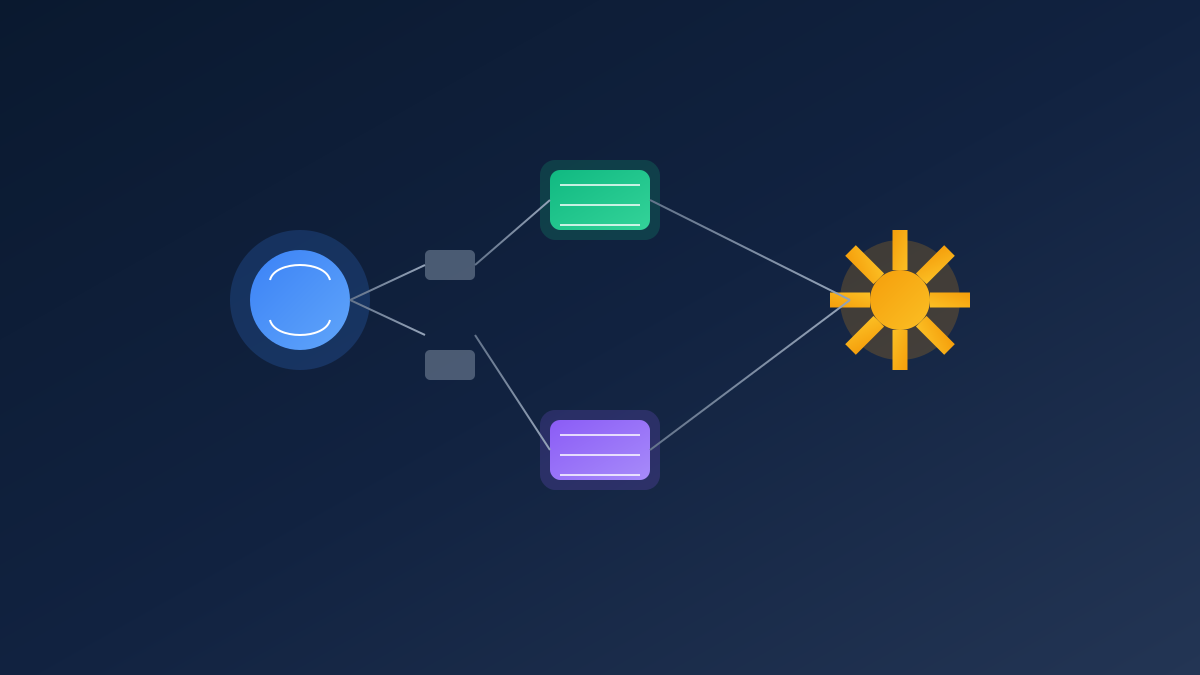
  • Analysis Agent: Responsible for information collection and in-depth analysis, outputting structured intelligence summaries;
  • Writing Agent: Generates personalized job application materials (cover letters, resume optimization suggestions, etc.) based on analysis results.

Integrated Services

Google Serper API (real-time search), Google Docs API (document generation and storage), large language model services like OpenAI/Anthropic.

4

Section 04

Detailed Explanation of the Complete Workflow

  1. Trigger and Input: User submits job URL/description, personal resume, desired material type;
  2. Company Research: Call Serper API to get company official website, news, industry reviews, etc.;
  3. Job Position Analysis: Identify core skill requirements, team culture, and candidate matching points;
  4. Content Generation: Generate cover letters highlighting relevant experience, resume optimization points, interview preparation checklists;
  5. Document Output: Automatically create Google Docs and save to the specified location.
5

Section 05

Highlights of Technical Implementation

  • Agent Collaboration: Sequential collaboration mode reduces cognitive load; intermediate results can be manually reviewed, facilitating optimization and error location;
  • Data Cleaning and Formatting: JS code nodes clean data, extract key information, and format output;
  • Configurable Extensibility: Supports adjusting search scope, modifying agent style, adding steps (email sending), and integrating other services (LinkedIn/Notion).
6

Section 06

Application Scenarios and Usage Suggestions

Applicable Scenarios:

  • Large-scale application phase: Quickly generate basic materials;
  • In-depth research on target companies: Provide comprehensive intelligence;
  • Career transition period: Identify transferable skills;
  • Interview preparation: Refer to analysis reports and checklists. Usage Suggestions: Use the system output as a starting point and add personalized details.
7

Section 07

Limitations and Notes

  • Personalization requires manual check: AI-generated content needs to be reviewed to ensure it truly reflects personal experience;
  • Avoid over-automation: Prevent templated materials from being identified by recruiters;
  • Data privacy considerations: Avoid transmitting sensitive data to third-party APIs.
8

Section 08

Future Directions and Insights from AI Workflows

Future Expansion: Integrate LinkedIn API, add interview simulation, application status tracking, multi-language output. Insights: Decompose complex tasks into subtasks, configure specialized agents, utilize existing APIs, retain manual review links; similar automation assistants can be applied to fields like travel planning and learning tutoring.

