Zing Forum

Reading

AI Agent-Driven End-to-End Testing: A New Paradigm for Automated QA with MCP Protocol and Playwright

Explore the technical architecture of building autonomous AI testing agents based on the Model Context Protocol (MCP) and Playwright, enabling the intelligent upgrade of end-to-end QA processes

AI AgentMCP协议Playwright端到端测试自动化QA智能测试浏览器自动化软件测试Model Context Protocol测试智能化
Published 2026-04-21 04:15Recent activity 2026-04-21 04:19Estimated read 8 min
AI Agent-Driven End-to-End Testing: A New Paradigm for Automated QA with MCP Protocol and Playwright
1

Section 01

AI Agent-Driven End-to-End Testing: Integrating MCP Protocol and Playwright

In the field of software development, traditional automated test scripts face issues like high maintenance costs and poor adaptability. With the advancement of large language model capabilities, a new paradigm of AI agents autonomously understanding interfaces and generating test steps has emerged. This article delves into the end-to-end QA workflow built on the MCP protocol and Playwright, demonstrating how AI is reshaping the future of software testing.


2

Section 02

Technical Background: Analysis of Three Core Components

AI Agent: The Intelligent Brain of the Testing Process

AI agents have autonomous decision-making capabilities; they can understand test objectives, plan steps, adjust strategies, locate elements based on semantic understanding to reduce script fragility, and optimize tests using historical results.

MCP Protocol: Standardized Tool Calling Interface

The MCP protocol introduced by Anthropic defines specifications for tool discovery, structured calling, result feedback, and secure sandboxes, enabling AI agents to call browser automation tools safely and reliably.

Playwright: A Benchmark for Modern Browser Automation

Microsoft's open-source Playwright provides reliable cross-browser support, and its features like accessibility trees, screenshot recording, network interception, and parallel execution offer strong support for AI testing.

3

Section 03

System Architecture and End-to-End Testing Workflow

Overall Architecture Overview

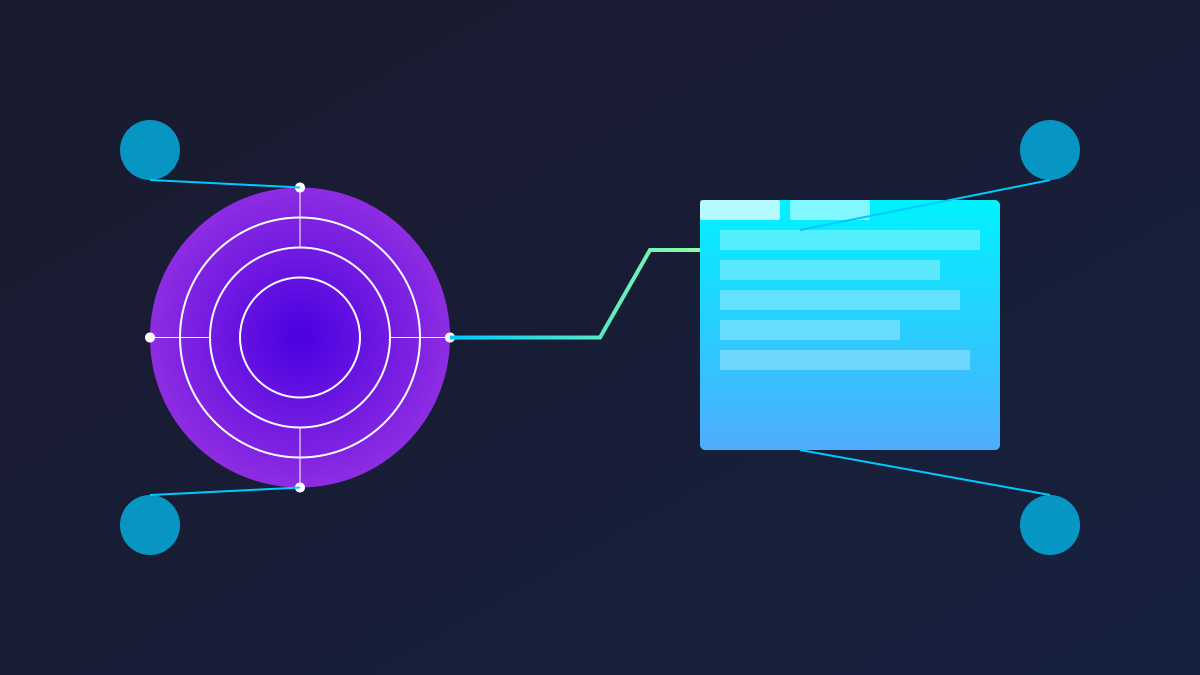
The project is divided into three layers: the intelligent decision-making layer (AI Agent), the protocol adaptation layer (MCP server), and the execution engine layer (Playwright). The layered design enhances scalability.

Detailed Workflow

  1. Requirement Understanding and Test Planning: The agent parses natural language requirements and generates a structured test plan;
  2. Page Exploration and Element Identification: Call Playwright via MCP to obtain page information and semantically locate key elements;
  3. Test Execution and Status Monitoring: Execute steps as planned and adjust strategies when failures occur;
  4. Result Verification and Report Generation: Aggregate results to generate reports with screenshots and logs, and analyze failure causes.
4

Section 04

Key Points of Technical Implementation

Playwright Integration with MCP Server

Define standardized tool interfaces such as navigate, click, fill, etc., with clear parameters and return formats to facilitate AI calls.

Intelligent Element Location Strategy

Adopt semantic positioning, visual positioning, context positioning, and multi-strategy fallback to replace easily invalid CSS selectors/XPath.

Adaptive Test Execution

Agents have capabilities like dynamic waiting, error recovery, path exploration, and intelligent assertions to enhance test adaptability.

5

Section 05

Application Scenarios and Value Analysis

  • Regression Test Automation: Execute test cases in parallel, intelligently select key modules to improve efficiency;
  • Exploratory Test Assistance: Simulate human exploration behavior to find defects that traditional scripts rarely cover;
  • Cross-Platform Compatibility Verification: Execute in parallel across multiple browsers to identify platform-specific issues;
  • Accessibility Testing: Automatically check page accessibility based on WCAG standards.
6

Section 06

Technical Challenges and Solutions

Challenge 1: AI Hallucinations and Incorrect Operations

Solutions: Tools verify element existence, real-time feedback on operation results, manual intervention in key scenarios.

Challenge 2: Determinism of Test Execution

Solutions: Reduce LLM sampling temperature, fix random seeds, automatically retry flaky tests.

Challenge 3: Execution Efficiency and Cost

Optimization strategies: Batch operations, cache page element mappings, layered execution (simple operations handled by scripts).

7

Section 07

Future Outlook and Summary Recommendations

Industry Trends

  • Shift-left testing: Introduce intelligent testing early in development, automatically generate test cases when code is submitted;
  • Natural language test cases: Complete testing without code, just by describing requirements;
  • Self-healing tests: Automatically analyze failure causes and update test strategies;
  • Cross-tool ecosystem integration: Seamlessly call multiple testing tools to achieve comprehensive quality assurance.

Summary Recommendations

The combination of AI with MCP and Playwright represents a new direction in testing. Although it faces challenges like cost and stability, its potential is huge. It is recommended that teams start with small-scale pilots, accumulate experience, and embrace the intelligent era.

