Zing Forum

Reading

AI Document Structuring Pipeline: Building a Reliable LLM Data Extraction System

This article introduces a production-grade AI document structuring pipeline, demonstrating how to convert unstructured text into validated structured data. The system supports multiple LLM providers, output verification, and automatic retry mechanisms, providing a reliable design pattern for real-world AI applications.

LLM文档处理数据提取模式验证自动化流水线OllamaOpenAI可靠性设计
Published 2026-05-23 22:12Recent activity 2026-05-23 22:18Estimated read 6 min
AI Document Structuring Pipeline: Building a Reliable LLM Data Extraction System
1

Section 01

AI Document Structuring Pipeline: Building a Reliable LLM Data Extraction System (Introduction)

This article introduces a production-grade AI document structuring pipeline, aiming to solve efficiency and reliability issues in unstructured text processing. The system supports multiple LLM providers (Ollama local models, OpenAI cloud APIs) and ensures data extraction reliability through mechanisms like output cleaning, schema validation, and intelligent retries, providing a reliable design pattern for real-world AI applications.


2

Section 02

Project Background: Pain Points and Solutions for Unstructured Text Processing

A large amount of information in enterprises exists in unstructured forms (customer feedback, meeting minutes, etc.). Traditional manual processing is inefficient and error-prone; direct use of LLMs for extraction faces issues like unstable outputs and inconsistent formats. This project takes "reliability first" as its core concept, providing a production-grade design pattern to integrate LLMs into automated workflows.

3

Section 03

System Architecture and Core Functional Features

The system uses a modular layered architecture and supports local and AWS cloud deployment:

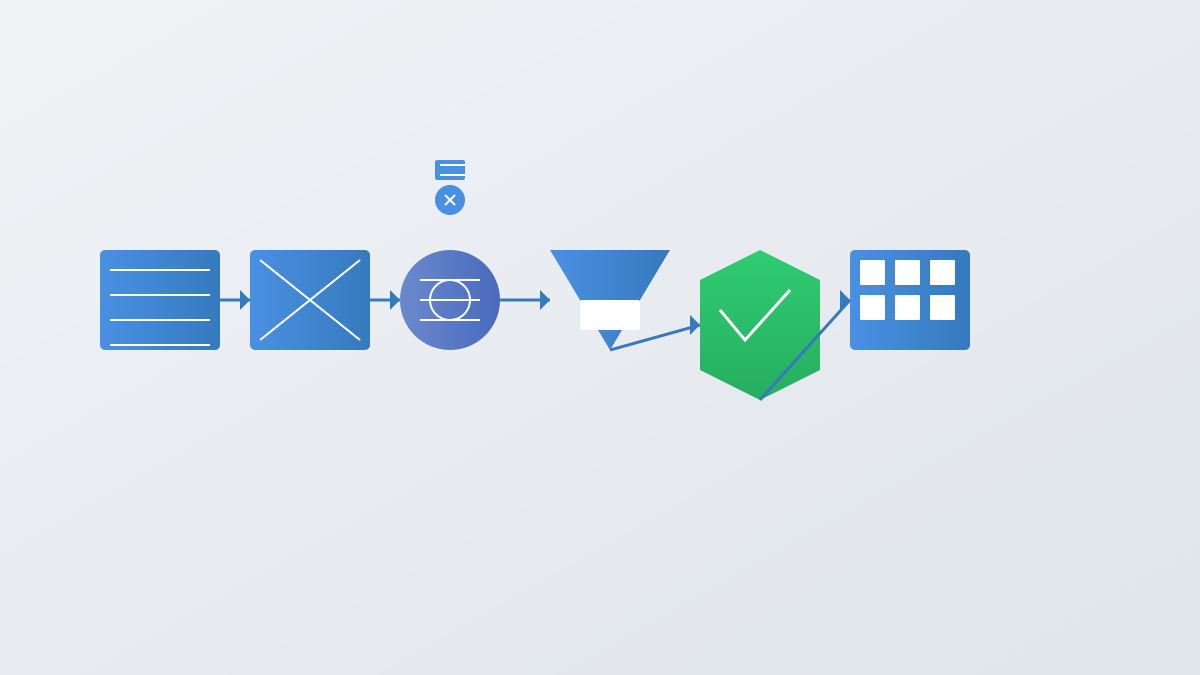
  • Local architecture: Input file → Processor pipeline → LLM abstraction layer → Output cleaning → Schema validation → Retry → Structured output + report
  • Cloud architecture: HTTP request → API Gateway → Lambda → Secrets Manager → OpenAI API → Return JSON Core features include: Multi-LLM support (local Ollama like llama3.1, cloud OpenAI like gpt-4.1-mini), output cleaning and standardization, strict schema validation, and intelligent retry mechanism.
4

Section 04

Design Trade-offs: Reasons for Key Engineering Decisions

  1. Schema validation: LLM outputs are non-deterministic; mandatory validation ensures reliable data contracts for downstream systems.
  2. Retry instead of repair: Retrying with optimized prompts works better than automatically fixing error outputs, and cost is controlled with exponential backoff.
  3. Multi-provider support: Local models protect privacy and reduce costs, while cloud models offer stable performance; flexible selection and failover support are provided.
5

Section 05

Practical Application Examples and Technical Details

  • Input example: "John Doe: My computer has become sentient."
  • Output example: {"user_name":"John Doe","issue_type":"Sentience","priority":"High"} Project structure: main.py (CLI entry), processor.py (pipeline logic), llm_client_ollama/openai.py (provider abstraction), validator.py (schema validation), etc. It uses a configuration-driven design; model selection, retry count, etc., are controlled via configuration files, so no code modification is needed to adapt to scenarios.
6

Section 06

Applicable Scenarios: Application Areas of the System

The system is applicable to:

  • Internal automation tools: Modernization of legacy document systems;
  • Platform engineering workflows: Intelligent data processing in CI/CD pipelines;
  • AI-driven document processing: Invoice, contract, and resume analysis;
  • Reliability-first LLM integration systems: Strict output quality requirements in production environments.
7

Section 07

Future Enhancement Directions: System Optimization Plan

Planned improvement directions for the project:

  • Automatic provider failover;
  • Timeout and cancellation handling;
  • Multi-modal support;
  • Metric tracking (accuracy, latency);
  • Parallel/asynchronous processing to improve throughput.
8

Section 08

Summary: Reference Value of Production-Grade LLM Applications

The DocumentStructuringUsingAI project provides an excellent reference for LLM production environment applications, demonstrating how to combine LLM capabilities with reliability mechanisms (validation, cleaning, retries). It is of great reference significance for teams planning to integrate LLMs into data processing workflows.

