Zing Forum

Reading

AI Gateway: A Unified API Gateway Solution for Building Multi-Agent Systems

Introducing the AI Gateway project, a unified API gateway that supports multi-provider automatic failover, shared memory, and built-in tools, helping developers build robust multi-agent AI systems.

AI Gateway多智能体API网关故障转移GroqOpenRouterGeminiSQLiteDocker
Published 2026-06-08 22:15Recent activity 2026-06-08 22:25Estimated read 6 min
AI Gateway: A Unified API Gateway Solution for Building Multi-Agent Systems
1

Section 01

AI Gateway: A Unified API Gateway for Robust Multi-Agent Systems

AI Gateway: A Unified API Gateway for Robust Multi-Agent Systems

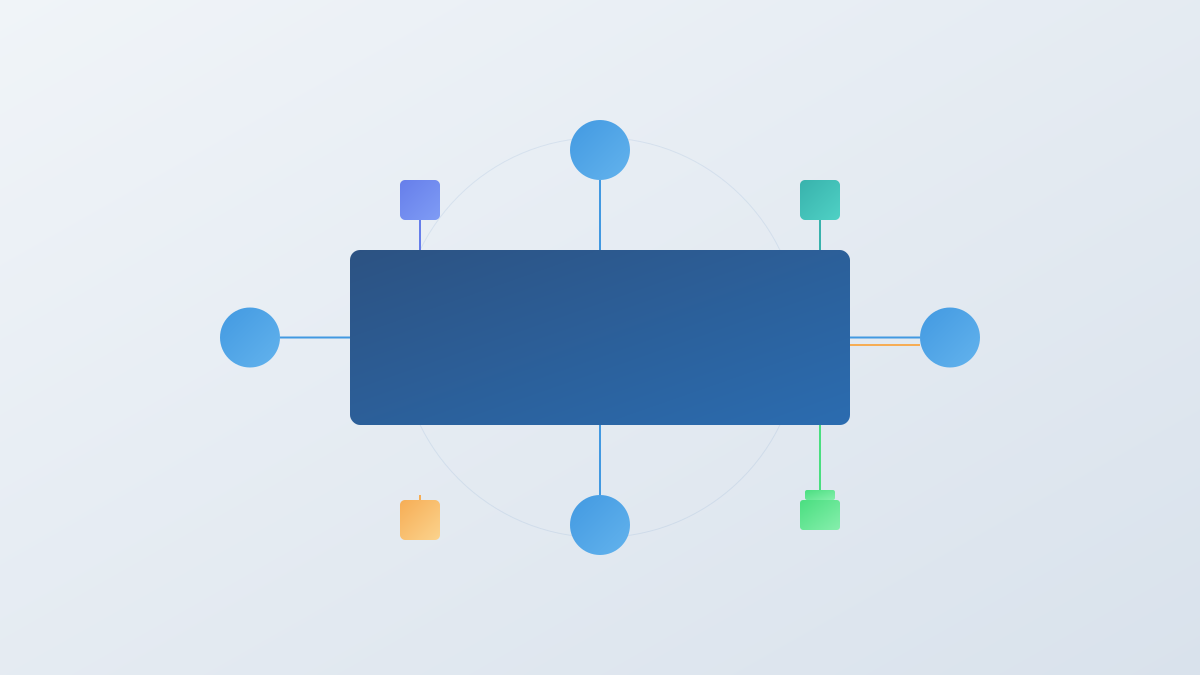
AI Gateway is an open-source unified API gateway project designed for multi-agent AI systems. It addresses core challenges in building such systems by providing features like multi-provider automatic failover, shared SQLite memory, and built-in tool integration.

Source Info:

This project aims to decouple upper-layer applications from underlying AI providers, letting developers focus on business logic while handling infrastructure issues like routing and fault recovery.


2

Section 02

Background: Challenges of Multi-Agent Systems

Background: Challenges of Multi-Agent Systems

As multi-agent architectures gain popularity, developers face several key challenges:

  1. Service Reliability: Single AI provider dependency leads to single-point failures.
  2. Cost Optimization: Balancing quality and cost across providers with varying prices/performance.
  3. Shared Context: Isolated state maintenance by agents causes info silos and redundant work.
  4. Tool Management: Unified access to external tools (weather, stock data, etc.) is complex.
3

Section 03

Core Architecture & Key Features

Core Architecture & Key Features

Multi-Provider Support

Supports multiple AI providers including Groq, OpenRouter, Gemini, Hugging Face, Inference, Novita, Cerebras, Replicate—enabling reliability and cost optimization.

Auto Failover

Automatically routes requests to backup providers on failures (triggered by HTTP errors, timeouts, rate limits). Developers can set provider priorities.

Shared SQLite Memory

Built-in SQLite-based shared memory allows agents to share context, session history, and intermediate results—avoiding redundancy and simplifying collaboration.

Built-in Tools

Pre-integrated tools like weather query, stock data, news retrieval, and web search—accessible via a unified interface with permission/quota management.

4

Section 04

Deployment & Operation

Deployment & Operation

Docker Support

Full Docker integration (Dockerfile + docker-compose) enables quick deployment in dev/production with environment consistency.

GitHub Actions CI

Configured CI pipeline automates testing, building, and release—ensuring code quality and lowering contribution barriers for the community.

5

Section 05

Typical Application Scenarios

Typical Application Scenarios

  1. Enterprise AI Assistant: Unified AI access for departments, ensuring high availability and compliance.
  2. Smart Customer Service: Routes queries to specialized agents; auto-failover maintains service quality.
  3. Research & Prototyping: Fast setup for multi-agent experiments with shared memory for multi-round dialogs.
6

Section 06

Technical Implementation Considerations

Technical Implementation Considerations

  • Performance: Focuses on low-latency routing, connection pool management, caching, and horizontal scaling for high concurrency.
  • Security: Handles authentication, authorization, rate limiting, input validation, and sensitive info protection.
  • Observability: Provides metrics, distributed tracing, and structured logs for easy monitoring and troubleshooting.
7

Section 07

Summary & Outlook

Summary & Outlook

AI Gateway addresses critical pain points in multi-agent systems via unified API, auto-failover, shared memory, and tool integration. As AI shifts to multi-agent collaboration, such infrastructure becomes increasingly essential.

For developers building multi-agent systems, this project offers valuable practical experience—whether used directly or as a reference architecture.

