Zing Forum

Reading

AI_Ecommerse-matcher: Multilingual E-commerce Product Intelligent Deduplication System

A semantic product deduplication solution based on large language models, addressing duplicate product identification issues in multilingual e-commerce platforms

电商商品去重多语言LLM语义匹配实体解析价格比较
Published 2026-04-06 23:12Recent activity 2026-04-06 23:21Estimated read 9 min
AI_Ecommerse-matcher: Multilingual E-commerce Product Intelligent Deduplication System
1

Section 01

AI_Ecommerse-matcher: Guide to Multilingual E-commerce Product Intelligent Deduplication System

AI_Ecommerse-matcher: Guide to Multilingual E-commerce Product Intelligent Deduplication System

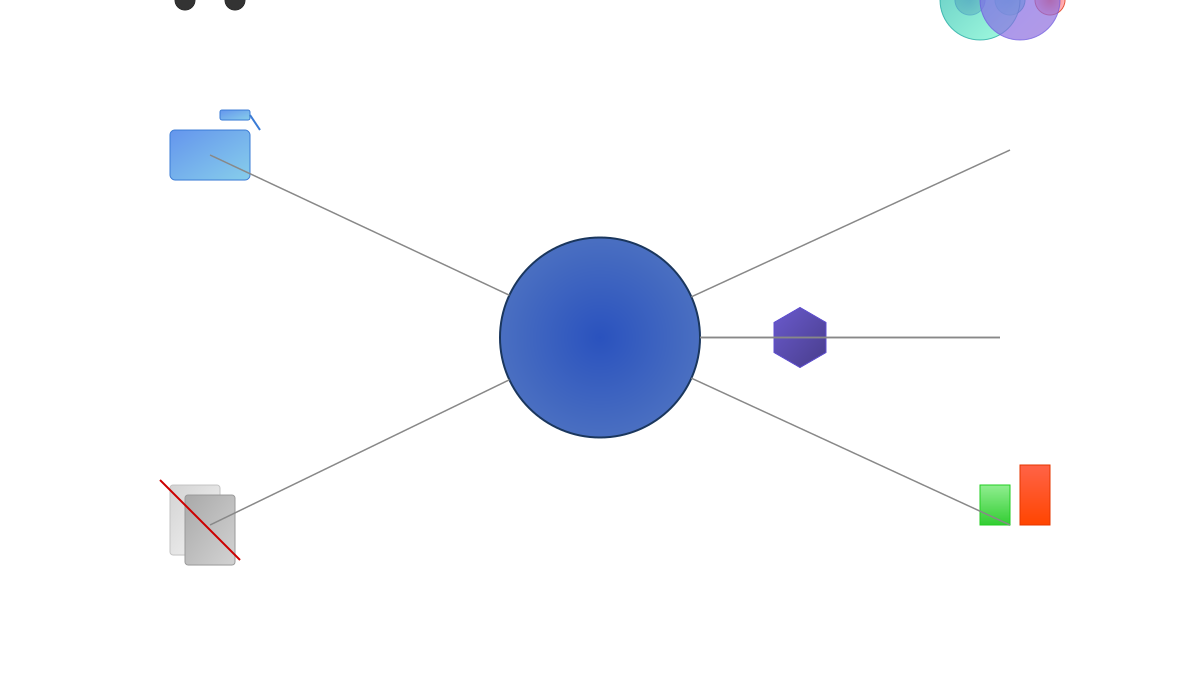
A semantic product deduplication solution based on large language models, addressing duplicate product identification issues in multilingual e-commerce platforms. This system leverages the deep semantic understanding capabilities of LLMs to break through the limitations of traditional rule/text matching, supporting cross-language and noise-resistant product deduplication. It is suitable for scenarios such as cross-border e-commerce, price comparison, and supply chain management, providing an intelligent solution for e-commerce data governance.


2

Section 02

Problem Background and Business Scenarios

Problem Background and Business Scenarios

Complexity of Multilingual E-commerce

Cross-border e-commerce platforms need to handle product information in dozens of languages. For example, the expression differences of "iPhone" across different language sites—traditional keyword matching cannot identify the same entity.

Impact of Data Noise

E-commerce data contains noise such as keyword stuffing, inconsistent description detail levels, and spelling errors, which increases the difficulty of deduplication.

Needs of Price Comparison Platforms

Insufficient deduplication accuracy leads to incomplete or incorrect price comparison results, undermining user experience and platform credibility.

3

Section 03

Core Technical Architecture and Mechanisms

Core Technical Architecture and Mechanisms

Semantic Understanding of Large Language Models

Leverages the deep semantic understanding capabilities of LLMs to capture the actual meaning behind product descriptions, matching based on key attributes like brand and model rather than surface text.

Entity Parsing and Alignment

Structured parsing of product descriptions to extract key attributes, perform attribute alignment, and make comprehensive matching degree judgments to improve accuracy and interpretability.

Semantic Clustering Algorithm

Through vector indexing and approximate nearest neighbor search, semantically similar products are grouped. New products only need to be compared with members within the cluster, reducing computational complexity.

4

Section 04

System Features

System Features

Cross-language Matching Capability

Supports semantic equivalence recognition across multiple languages such as English, French, and Chinese, adapting to the needs of multilingual sites in cross-border e-commerce.

Noise Robustness

Uses techniques like spelling tolerance, synonym expansion, and description completion to handle scenarios with poor data quality.

Configurable Deduplication Strategies

Supports flexible adjustment of matching thresholds and rules to meet strict/loose deduplication needs of different business scenarios.

Incremental Processing Capability

New products do not need to be compared against the entire database; they only enter the corresponding semantic cluster, ensuring the scalability of dynamic product libraries.

5

Section 05

Analysis of Key Application Scenarios

Analysis of Key Application Scenarios

Cross-border E-commerce Platforms

Automatically identifies the same product in different language versions, enabling unified inventory management, coordinated pricing, and cross-language product comparison.

Price Aggregation Services

Crawls product information from multiple data sources, deduplicates it, forms a unified catalog, and supports users' price comparison decisions.

Supply Chain Management Systems

Identifies the same product entries from different suppliers, optimizing procurement and inventory management.

Second-hand Trading Platforms

Handles non-standard product descriptions, identifies duplicate postings, and prevents information overload.

6

Section 06

Key Technical Implementation Points

Key Technical Implementation Points

Data Preprocessing Process

Includes steps such as HTML tag removal, special character processing, unit unification, and brand name standardization.

Multimodal Feature Fusion

Fuses text and visual features for comprehensive judgment to distinguish similar-described products with obvious appearance differences.

Performance Optimization Strategies

Vector quantization for compressed storage, approximate search for accelerated recall, and multi-level filtering to reduce precise comparisons, supporting the processing of 100-million-level product libraries.

Result Feedback and Model Iteration

Users can correct matching results; feedback data is used to continuously optimize the model and improve recognition accuracy in specific domains.

7

Section 07

Industry Value and Future Significance

Industry Value and Future Significance

AI_Ecommerse-matcher demonstrates the deep application of LLMs in e-commerce data governance, solving complex scenarios that traditional methods struggle to handle. Accurate product deduplication affects core e-commerce links such as search ranking and recommendation systems; open-source solutions improve the industry's data governance level. As cross-border e-commerce grows, intelligent deduplication tools will become standard components in the e-commerce technology stack, facilitating expansion into multilingual markets.

