Zing Forum

Reading

AI-Document-Analyser: A Flask-based Intelligent Analysis System for Multi-format Documents

AI-Document-Analyser is a Flask-based document analysis application that allows users to upload multiple formats including PDF, Word, text files, and images. It retrieves relevant content via RAG technology and uses large language models to generate accurate answers, enabling intelligent Q&A interactions with document content.

文档分析RAGFlaskPDF处理智能问答向量检索开源项目
Published 2026-06-04 14:15Recent activity 2026-06-04 14:26Estimated read 5 min
AI-Document-Analyser: A Flask-based Intelligent Analysis System for Multi-format Documents
1

Section 01

AI-Document-Analyser Project Guide

AI-Document-Analyser is an open-source intelligent document analysis system based on the Flask framework. It supports uploading multiple formats such as PDF, Word, text, and images. By combining RAG technology (Retrieval-Augmented Generation) with large language models, it enables intelligent Q&A interactions, solving the time-consuming and labor-intensive problem of daily document information retrieval and improving information acquisition efficiency.


2

Section 02

Project Background: Pain Points of Document Information Retrieval

In daily work and study, finding specific information when dealing with large amounts of PDF reports, Word documents, text files, and image materials is often time-consuming and labor-intensive. AI-Document-Analyser aims to solve this problem through technical means and provide a simple yet powerful intelligent document analysis solution.

3

Section 03

Core Technologies and Methods: RAG Architecture and Multi-format Support

Core Functional Features

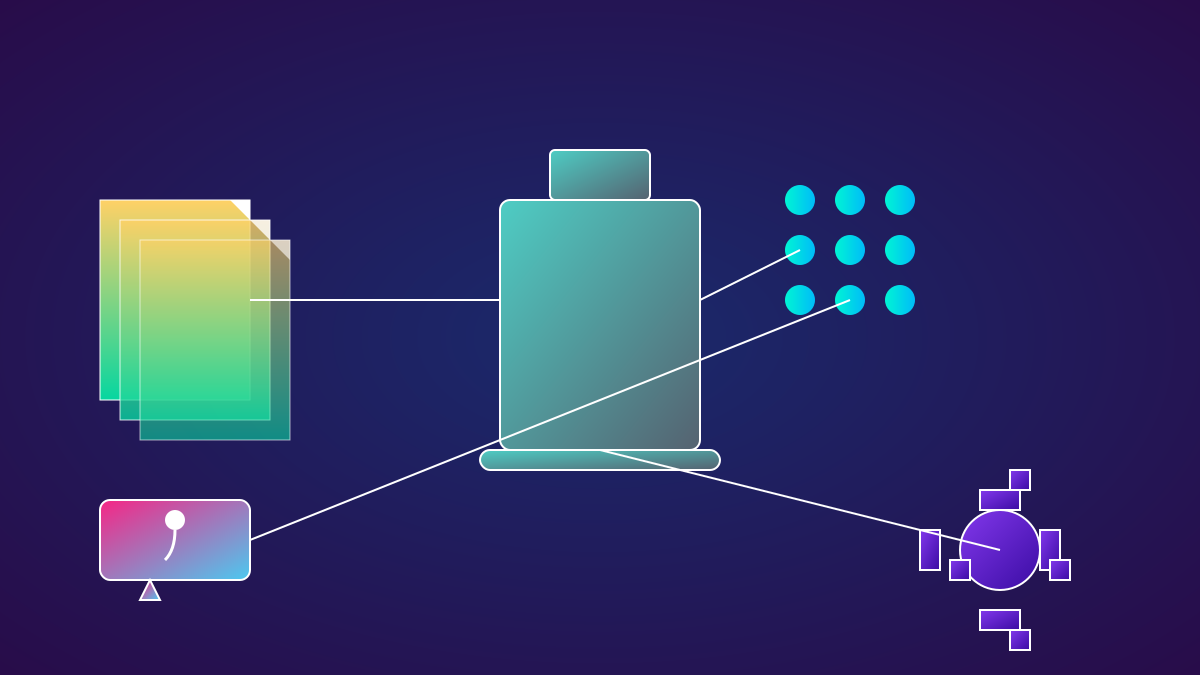
  1. Multi-format Support: Covers PDF (including scanned copies), Word, text, images (OCR extraction), etc.
  2. Intelligent Content Extraction: Uses PDF parsing, OCR recognition, layout analysis, and other technologies to accurately extract content.
  3. RAG Architecture: Document vectorization storage, intelligent semantic retrieval, and answer generation combined with LLM.
  4. Web Interface: User-friendly file upload, dialogue interaction, and history record functions.

Technical Architecture

  • Backend: Flask framework (lightweight, scalable).
  • AI Components: Embedding models (e.g., text-embedding-ada-002), vector databases (e.g., FAISS), large language models (e.g., GPT series).
  • Workflow: Upload → Parse → Split → Embed → Store → Query and generate answers.
4

Section 04

Application Scenarios and Value: Practical Applications Across Multiple Domains

Academic Research

Assists in literature review, paper reading, cross-document comparison;

Enterprise Document Management

Contract review, report analysis, knowledge base construction;

Education and Training

Textbook learning, homework assistance, exam review;

Personal Knowledge Management

Note organization, data archiving, reading assistance.

5

Section 05

Project Summary and Evaluation: A Practical Open-source Document Analysis Tool

AI-Document-Analyser is a practical and well-designed open-source project with the following advantages:

  1. Practicality: Solves real pain points in document retrieval;
  2. Multi-format Support: Covers common document types;
  3. Reasonable Technology Selection: The Flask+RAG combination is popular and effective;
  4. Easy Deployment: Supports local, Docker, and cloud service deployment. It is suitable for individual users, researchers, and small teams.
6

Section 06

Potential Improvement Directions: Future Development Suggestions

  1. Multimodal Support: Table parsing, chart understanding, video content extraction;
  2. Collaboration Features: Shared knowledge base, permission management, annotation functions;
  3. Advanced Retrieval: Hybrid retrieval, re-ranking, multi-hop reasoning;
  4. Local Model Support: Reduce dependence on cloud services and enhance privacy protection.

