Zing Forum

Reading

Multi-Agent AI Feedback Analysis System: Enabling Large Language Models to Collaboratively Process Customer Voices

This article introduces an end-to-end multi-agent AI system that uses large language models to automatically analyze, categorize, prioritize, and route customer feedback, demonstrating how agentic AI simulates multi-agent collaborative decision-making to automate real-world business processes.

Agentic AI多智能体系统客户反馈分析大语言模型自动化工作流智能客服情感分析优先级排序
Published 2026-05-12 04:47Recent activity 2026-05-12 04:49Estimated read 7 min
Multi-Agent AI Feedback Analysis System: Enabling Large Language Models to Collaboratively Process Customer Voices
1

Section 01

[Introduction] Multi-Agent AI Feedback Analysis System: Enabling Large Language Models to Collaboratively Process Customer Voices

This article introduces an end-to-end multi-agent AI feedback analysis system designed to address the pain points of low efficiency in enterprise customer feedback processing and the easy loss of deep insights. By simulating human team collaboration models, the system uses multiple AI agents that perform their respective duties and work collaboratively to achieve fully automated intelligent processing of customer feedback, demonstrating the great potential of Agentic AI in automating real-world business processes.


2

Section 02

Background: Pain Points in Customer Feedback Processing and Definition of Agentic AI

Pain Points in Customer Feedback Processing

In today's digital era, enterprises face massive customer feedback. Traditional manual processing is inefficient, lacks consistency, and is not timely, often leading to the loss of deep insights in feedback.

Definition of Agentic AI

Agentic AI (intelligent agent AI) consists of multiple agents with specific capabilities. Each agent can independently perceive, reason, and act, completing complex tasks through collaboration mechanisms. Drawing on human organizational operation models, it is highly scalable and each link can be optimized independently.

3

Section 03

Methodology: System Architecture and Core Functional Modules

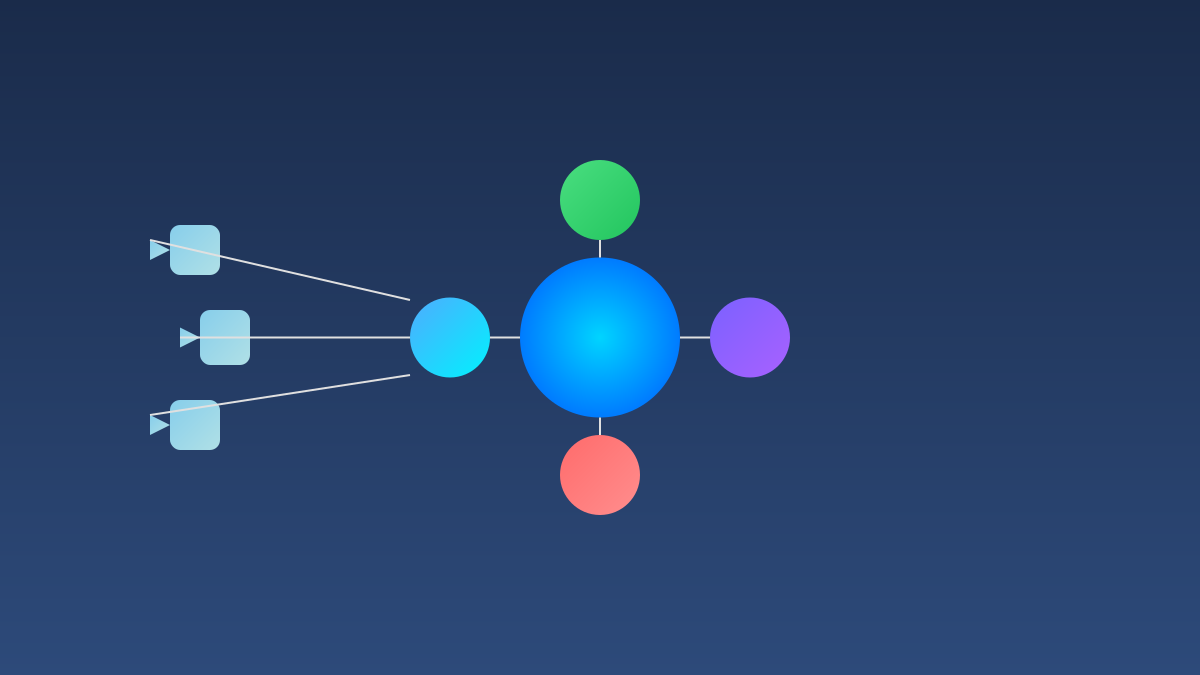
The system adopts a multi-agent architecture, with core modules including:

  1. Data Collection and Preprocessing Agent: Collects feedback from multiple channels, cleans, deduplicates, and standardizes formats;
  2. Sentiment Analysis and Classification Agent: Uses LLM for deep semantic analysis of emotions (including subtle emotions) and automatically classifies them into predefined categories;
  3. Priority Ranking Agent: Calculates priority scores based on multiple dimensions such as customer value and problem severity;
  4. Routing and Distribution Agent: Routes feedback to appropriate teams/individuals based on content and priority.
4

Section 04

Technical Highlights: Application of Large Language Models and Agent Collaboration Mechanisms

Application of Large Language Models

  • Context understanding: Accurately grasp the implicit intent and background of feedback;
  • Multilingual processing: Supports cross-language feedback analysis;
  • Reasoning ability: Reasonably infers associations based on limited information;
  • Generation ability: Automatically generates summaries, reply suggestions, etc.

Agent Collaboration Mechanisms

  • Message bus: A unified channel for information exchange;
  • State sharing: Maintains global context to ensure consistency;
  • Conflict resolution: Negotiates to reach consensus;
  • Feedback loop: Processes results are fed back to optimize models.
5

Section 05

Evidence: Real-World Application Scenarios and Business Value

E-commerce Platforms

  • Response time to negative reviews reduced from 48 hours to 2 hours;
  • Product problem identification accuracy increased to 92%;
  • Early identification of potential public relations crises.

SaaS Enterprises

  • Early identification of customer churn risks (e.g., increased functional complaints, mentions of competitors);
  • Proactively care for customers, transforming passive service into active service.

Financial Services

  • Automatically identify feedback on compliance issues;
  • Classify and mark according to regulatory requirements to ensure timely processing;
  • Generate statistical data for compliance reports.
6

Section 06

Conclusion and Future Development Directions

Conclusion

The multi-agent AI feedback analysis system builds a collaborative agent ecosystem, representing the evolution direction of AI from 'tool' to 'colleague', which can work side by side with humans to solve complex problems.

Future Directions

  • Predictive analysis: Predict customer service peaks and product problem outbreaks;
  • Proactive communication: Generate personalized solutions to actively reach customers;
  • Cross-enterprise knowledge sharing: Share industry insights under privacy protection.
7

Section 07

Recommendation: Timing for Enterprises to Deploy Multi-Agent AI Systems

For enterprises that want to improve customer experience and optimize operational efficiency, now is the best time to explore and deploy multi-agent AI feedback analysis systems. They can use this system to unlock the value of customer feedback and drive business decisions.

