Zing Forum

Reading

AI-CQ-Pipeline: An Automated Code Quality Analysis and Repair Pipeline Based on Large Language Models

An automated pipeline system triggered by Pull Requests, integrating static analysis tools like Radon and Pylint with Large Language Models (LLMs) to enable automatic code quality detection and intelligent refactoring.

DevOps代码质量LLM自动化重构静态分析RadonPylintCI/CD
Published 2026-04-28 20:05Recent activity 2026-04-28 20:17Estimated read 5 min
AI-CQ-Pipeline: An Automated Code Quality Analysis and Repair Pipeline Based on Large Language Models
1

Section 01

[Introduction] AI-CQ-Pipeline: Core Introduction to the Automated Code Quality Analysis and Repair Pipeline

AI-CQ-Pipeline is an automated pipeline system triggered by Pull Requests. It integrates static analysis tools such as Radon and Pylint with Large Language Models (LLMs) to achieve automatic code quality detection and intelligent refactoring. Its core design concept is to automatically complete quality checks, intelligent refactoring, and verification before code merging without manual intervention, significantly improving code review efficiency and consistency, and facilitating intelligent code quality management in DevOps scenarios.


2

Section 02

Background and Motivation

In modern software development, maintaining code quality is time-consuming and easily affected by human factors. As project scales grow, manual reviews struggle to cover all potential issues; while traditional static analysis tools can identify problems, they cannot automatically provide repair solutions. The AI-CQ-Pipeline project aims to address this pain point by combining LLM capabilities with mature code quality tools to build a fully automated code quality analysis and repair pipeline.

3

Section 03

Technical Architecture and Workflow

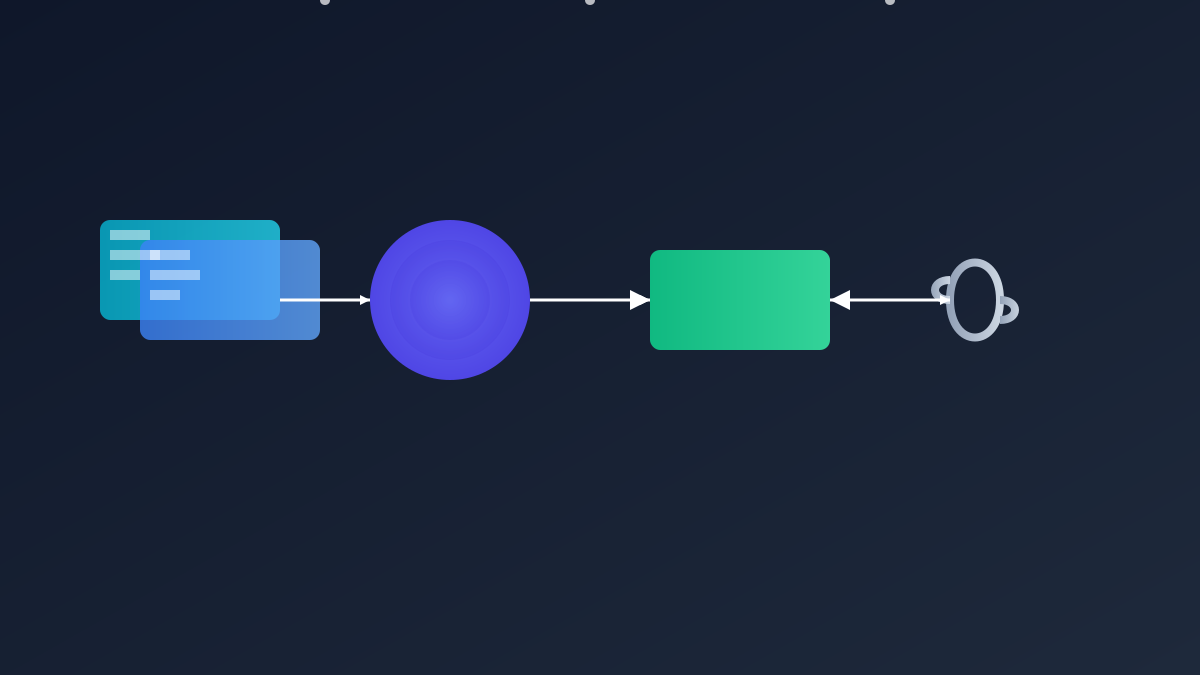
The pipeline workflow consists of three stages:

  1. Change Detection and Static Analysis: When a PR is submitted, identify changed Python functions, call Radon to calculate cyclomatic complexity and maintainability index, and use Pylint to detect code smells, providing quantitative basis for LLM intervention;
  2. Intelligent Refactoring and Code Generation: For functions exceeding quality thresholds, the LLM understands the code logic and generates a structurally optimized version;
  3. Automated Validation and Reporting: Push the refactored code to the autofix/pr-{number} branch, trigger pytest verification, generate an HTML report comparing metrics before and after repair (valid for 7 days), and share it via PR comments.
4

Section 04

Flexible Configuration Capabilities

The project supports team-customized configurations: LLM providers, quality threshold settings, and prompt strategies can all be adjusted in pipeline/fargate/src/llm_handler. Teams can customize system sensitivity and repair styles according to their own technology stacks and code specifications.

5

Section 05

Deployment and Integration Requirements

The project is developed based on Python 3.13, and deployment depends on an AWS account, GitHub repository, and Ansible 2.12. Installation simplifies local development through virtual environments and pre-commit hooks; infrastructure configuration (AWS resources, Docker images, GitHub keys) is automated via Ansible.

6

Section 06

Practical Significance and Future Outlook

AI-CQ-Pipeline automates repetitive quality maintenance work, allowing engineers to focus on creative tasks rather than replacing developers. As LLM capabilities improve, such intelligent pipelines are expected to be implemented in more programming languages and scenarios, becoming a standard component of modern DevOps toolchains.

