Zing Forum

Reading

Quantitative Research on Error Propagation in Multi-step AI Agent Workflows

An experimental framework for systematically studying error propagation patterns in multi-step AI agent workflows, which analyzes the error accumulation and recovery capabilities of different large language models across search, filtering, summarization, writing, and verification stages by injecting controlled errors.

AI智能体错误传播大语言模型多步骤工作流智能体可靠性错误注入LLM评估自动化工作流
Published 2026-04-15 02:44Recent activity 2026-04-15 02:47Estimated read 6 min
Quantitative Research on Error Propagation in Multi-step AI Agent Workflows
1

Section 01

Guide to Quantitative Research on Error Propagation in Multi-step AI Agents

This study focuses on the error propagation phenomenon in multi-step AI agent workflows. By injecting controlled errors via the open-source framework error-propagation-agents, it systematically analyzes the error accumulation and recovery capabilities of different large language models across search, filtering, summarization, writing, and verification stages, providing data support for building more robust agent architectures.


2

Section 02

Research Background and Motivation

With the increasing application of Large Language Models (LLMs) in automated workflows, multi-step AI agent systems have become the mainstream solution for complex tasks. However, the issue of how errors from early steps affect subsequent accuracy has long been overlooked. The error propagation phenomenon is directly related to the reliability and practicality of agent systems; understanding and quantifying its mechanism is of great guiding significance for designing robust architectures.

3

Section 03

Project Overview and Workflow Design

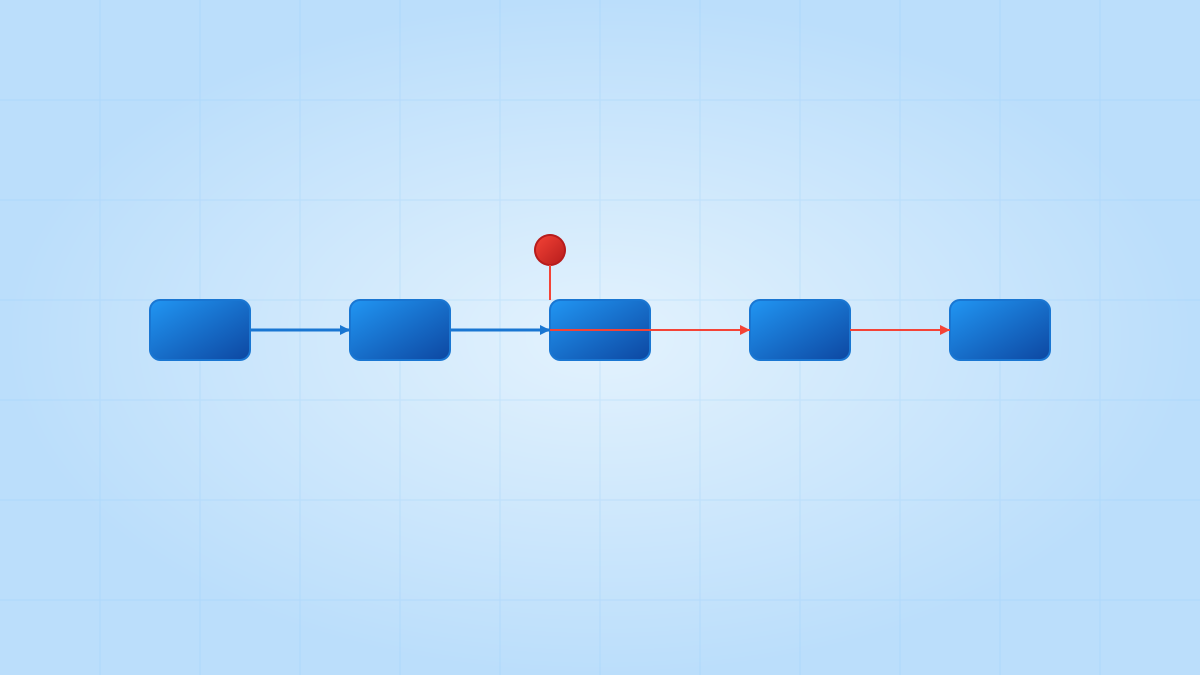
error-propagation-agents is an open-source framework for quantifying error propagation dynamics in multi-step agent workflows. It supports parallel testing of multiple mainstream LLMs (open-source models like Llama-3.1-8B, Qwen-2.5-7B; API models like GPT-4o-mini, Claude-Haiku). A five-stage workflow is defined: Search → Filter → Summarize → Write → Verify, simulating real-world agent task patterns.

4

Section 04

Experimental Methods and Quantitative Analysis Framework

The core strategy is systematic error injection (factual, logical, semantic errors). The vulnerability index is calculated by comparing differences between baseline and error-injected scenarios. Three mathematical models are used to fit error propagation curves (exponential decay, linear decay, constant model), and the best-fitting model is identified via RMSE. Key metrics include failure rate, degradation coefficient, and critical step identification. The framework automatically generates visualizations such as error propagation curves and heatmaps.

5

Section 05

Experimental Findings and Insights

Significant model differences: Open-source models exhibit strong robustness in specific steps but have scattered patterns; API models have more consistent error recovery characteristics but may fail in some steps; the relationship between model size and recovery capability is non-linear. Step vulnerability distribution: Errors in early steps (search, filtering) have an amplification effect; middle steps show diverse patterns; the verification step serves as the final defense line.

6

Section 06

Practical Application Value and Technical Implementation

Application value: Guides agent architecture optimization (strengthening critical steps, model selection, error budget allocation) and helps enterprises establish quality assurance systems (automatic checks, error prediction, dynamic rollback). Technical details: Modular architecture (experiment.py, analysis.py, etc.), supporting extensions (adding new models, custom steps, batch experiments).

7

Section 07

Future Directions and Conclusion

Future research directions: Cross-task generalization verification, optimization of intervention strategies, and transformation into real-time monitoring systems. Conclusion: This framework provides an important tool for understanding agent reliability, offers scientific guidance for developers to identify vulnerabilities and optimize systems, and serves as a necessary foundation for building trustworthy AI systems.

