Zing Forum

Reading

Multi-Tenant Agent Workflow Platform: Enterprise-Grade AI Automation Architecture

This article introduces an open-source multi-tenant agent workflow platform project, analyzing its multi-tenant architecture design, agent orchestration capabilities, and core features of enterprise-grade AI automation solutions.

multi-tenantagentic workflowAI automationenterprise AIworkflow orchestrationLLM platform
Published 2026-04-14 22:15Recent activity 2026-04-14 22:25Estimated read 8 min
Multi-Tenant Agent Workflow Platform: Enterprise-Grade AI Automation Architecture
1

Section 01

Introduction to Multi-Tenant Agent Workflow Platform: Enterprise-Grade AI Automation Architecture

Introduction to Multi-Tenant Agent Workflow Platform: Enterprise-Grade AI Automation Architecture

This open-source project focuses on enterprise-grade AI automation, addressing three core challenges: multi-tenant isolation, agent workflow orchestration, and large-scale operation. The platform covers architecture design, enterprise-level features, application scenarios, deployment modes, and best practices, serving as key infrastructure connecting LLM capabilities to business scenarios.


2

Section 02

Era Background of Agent Workflow

Era Background of Agent Workflow

With the rapid advancement of large language model capabilities, AI agents are moving from concept to production environments. Agent workflow platforms have become key infrastructure linking model capabilities to business scenarios. This project aims to solve core challenges in enterprise-level deployment: multi-tenant isolation, workflow orchestration, and large-scale operation.

3

Section 03

Definition and Core Isolation Points of Multi-Tenant Agent Platform

Definition and Core Isolation Points of Multi-Tenant Agent Platform

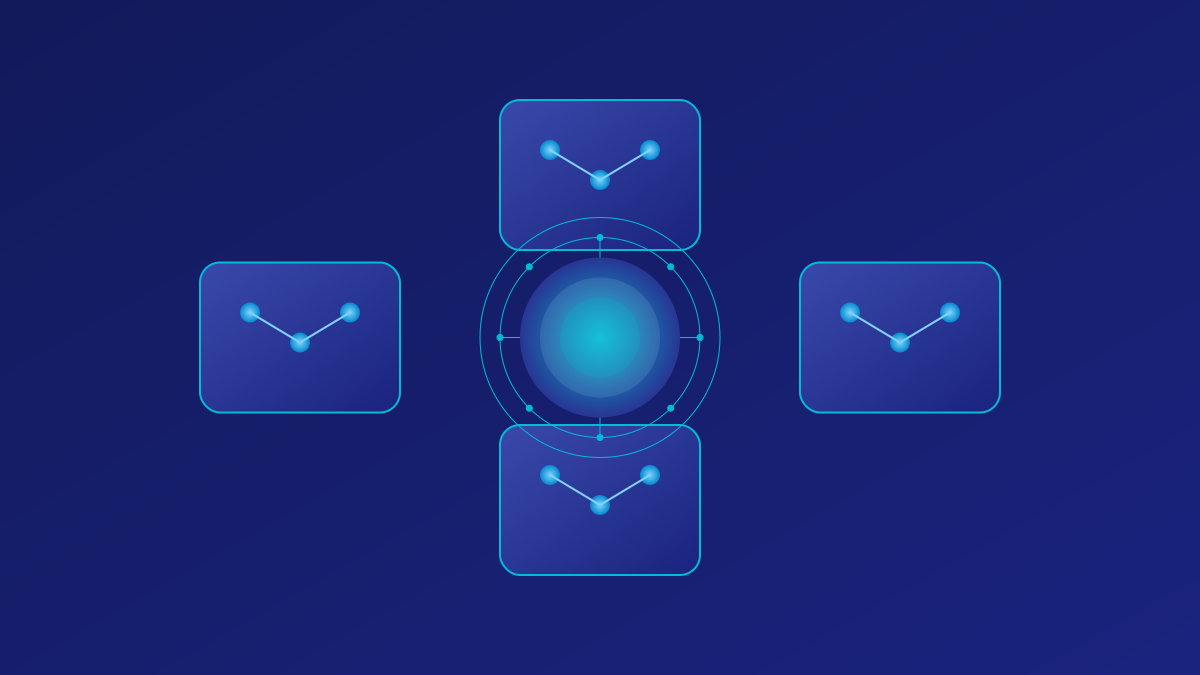
A multi-tenant architecture allows a single platform instance to serve multiple organizations or teams while ensuring data isolation, resource quotas, and customized configurations. In AI agent scenarios, core isolation points include:

  • Independent agent configurations and knowledge bases for different tenants
  • Model call quotas isolated by tenant for billing
  • Mutually isolated workflow definitions and execution environments
  • Permission systems supporting cross-tenant collaboration and management
4

Section 04

Detailed Explanation of Platform Architecture Design

Detailed Explanation of Platform Architecture Design

The platform architecture consists of four core layers:

1. Tenant Isolation Layer

Based on a multi-tenant data model of organization, workspace, user, and role, row-level security is implemented via tenant ID to ensure automatic filtering of tenant scope during data queries.

2. Agent Engine

Provides declarative agent definition (YAML/JSON), tool registration (custom tools, API integration), memory management (short-term dialogue + long-term knowledge base), and multi-model routing (matching optimal models for task types).

3. Workflow Orchestration

Supports complex collaboration modes: sequential execution, parallel branching, conditional routing, loop iteration, and human intervention.

4. Execution Engine

Ensures reliable task scheduling: asynchronous queues, state machine tracking, retry mechanisms, and timeout control.

5

Section 05

Enterprise-Grade Core Features

Enterprise-Grade Core Features

Security and Compliance

  • TLS for transport layer + static data encryption
  • Complete audit logs and change tracking
  • PII data detection and desensitization
  • Support for compliance frameworks like SOC2 and GDPR

Observability

  • Real-time monitoring of workflow status, latency, and success rate
  • Token consumption statistics by tenant/workflow
  • Agent call link tracing
  • Anomaly detection and alert mechanisms

Extensibility

  • Plugin system (custom tools, data sources, model adapters)
  • RESTful API and Webhook support
  • Event-driven integration with external systems
  • Version management for workflows and agents
6

Section 06

Application Scenarios and Deployment Modes

Application Scenarios and Deployment Modes

Application Scenarios

  1. Customer Service Automation: Problem classification → knowledge base retrieval → auto-reply/human transfer → satisfaction collection
  2. Content Generation Pipeline: Topic research → outline generation → multi-version creation → SEO optimization and publishing
  3. Data Analysis Assistant: NL2SQL query → data visualization → report generation → anomaly alert

Deployment Modes

  • SaaS Mode: Multi-tenant shared instance, pay-as-you-go billing
  • Private Deployment: Single-tenant exclusive, full data autonomy
  • Hybrid Mode: Shared core platform, isolated execution environments
7

Section 07

Challenges and Best Practices

Challenges and Best Practices

Multi-Tenant Performance Isolation

Challenge: Resource consumption by one tenant affects others. Solution: Request rate limiting, resource quota scheduling, model call pooling and caching.

Agent Reliability

Challenge: Uncertainty and hallucination in LLM outputs. Solution: Output validation and structured constraints, multi-model voting, reasonable configuration of human review nodes.

Cost Control

Challenge: Rapid growth of LLM call costs. Solution: Intelligent cache reuse, model routing (small models for simple tasks), budget alerts and automatic throttling.

8

Section 08

Summary and Outlook

Summary and Outlook

The multi-tenant agent workflow platform is a key step for AI applications to move from experimentation to production. It not only solves technical orchestration and scheduling issues but also provides isolation, security, and observability guarantees required for enterprise operations. As agent applications become widespread, such platforms will become standard components of enterprise AI infrastructure.
