Zing Forum

Reading

AI Agents Workflows: Practice of Intelligent Agent Workflows for Automated Task Execution

An in-depth analysis of Zachary Levesque's open-source AI Agents Workflows project, exploring how modularly designed intelligent agents enable automated execution of diverse tasks, and the practical value of this architecture in improving work efficiency and reducing manual intervention.

AI Agent智能代理工作流自动化任务自动化LLM应用模块化架构工作流编排GitHub开源自动化工具多代理系统
Published 2026-05-04 01:45Recent activity 2026-05-04 01:54Estimated read 6 min
AI Agents Workflows: Practice of Intelligent Agent Workflows for Automated Task Execution
1

Section 01

Introduction: Core Value and Practical Significance of the AI Agents Workflows Project

This article provides an in-depth analysis of Zachary Levesque's open-source AI Agents Workflows project, exploring how its modular intelligent agent architecture enables automated execution of diverse tasks, and the practical value of this architecture in improving efficiency and reducing manual intervention. Through specialized agent division of labor and flexible workflow orchestration, the project offers an intelligent automation solution for complex business scenarios, serving as a typical practice of AI Agent technology in the workflow domain.


2

Section 02

Project Background and Motivation: Pain Points of Traditional Automation and Exploration of New Paradigms

Traditional automation requires writing dedicated scripts for each task, which has problems such as low reusability, high maintenance costs, and poor adaptability. With the improvement of LLM capabilities, a new paradigm where AI agents independently plan steps and dynamically call tools has emerged. The AI Agents Workflows project aims to explore the feasibility of this paradigm, with the goal of providing AI agents and workflows that can automate various tasks and solve the pain points in the current automation field.

3

Section 03

Core Architecture: Modular Agent Design and Flexible Workflow Orchestration

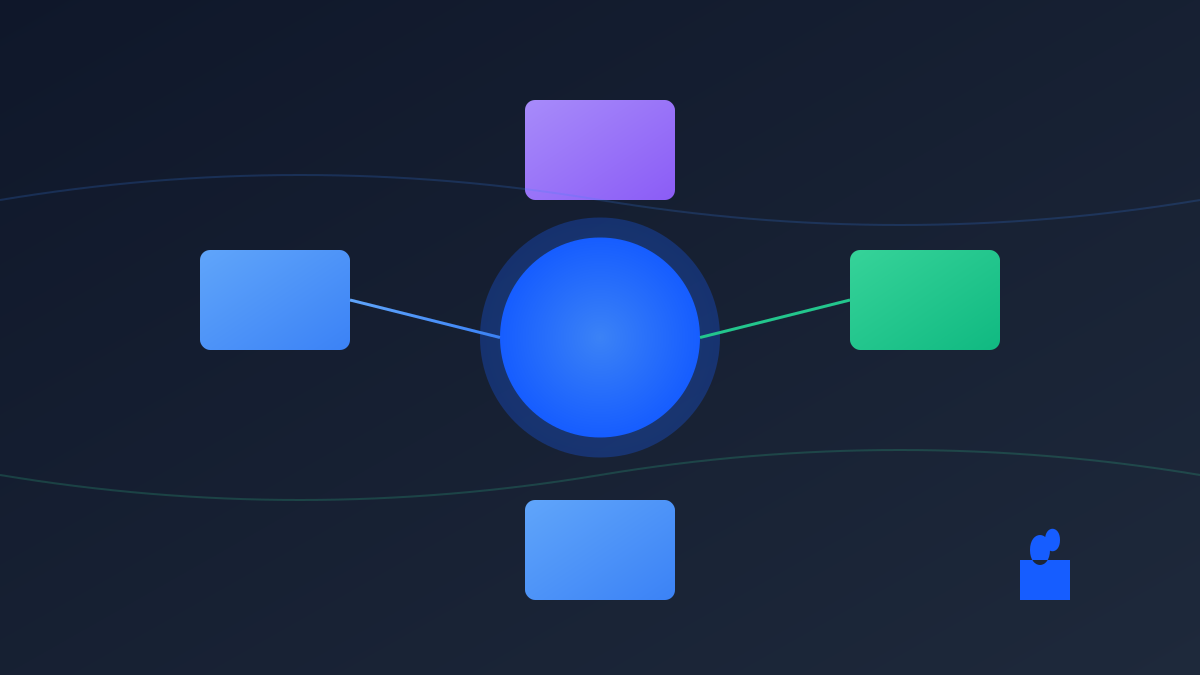
The project adopts a modular agent architecture:

  • Agent Roles: Specialized division of labor such as data acquisition, analysis and processing, decision-making, and execution, avoiding the trap of a one-size-fits-all agent, and improving execution quality and maintainability;
  • Workflow Orchestration: Supports modes like sequential execution, parallel branching, conditional routing, and loop iteration, adapting to automation needs of different complexities and coordinating agent collaboration.
4

Section 04

Key Considerations for Technical Implementation: Ensuring System Reliability and Efficiency

Building a reliable system requires considering:

  1. State Management: Records execution status, intermediate results, and context, supporting fault recovery and resumption from breakpoints;
  2. Error Handling: Defines strategies for automatic retries, degradation, and manual intervention to improve availability in production environments;
  3. Tool Calling: Provides a framework for securely calling external resources such as APIs and databases, expanding the scope of automation;
  4. Observability: Facilitates fault diagnosis and maintenance through logs, trajectory visualization, and debugging interfaces.
5

Section 05

Application Scenarios and Value: Multi-Domain Automation Practices

The project demonstrates value across multiple domains:

  • Data Processing: Automates sales data collection, analysis, report generation, and distribution;
  • Customer Service: Classifies work orders, retrieves knowledge bases, generates solutions, and optimizes resource allocation;
  • Content Creation: Automates the entire process from topic selection, outline creation, writing, image generation to multi-platform publishing;
  • Software Development: Automates repetitive tasks such as code review, document generation, and test case creation.
6

Section 06

Challenges and Limitations: Practical Issues of AI Agent Workflows

Practical applications face challenges:

  • Reliability: Probabilistic output of LLMs leads to uncertain behavior, requiring step verification or manual confirmation and supplementation;
  • Cost: Multiple LLM calls increase operational costs, requiring a balance between intelligence and economy;
  • Security: Agent tool calling permissions pose risks, requiring strict permission models and input validation.
7

Section 07

Future Directions and Conclusion: The Evolution Path of Intelligent Automation

Future development directions include: multi-modal capability expansion, collaborative agent networks, adaptive learning optimization, and standardized interoperability. Conclusion: This project provides a new construction idea for AI automation, transforming LLM capabilities into reliable systems, which is worthy of developers' attention. With technological evolution, such projects will play a value in more scenarios.