Zing Forum

Reading

Multi-Agent AI System for Bank Customer Service: Application Practice of Agentic AI in Financial Services

This article introduces a graduation project from Purdue University's Applied Generative AI Certificate Program—a multi-agent AI system for bank customer service scenarios. The project demonstrates how to provide an immediate, efficient, and manageable intelligent response solution for bank customer service through multi-agent workflows and human-machine collaboration mechanisms.

Agentic AI多智能体银行客服人机协作金融服务智能客服大语言模型工作流编排
Published 2026-05-23 05:24Recent activity 2026-05-23 05:28Estimated read 9 min
Multi-Agent AI System for Bank Customer Service: Application Practice of Agentic AI in Financial Services
1

Section 01

[Introduction] Multi-Agent AI System for Bank Customer Service: Core Practice of Agentic AI in Financial Services

This article introduces the graduation project of Purdue University's Applied Generative AI Certificate Program—a multi-agent AI system for bank customer service scenarios. Through multi-agent collaborative workflows and human-machine collaboration mechanisms, the system addresses the issues of high cost and insufficient consistency in traditional customer service, while meeting the compliance requirements of the banking industry, achieving immediate and efficient intelligent responses, and providing practical references for AI transformation in financial services.


2

Section 02

Project Background: Why Choose the Bank Customer Service Scenario?

This project is Stephanie Wong's Agentic AI Capstone graduation project completed in 2026 for Purdue University's Online Applied Generative AI Certificate Program. The bank customer service scenario was chosen because of its strict requirements for accuracy, compliance, and response speed, which can fully verify the advantages of the multi-agent architecture in complex business scenarios.

3

Section 03

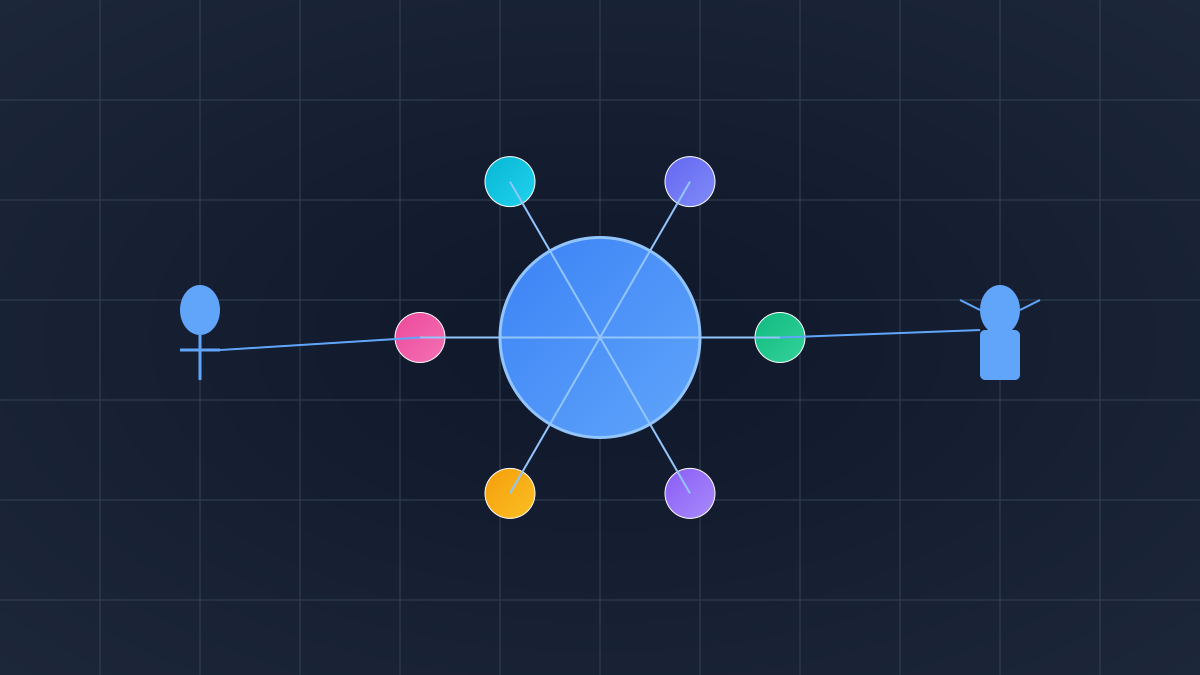
System Architecture and Role Division of Agents

System Architecture Design

  • Full-stack UX/Product Design: Balances technical implementation and user experience (for both customers and customer service staff), optimizes interfaces, interaction processes, and information architecture.
  • Multi-agent Collaborative Architecture: Configures multiple specialized agents to collaborate, improving accuracy and the ability to handle complex requests.
  • Human-Machine Collaboration Mechanism: Introduces human review for key decisions, high-risk operations, or when agents have insufficient confidence, balancing efficiency and compliance.

Agent Roles

  • Intent Recognition Agent: Understands customer needs, identifies service types, and routes requests.
  • Account Service Agent: Handles account queries and operations (e.g., balance checks, transfers), integrates with core banking systems to ensure security and compliance.
  • Product Consultation Agent: Provides product introductions (e.g., savings, loans) and personalized recommendations.
  • Complaint Handling Agent: Calms emotions, records issues, provides solutions, or escalates.
  • Compliance Review Agent: Monitors outputs of other agents in the background to ensure compliance with bank regulations.
4

Section 04

Multi-agent Workflow and Human-Machine Collaboration Mechanism

Multi-agent Workflow

  1. Request Routing: The intent recognition agent routes requests to the corresponding specialized agent; for complex requests, it coordinates collaboration among multiple agents.
  2. Information Collection: Collects necessary information through multi-turn dialogues and maintains dialogue status to ensure completeness.
  3. Service Execution: Performs operations (e.g., transfers), with manual confirmation for key steps, and provides real-time feedback on results.
  4. Escalation Handling: When agents cannot handle a request, it involves high risk, or the customer requests a human, it transfers to an agent and passes the complete context.

Human-Machine Collaboration Design

  • Trigger Conditions for Manual Review: Large-value transactions, sensitive information modifications, complaint escalations, low agent confidence, etc.
  • Context Transfer: Provides dialogue history, customer information, operation records, etc., when transferring to a human agent to help them take over quickly.
  • Collaboration Interface: Provides AI suggestions, confidence scores, and risk prompts for customer service staff, supporting adoption, modification, or manual handling.
5

Section 05

Key Technical Implementation Points and Application Value

Key Technical Implementation Points

  • Large Language Model Selection: Considers performance, cost, latency, and security, adopting a hybrid model of cloud API and local deployment.
  • Bank System Integration: Integrates with core systems, CRM, and knowledge bases through standard interfaces to ensure real-time data access and security control.
  • Dialogue State Management: Maintains multi-turn dialogue status to ensure coherence and information integrity.
  • Security and Compliance: Implements identity verification, permission control, operation auditing, and data encryption to meet banking regulatory requirements.

Application Value

  • 24/7 Service: Handles common requests around the clock, improving availability.
  • Immediate Response: Responds to customers in seconds, reducing waiting time.
  • Service Consistency: Unifies processes and knowledge bases, avoiding subjective differences in manual services.
  • Cost Optimization: AI handles routine requests, allowing humans to focus on complex high-value scenarios.
  • Human Empowerment: Provides information support and suggestions for customer service staff, enhancing service professionalism.
6

Section 06

Project Outcomes, Insights, and Future Development Directions

Project Outcomes and Insights

  • Academic Value: Verifies the feasibility of the multi-agent architecture in complex business scenarios, providing practical cases for related research.
  • Industry Insights: Demonstrates how multi-agent systems can improve efficiency under compliance constraints, offering references for bank digital transformation.
  • Technical Demonstration: Open-sources the complete technology stack, helping developers learn agent design, workflow orchestration, and other technologies.

Future Directions

  • Emotional Intelligence Enhancement: Improves emotion understanding ability and adjusts communication strategies.
  • Personalized Services: Provides customized recommendations and solutions based on customer data.
  • Predictive Services: Proactively identifies needs (e.g., account anomaly alerts).
  • Multi-language Support: Expands native language services to support international business.

