Zing Forum

Reading

AI Programming Resource Treasure Trove: Curated Collection of Custom Agents, Workflows, and Plugins

This project compiles useful resources accumulated by the author in their work, including custom agents, instructions, skills, hooks, workflows, and plugins, providing a one-stop reference for AI-assisted programming.

AI编程自定义Agent提示词工程开发工具代码生成工作流自动化插件生态开发者资源
Published 2026-06-03 16:15Recent activity 2026-06-03 16:23Estimated read 5 min
AI Programming Resource Treasure Trove: Curated Collection of Custom Agents, Workflows, and Plugins
1

Section 01

AI Programming Resource Treasure Trove: Guide to the One-Stop Curated Collection of Custom Agents and Workflows

This project is maintained by LEON-sci on GitHub with the original title 'AI-coding-resource-collection'. It aims to address the fragmentation issue of AI-assisted programming tools, compiling resources such as custom agents, instructions, skills, hooks, workflows, and plugins that the author has verified in their work, providing a one-stop reference for AI-assisted programming.


2

Section 02

Background: The Fragmentation Dilemma of AI-Assisted Programming Tools

With the widespread application of large language models in the code domain, AI-assisted programming tools have proliferated. However, the fragmentation of the tool ecosystem (different prompt formats, instruction syntaxes, plugin systems) leads to high switching costs for developers; excellent community practices are scattered, making systematic acquisition difficult. This project, as a curated collection, was created to address this challenge.

3

Section 03

Project Content: Categorized AI Programming Resource Types

The repository is categorized by type and scenario, including:

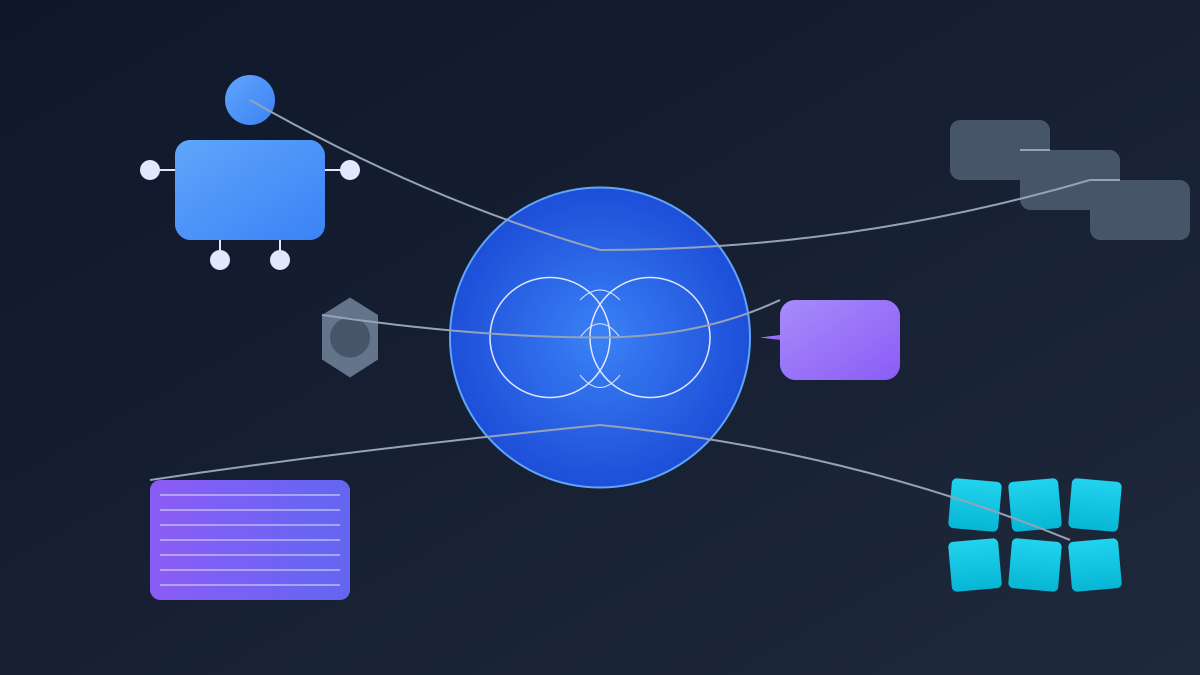
  • Custom Agents: Configurations optimized for specific tasks/tech stacks (e.g., front-end, database design agents);
  • Instruction Sets: Prompt templates for scenarios like code generation and explanation;
  • Skills: Reusable functional modules (e.g., Function Calling formats);
  • Hooks: Event-triggered automation scripts (e.g., AI review before code submission);
  • Workflows: Multi-step AI-assisted process definitions;
  • Plugins: IDE/editor extensions.
4

Section 04

Resource Value: Four Core Usage Scenarios

  1. Quick Task Initiation: Use predefined agents/instructions to quickly handle unfamiliar tasks;
  2. Standardized Team Practices: Unify instructions/agents to ensure output consistency;
  3. Automate Repetitive Work: Automate tasks like CRUD and unit testing via hooks/workflows;
  4. Learning & Experimentation: Study prompt/agent design to improve AI interaction skills.
5

Section 05

Technical Compatibility: Multi-Platform Support for Mainstream Tools

The resources are compatible with mainstream AI programming tool ecosystems, including:

  • OpenAI/ChatGPT (custom instructions, GPTs configurations);
  • Claude (Projects, Artifacts instructions);
  • Cursor (Composer, Chat prompts);
  • GitHub Copilot (Chat instruction tips);
  • Open-source solutions (Local LLM, Ollama configurations).
6

Section 06

Community Contribution: Quality and Evolution Model of the Curated Collection

The project adopts a curated model; each resource is screened and tested by the author to ensure quality. The update frequency depends on the author's actual needs. The community can fork and customize it, learning its organization and sharing model.

7

Section 07

Limitations & Notes: Key Points to Consider When Using Resources

  1. Model version updates may affect prompt effectiveness;
  2. Tool ecosystem evolution requires synchronous configuration updates;
  3. Understand the principles of the resources to avoid blind use in sensitive/critical scenarios.
8

Section 08

Conclusion: Future Directions for AI Programming Knowledge Management

This project represents the transition of AI programming from exploration to systematic knowledge management. It is recommended that developers build personal resource libraries to accumulate knowledge assets. In the future, there will be more curated collections and standardization efforts to promote AI-assisted programming as a universal skill.

