Zing Forum

Reading

Privacy-Preserving Multimodal AI Training: Interpretation of the AFSPL Adaptive Federated Soft Prompt Learning Framework

This article introduces a cutting-edge research project integrating the CLIP visual encoder, Flan-T5 text decoder, and federated learning, demonstrating how to achieve efficient fine-tuning of large-scale multimodal models while protecting data privacy.

联邦学习软提示学习多模态模型CLIPFlan-T5隐私保护Flower框架参数高效微调分布式训练
Published 2026-04-25 03:39Recent activity 2026-04-25 03:50Estimated read 7 min
Privacy-Preserving Multimodal AI Training: Interpretation of the AFSPL Adaptive Federated Soft Prompt Learning Framework
1

Section 01

[Introduction] AFSPL Adaptive Federated Soft Prompt Learning Framework: A New Paradigm for Privacy-Preserving Multimodal AI Training

This article introduces the AFSPL (Adaptive Federated Soft Prompt Learning) framework, which integrates federated learning, soft prompt learning, and multimodal models (CLIP visual encoder + Flan-T5 text decoder) to achieve efficient fine-tuning of large-scale multimodal models while protecting data privacy. Its core innovation lies in the adaptive soft prompt mechanism combined with the Flower federated learning framework, solving the problems of scattered data in sensitive fields and high fine-tuning costs of large models, and providing a new paradigm for privacy-preserving multimodal AI training.


2

Section 02

Research Background and Core Challenges

Multimodal large models (such as CLIP and Flan-T5) require massive data, but data in sensitive fields (medical, finance, etc.) is scattered and cannot be centrally trained due to privacy regulations, leading to the emergence of federated learning. Meanwhile, full-parameter fine-tuning of large models is extremely costly, and soft prompt learning—an efficient parameter fine-tuning method—can reduce overhead. AFSPL combines these three to resolve the conflict between privacy protection and efficient training.

3

Section 03

Technical Architecture and Core Components

The AFSPL architecture consists of three core components:

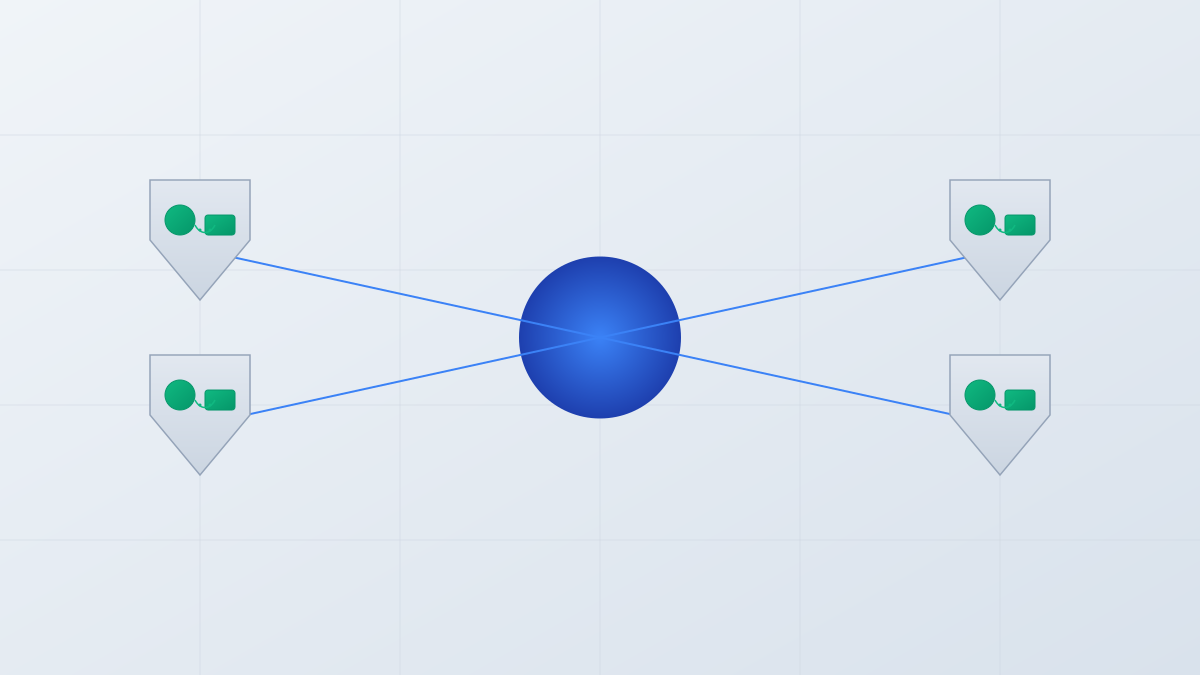
  1. Federated Learning Infrastructure: Based on the Flower framework, supports algorithms like FedAvg, and allows flexible configuration of client selection and aggregation rules;
  2. Multimodal Model Core: Integrates CLIP (visual encoding) and Flan-T5 (text decoding) to handle tasks such as image caption generation and visual question answering;
  3. Adaptive Soft Prompt Mechanism: Dynamic fusion strategy + adaptive Top-K token selection, adjusting soft prompts according to input characteristics to adapt to data distribution differences across multiple clients.
4

Section 04

Training Process and Optimization Strategy

Training follows the federated paradigm: The server distributes global soft prompts → clients perform local training to update soft prompts → clients return updated soft prompts → the server aggregates (e.g., FedAvg) to form new global soft prompts. Advantages: Soft prompts have a small parameter size, ensuring high communication efficiency; original data is retained locally to guarantee privacy. A total of 30 training rounds are planned, with 20 rounds completed so far. Evaluation metrics include CIDEr (consistency) and BLEU-4 (n-gram accuracy).

5

Section 05

Technical Details of the Adaptive Mechanism

The adaptive soft prompt mechanism includes two major innovations:

  1. Dynamic Fusion Strategy: Dynamically adjusts the fusion weights of soft prompts based on input visual/text features to adapt to differences in modal dependencies of different samples;
  2. Adaptive Top-K Token Selection: Selects the most relevant K combinations from candidate prompt vectors, using sparse activation to improve expressive power while controlling computational overhead.
6

Section 06

Application Scenarios and Potential Value

AFSPL has application prospects in multiple fields:

  • Medical: Multi-hospital collaborative training of medical image-report generation models without sharing patient data;
  • Autonomous driving: Federated training of visual-language navigation models to improve generalization ability;
  • Finance: Collaborative training of multimodal financial analysis models combining news, charts, and transaction data;
  • Academia: Provides a benchmark implementation for federated multimodal learning, and is open-source to facilitate expansion and improvement.
7

Section 07

Technical Insights and Future Outlook

AFSPL solves the tripartite trade-off between privacy protection, computational efficiency, and model performance. The combination of "federated + efficient fine-tuning + multimodal" will become an important paradigm for future AI applications. Future directions: Explore attention-based dynamic prompt selection, fairness and convergence of heterogeneous clients, expansion to more modalities (audio/video), and lightweight soft prompts adapted to edge devices. Open-source implementation accelerates the deployment of the technology.

