Zing Forum

Reading

Multi-Agent Autonomous Work Assistant: How AI Agents Reshape Modern Office Work

The multi-agent work assistant system developed by aishanee-sinha deeply integrates office tools like Slack, Jira, and email through autonomous AI agents, automating daily tasks such as meeting scheduling, document summarization, and task organization, while proactively identifying and resolving productivity bottlenecks.

多智能体AI代理办公自动化Slack集成Jira集成生产力工具工作流优化智能助手
Published 2026-04-13 06:15Recent activity 2026-04-13 06:23Estimated read 9 min
Multi-Agent Autonomous Work Assistant: How AI Agents Reshape Modern Office Work
1

Section 01

[Introduction] Multi-Agent Autonomous Work Assistant: Core Value of AI Agents Reshaping Modern Office Work

The multi-agent autonomous work assistant system developed by aishanee-sinha deeply integrates office tools like Slack, Jira, and email, automating daily tasks such as meeting scheduling, document summarization, and task organization, while proactively identifying and resolving productivity bottlenecks. This system transforms AI from a passive tool into an autonomous "digital colleague", freeing knowledge workers to focus on core value creation and representing a new paradigm of human-AI collaboration.


2

Section 02

Background: Efficiency Dilemma of Knowledge Workers

Efficiency Dilemma of Knowledge Workers

The modern office environment faces an efficiency paradox: while productivity tools (email, instant messaging, project management, etc.) are increasing, knowledge workers are overwhelmed by these tools. Studies show that the average employee spends hours daily on "meta-work" such as coordination, information organization, and schedule arrangement, severely squeezing core work time; fragmented tasks disrupt deep thinking, leading to cognitive load and professional burnout. The multi-agent system is designed to address this systemic issue.

3

Section 03

System Design: The "Digital Colleague" Concept of Multi-Agent Architecture

System Design Philosophy: From Tool to Colleague

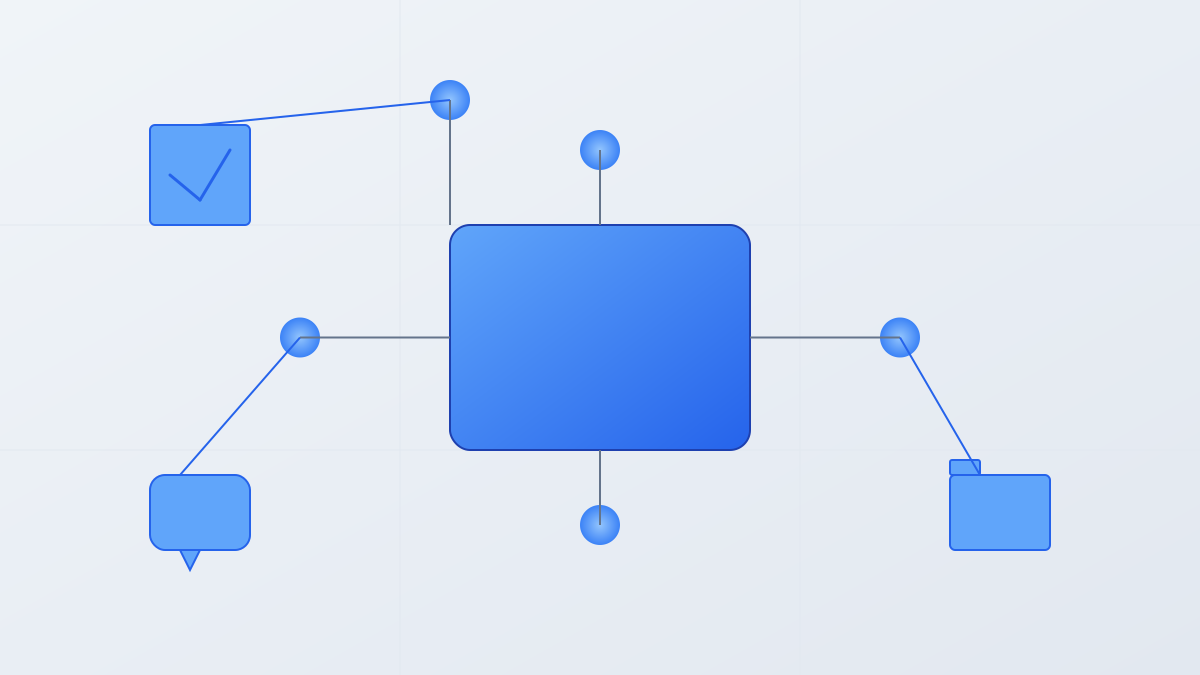
Traditional office software passively waits for instructions, but this system adopts a multi-agent architecture: it decomposes work into specialized agents for schedule management, document processing, task coordination, etc. Each agent focuses on a specific domain and collaborates to complete complex processes, drawing on the division of labor principles in human organizations to balance specialization and flexible combination, turning AI into an autonomous "digital colleague".

4

Section 04

Deep Integration: Breaking Information Silos of Office Tools

Deep Integration: Building a Unified Work View

The system deeply integrates mainstream office platforms via APIs, achieving semantic-level understanding rather than simple data synchronization:

  • Slack Integration: Reads channel messages, identifies follow-up items, creates task reminders, and automatically replies to common questions;
  • Jira Integration: Converts bugs mentioned in Slack into work orders, tracks progress, sends deadline reminders, and generates sprint reports;
  • Email/Calendar Integration: Filters important emails and summarizes them, processes meeting invitations, analyzes time preferences, and coordinates free time slots.
5

Section 05

Autonomous Capabilities and Document Intelligence: A Breakthrough from Response to Prediction

Autonomous Capabilities: Proactive Action and Adaptive Learning

The system has revolutionary autonomous capabilities:

  • Proactive task identification: Extracts follow-up items from communications (e.g., automatically creates a task when an email mentions "submit the report by next week");
  • Bottleneck prediction: Analyzes historical data to identify project delay risks;
  • Adaptive learning: Observes user habits to optimize scheduling strategies;
  • Conflict resolution: Proposes solutions for schedule conflicts or resource competition.

Document Intelligence Processing: From Information Overload to Knowledge Extraction

  • Intelligent summarization: Generates structured summaries of different granularities;
  • Information extraction: Extracts decision items and action items from unstructured documents and converts them into tasks;
  • Knowledge association: Recommends relevant documents;
  • Multilingual processing: Supports cross-language translation and summarization.
6

Section 06

Productivity Optimization and Privacy Trust: Balancing Efficiency and Security

Intelligent Identification and Resolution of Productivity Bottlenecks

The system proactively monitors work processes:

  • Process analysis: Identifies repetitive steps, unnecessary approvals, and reasons for rework;
  • Collaboration optimization: Discovers team friction points and bottlenecks;
  • Resource balancing: Recommends task allocation for overloaded members;
  • Time insight: Identifies "time black holes" (e.g., cancelable meetings).

Privacy and Trust: Boundaries of Digital Colleagues

  • Permission control: Fine-grained management of agent access to data and operations;
  • Transparent logs: Records all agent actions for user review;
  • Manual confirmation: Sensitive operations require manual approval;
  • Data security: Enterprise-level encryption, on-premises deployment options, and compliance with regulations like GDPR.
7

Section 07

Deployment Recommendations and Future Outlook: A New Paradigm of Human-AI Collaboration

Deployment and Adoption Strategy

  • Gradual introduction: Start with a single function (e.g., meeting scheduling) and expand gradually;
  • Personalized configuration: Adjust AI behavior style to match user preferences;
  • Feedback loop: Continuously improve based on user feedback;
  • Training support: Help users understand AI boundaries and collaboration methods.

Future Outlook

Multi-agent systems represent the evolution direction of human-AI collaboration: In the future, every knowledge worker will have an AI "digital colleague" to handle routine tasks, allowing humans to focus on creative and strategic work. As AI capabilities improve, closer collaboration (e.g., brainstorming, decision support) will be achieved, requiring the establishment of ethical frameworks and division of labor principles. This project provides a technical foundation for this vision and is worth the attention and trial of organizations.

