Zing Forum

Reading

AI Inference Gateway: Building Production-Grade Multi-Model Unified Scheduling Infrastructure

Introducing the ai-inference-gateway project, an open-source unified API gateway that supports multi-LLM provider routing, load balancing, caching, rate limiting, and observability to help enterprises build production-grade AI infrastructure.

AI网关LLM路由多模型管理负载均衡API网关生产环境OpenAIAnthropic开源项目
Published 2026-06-15 14:13Recent activity 2026-06-15 14:18Estimated read 6 min
AI Inference Gateway: Building Production-Grade Multi-Model Unified Scheduling Infrastructure
1

Section 01

AI Inference Gateway: Guide to Production-Grade Multi-Model Unified Scheduling Infrastructure

Core Insights

Introducing the open-source project ai-inference-gateway, a unified API gateway that supports multi-LLM provider routing, load balancing, caching, rate limiting, and observability to help enterprises build production-grade AI infrastructure.

Project Basic Information

2

Section 02

Project Background and Core Pain Points

Directly using LLM native APIs in production environments has the following issues:

  1. Inconsistent API Formats: Different providers (e.g., OpenAI, Anthropic) have large differences in API formats and authentication mechanisms, requiring separate integration code for each model;
  2. Lack of Unified Traffic Management: Cannot automatically switch from faulty/slow-response services;
  3. Difficult Cost Monitoring: Usage data is scattered across various consoles, making it hard to control costs uniformly.

This project addresses these pain points by providing a unified API interface layer to encapsulate multi-model resources.

3

Section 03

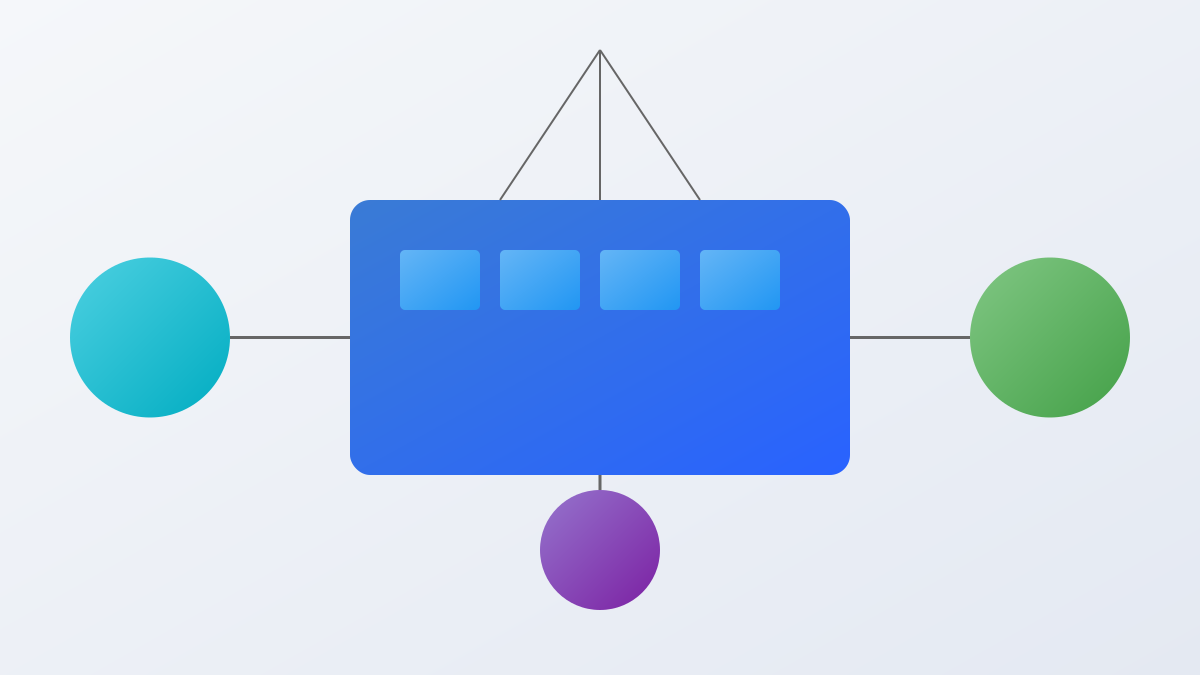
Core Features and Architecture Design

Core Feature Modules

  1. Multi-Provider Routing: Supports OpenAI, Anthropic, and local models (Ollama/vLLM), allowing model selection based on task characteristics;
  2. Intelligent Load Balancing: Distributes requests based on load, response time, and cost, with automatic failover;
  3. Multi-Level Caching Strategy: Uses semantic similarity matching to cache repeated queries, reducing call costs and waiting time;
  4. Granular Rate Limiting: Sets request count and token quotas per user/application, with unified rate limiting enforcement;
  5. Comprehensive Observability: Integrates logging, metric collection, and tracing functions to monitor latency, error rates, and cost distribution.

Design Principles: High Availability, Observability, Cost-Effectiveness.

4

Section 04

Deployment and Configuration Methods

Deployment Options

  • Small Teams: Quick startup with Docker containers;
  • Large-Scale Production: Kubernetes deployment configuration, supporting horizontal scaling and high availability.

Configuration Methods

Uses environment variables + configuration files to manage parameters (API keys, routing rules, caching/rate limiting policies), separating configuration from code for easy migration across multiple environments.

5

Section 05

Analysis of Practical Application Scenarios

Suitable for the following scenarios:

  1. Enterprise AI Platforms: Serves as a central access point to unify model permission and usage quota management;
  2. Multi-Model Strategy for AI Products: Dynamically selects models (e.g., GPT-4 for complex reasoning, local models for simple classification);
  3. Cost-Sensitive Applications: Reduces API call costs via caching + intelligent routing;
  4. Compliance Scenarios: Mixes cloud and local models to meet requirements like data non-outbound.
6

Section 06

Technical Implementation Highlights

  1. Modular Design: Separates core routing logic from provider adapters, making it easy to add new models;
  2. Test Coverage: Critical path test suites ensure production stability;
  3. CI/CD Support: Automated testing and deployment processes to facilitate rapid iteration.
7

Section 07

Summary and Future Outlook

ai-inference-gateway represents the evolutionary direction of AI infrastructure from direct model API usage to a unified management layer.

Value for production teams:

  • Solves multi-model management pain points;
  • Reserves space for expansion and optimization;
  • Helps build robust, cost-effective, and controllable AI service architectures, suitable for startups and large enterprises.



