Zing Forum

Reading

Multi-Agent AI Customer Service System: Design and Practice of an Enterprise-Grade Autonomous Task Execution Framework

An in-depth analysis of the multi-agent-customer-support-system project, exploring how to use LangGraph and LangChain to build production-ready multi-agent AI systems, enabling autonomous task orchestration, memory management, and tool calling.

multi-agentLangGraphLangChainRAGcustomer supportAI frameworkenterprise AI
Published 2026-05-17 06:14Recent activity 2026-05-17 06:22Estimated read 8 min
Multi-Agent AI Customer Service System: Design and Practice of an Enterprise-Grade Autonomous Task Execution Framework
1

Section 01

Introduction: Core Value and Technical Framework of Multi-Agent AI Customer Service Systems

With the enhancement of large language model capabilities, a single AI agent can hardly meet complex enterprise scenarios. This article provides an in-depth analysis of the open-source multi-agent-customer-support-system project, exploring how to use LangGraph and LangChain to build a production-ready multi-agent AI customer service system, enabling autonomous task orchestration, memory management, tool calling, and RAG integration to improve system flexibility and processing capabilities.


2

Section 02

Background: Evolution from Single-Agent to Multi-Agent Architecture

Traditional AI customer service systems use a single dialogue model to handle all requests, but they are inadequate when facing multi-step reasoning, cross-system operations, or complex decision-making scenarios. The multi-agent architecture decomposes complex tasks into specialized agents for collaborative completion, significantly improving system flexibility and processing capabilities.

3

Section 03

Technical Architecture and Core Methods

LangGraph-Powered State Machine

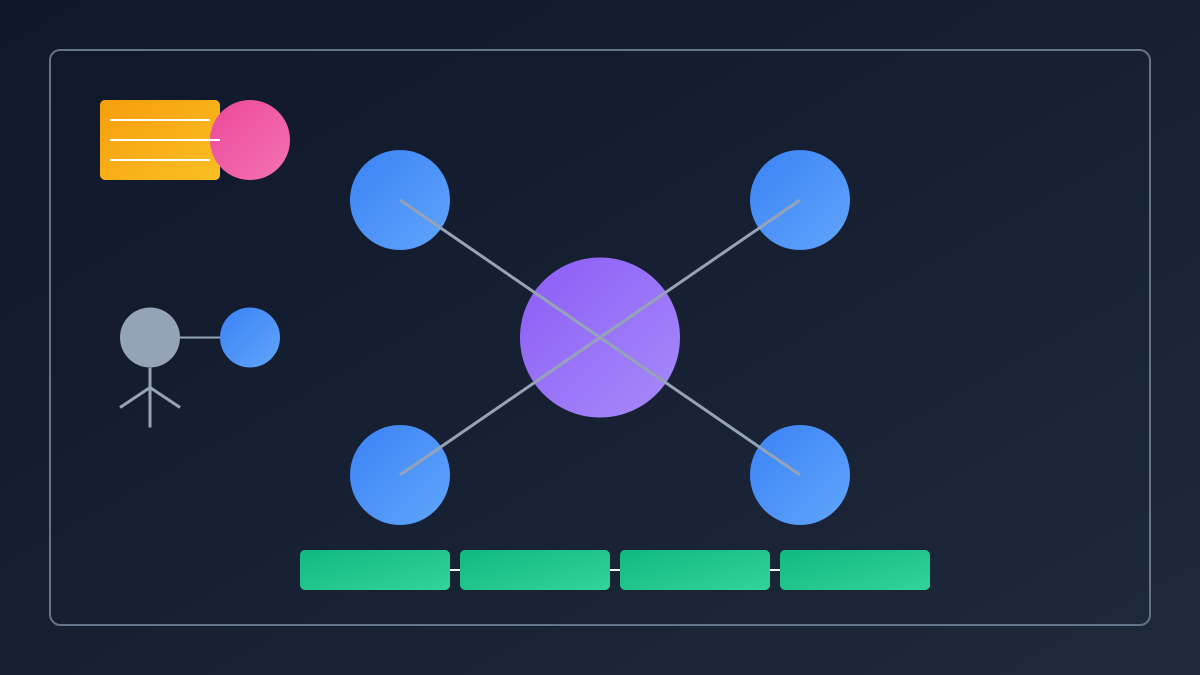
This project uses LangGraph as the core orchestration engine, modeling agent interactions as directed graphs (nodes represent agents/tools, edges represent state transitions). Its advantages include visual workflows, loop support, conditional routing, and fault tolerance mechanisms.

Hierarchical Memory Management

Implements a hierarchical memory architecture with short-term (current conversation context), long-term (user preferences/historical interactions/domain knowledge), and shared (public knowledge base) layers, ensuring agents understand the immediate context and leverage accumulated experience.

RAG Pipeline Integration

Built-in full RAG support: document ingestion (multiple formats), vector storage (embedding models to build semantic indexes), retrieval strategies (sparse + dense to improve recall), and re-ranking optimization (relevance sorting).

4

Section 04

Enterprise Integration Practice: Tool Calling and Security Control

Tool Calling and API Integration

The framework supports agents calling external systems: querying order systems, updating CRM information, checking inventory, triggering ticketing systems. Each tool has clear input/output specifications, and structured prompts ensure correct usage.

Security and Permission Control

Enterprise-level deployment considerations: identity authentication (SSO integration), permission isolation (different agents have different permissions), audit logs (recording key operations), data desensitization (automatic identification and masking of sensitive information).

5

Section 05

Practical Application Scenarios (Evidence)

Scenario 1: Escalation of Complex Issues

When the frontline customer service agent cannot solve the problem, it automatically analyzes the problem type, retrieves the knowledge base, and if still unsolvable, transfers to a professional agent/human while maintaining context continuity.

Scenario 2: Cross-System Operations

When a user requests "query the last three months' orders and apply for a return", the order query agent calls the API, the return processing agent verifies the policy, the inventory agent confirms the status, and the notification agent sends an email.

Scenario 3: Proactive Service

Based on user historical behavior and context, it proactively predicts problems, pushes help documents, and provides personalized product recommendations.

6

Section 06

Performance Optimization and Scalability Strategies

Horizontal Scaling Strategy

Supports adding worker nodes to expand capacity: agent states are stored in a shared database, message queues coordinate task distribution, and load balancing ensures resource utilization.

Latency Optimization Techniques

Streaming responses (return partial results in real time), parallel execution (process independent subtasks simultaneously), caching strategies (precompute and cache common queries), model routing (use lightweight models for simple tasks).

7

Section 07

Implementation Recommendations for Developers

For teams adopting this framework, recommended steps:

  1. Requirement analysis: Clarify business scenarios and agent responsibility division
  2. Prototype verification: Start with a single use case to verify architecture feasibility
  3. Gradual expansion: Gradually increase the number of agents and functional complexity
  4. Monitoring and optimization: Establish a complete log and metric collection system
  5. Continuous iteration: Optimize prompts and processes based on feedback.
8

Section 08

Conclusion and Future Outlook

Conclusion

The multi-agent-customer-support-system project demonstrates the path of transforming cutting-edge AI technology into practical enterprise solutions. Through reasonable architecture design and engineering practice, multi-agent systems can provide intelligent service levels far exceeding traditional solutions while ensuring reliability, serving as a reference implementation for enterprise AI transformation.

Future Outlook

Multi-agent systems are an important direction for AI application architecture. With the improvement of model capabilities and the perfection of the tool ecosystem, they will achieve more intelligent autonomous decision-making, more natural cross-agent collaboration, lower-cost deployment and operation, and richer industry-specific templates.
