Zing Forum

Reading

Autonomous Intelligent Governance System: Multi-Agent AI Empowers Automation of Citizen Services

An AI-driven citizen governance assistant that can autonomously collect complaints, provide intelligent guidance using multi-agent workflows, escalate unresolved issues to human handling, and explore innovative applications of AI in the public service sector.

智能治理公民服务多代理系统AI政务自动化投诉处理公共服务智能客服政府数字化
Published 2026-05-09 19:13Recent activity 2026-05-09 19:20Estimated read 6 min
Autonomous Intelligent Governance System: Multi-Agent AI Empowers Automation of Citizen Services
1

Section 01

[Introduction] Autonomous Intelligent Governance System: Multi-Agent AI Empowers Automation of Citizen Services

The autonomous intelligent governance project explores the integration of multi-agent AI systems into citizen service processes, enabling end-to-end automation from complaint collection and intelligent guidance to escalating complex issues to human handling. It aims to improve public service efficiency and citizen satisfaction, representing an innovative application attempt of AI in the public service sector.


2

Section 02

Project Background: Pain Points in Traditional Citizen Service Processing

In modern urban governance, citizen complaint handling faces issues such as scattered information, delayed responses, and cumbersome processes; similar complaints recur but lack standardized solutions, leading to heavy manual burdens and low citizen satisfaction. This project was thus born with the goal of building a 7×24 AI-driven governance assistant that seamlessly connects automated processing and human intervention.

3

Section 03

System Architecture: Core Design of Multi-Agent Collaboration

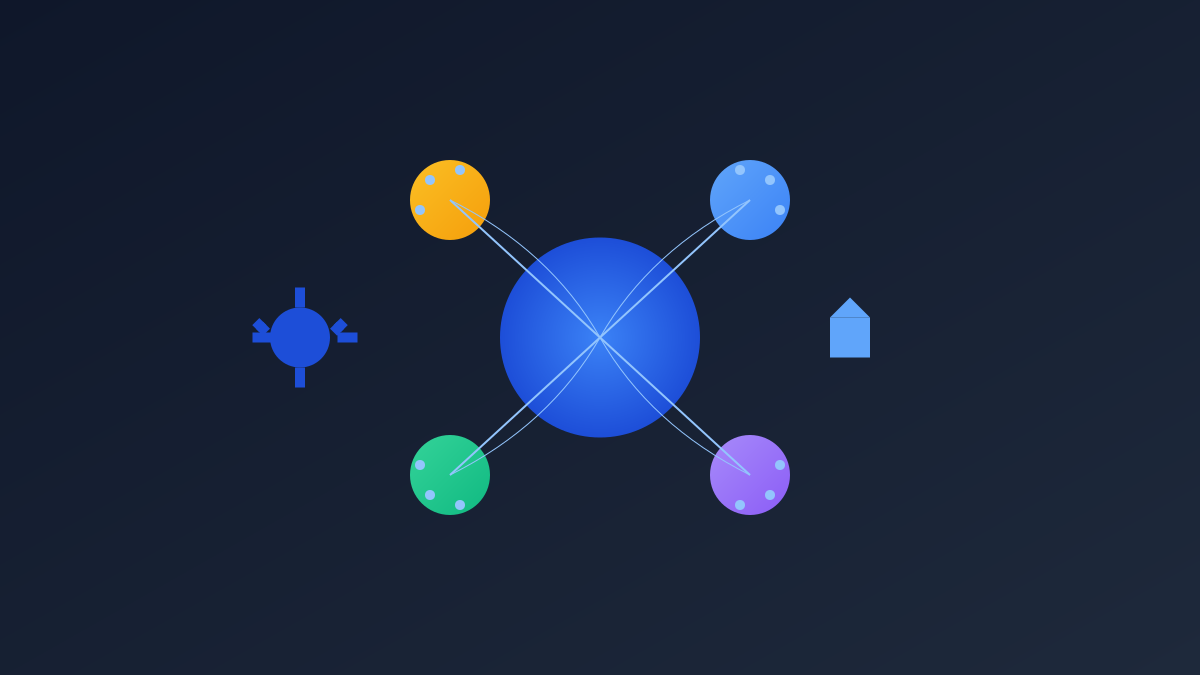
The system uses a multi-agent model to decompose tasks: 1. Complaint Collection Agent: Collects demands from multiple channels such as web forms and social media and standardizes them; 2. Classification and Routing Agent: Uses semantic analysis to categorize complaints, assess priorities, and route them to the corresponding departments; 3. Intelligent Guidance Agent: Provides self-service such as instant answers to common questions, information completion, and progress inquiries; 4. Escalation Handling Agent: Generates summaries of complex/sensitive issues and forwards them to humans.

4

Section 04

Technical Implementation: Key Support from Integrating AI and Data Technologies

The system integrates multiple technologies: 1. NLP: Intent recognition, entity extraction, sentiment analysis, and multi-language support; 2. Knowledge Graph and RAG: Ensure accurate answers and reduce AI hallucinations; 3. Workflow Orchestration: Manages business process status, timeout reminders, etc.; 4. Human-Machine Collaboration Interface: Provides case summaries and auxiliary information for human handling, supporting iterative learning of the system.

5

Section 05

Application Value: An Intelligent Governance Solution Benefiting Multiple Parties

For citizens: 7×24 service, instant response, transparent progress, and reduced repeated communication; For the government: Reduced manual burden, improved efficiency, process optimization through data insights, and service quality monitoring; For society: Enhanced government credibility, promoted public participation, and data-driven decision-making.

6

Section 06

Challenges and Reflections: Unsolved Problems in AI Governance Applications

Facing four major challenges: 1. Privacy and Security: Need to strictly protect sensitive information and comply with regulations; 2. Fairness and Bias: Avoid systemic bias caused by training data and conduct regular audits; 3. Responsibility Attribution: Clarify the boundary between AI and humans and establish appeal and correction mechanisms; 4. Technical Dependency: Balance efficiency and system resilience to prevent the degradation of human capabilities.

7

Section 07

Future Outlook and Summary: Balancing Technological Innovation and Humanistic Care

In the future, the system may have capabilities such as image recognition, predictive services, cross-departmental collaboration, and personalized services; this project is a positive exploration of AI in public services, with the core goal of improving service efficiency and satisfaction. However, it is necessary to find a balance between technological innovation, humanistic care, and fairness and justice, making AI a warm bridge between the government and citizens.

