Zing Forum

Reading

AI Digital Factory: A Fully Automated Digital Product Pipeline from Content Creation to Marketing & Distribution

An in-depth analysis of the AI Digital Factory project, exploring how to build an autonomous system for continuous generation, marketing, and distribution of digital products through multi-agent collaboration and automated workflows, revealing the future landscape of the AI-driven content industry.

AI内容生成数字产品自动化工作流多Agent系统Clauden8n内容营销被动收入
Published 2026-05-05 09:15Recent activity 2026-05-05 10:29Estimated read 5 min
AI Digital Factory: A Fully Automated Digital Product Pipeline from Content Creation to Marketing & Distribution
1

Section 01

Introduction: AI Digital Factory — Core Analysis of a Fully Automated Digital Product Pipeline

This article provides an in-depth analysis of the AI Digital Factory project, exploring how to build an end-to-end autonomous system from market research, product creation to marketing and distribution through multi-agent collaboration and automated workflows, revealing the future landscape of the AI-driven content industry. The project's vision is to create a "self-improving AI-driven factory" that continuously produces valuable digital products with minimal human intervention, serving as a reference for developers and content entrepreneurs.


2

Section 02

Background & Core Concept: Pipeline-based Production of Digital Products

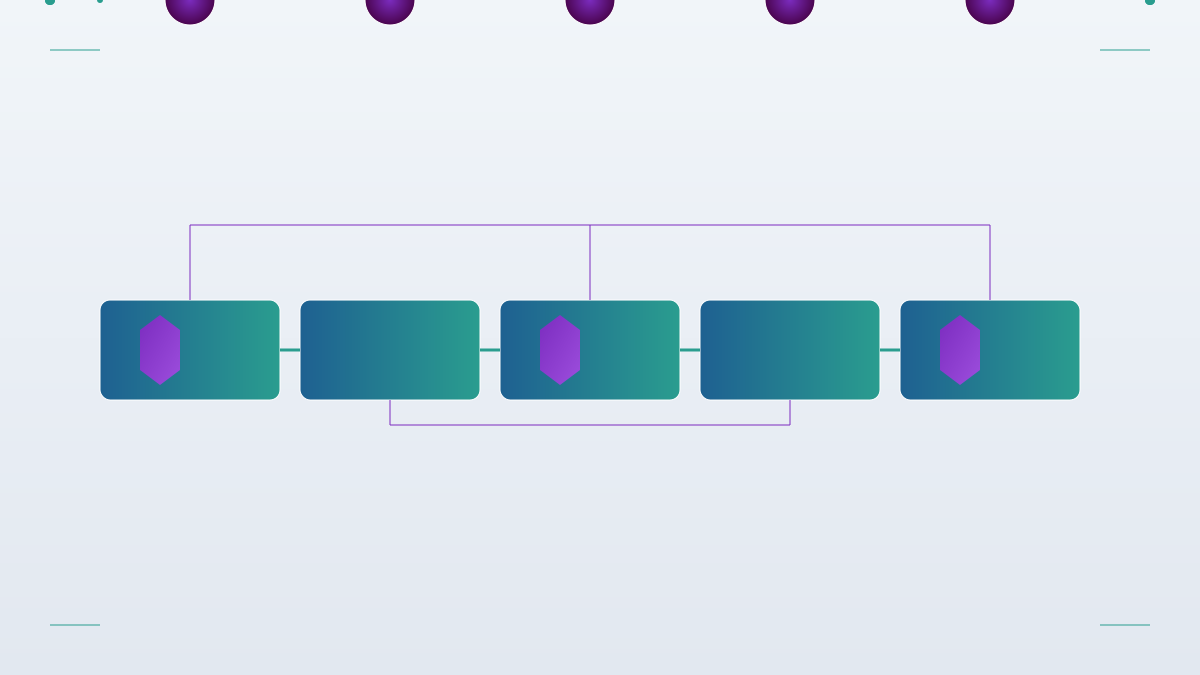
The digital content industry is undergoing an AI-powered transformation, with production methods for digital products like e-books and online courses being restructured. Inspired by industrial assembly lines, the AI Digital Factory transforms ideas into marketable products, defining a five-stage process: Research → Product Creation → Marketing → Distribution → Optimization. Each stage is handled by a specialized AI Agent, connected via automated workflows, supporting parallel processing and independent optimization.

3

Section 03

Tech Stack & Architecture Implementation

AI Model Layer: Uses Anthropic Claude (strong long-context and instruction-following capabilities), with future plans to support GPT/Gemini; Automation Engine: n8n handles triggering Agents, orchestrating workflows, and scheduling tasks; Agent Architecture: Specialized division of labor (Research/Product/Marketing/Distribution/Optimization Agents), each focusing on specific tasks. The project structure is modular, including directories like agents, prompts, workflows, etc., for easy expansion and maintenance.

4

Section 04

Design Principles & Tool Integration

Core Design Principles: 1. Portability (version control via GitHub); 2. Automation (reducing human intervention); 3. Scalability (supporting mass product generation); 4. Cost-effectiveness (optimizing prompts and processes to lower AI costs). Tool Integration: Currently uses Claude, n8n, Docker, GitHub; planned features include automatic niche market discovery, autonomous product generation, automatic social media publishing, etc.

5

Section 05

Application Scenarios & Challenges

Applicable Scenarios: Content entrepreneurs (passive income), knowledge payment institutions (batch material generation), marketing teams (rapid asset creation), developers (learning multi-agent architecture). Challenges: Content quality control (needs review mechanisms), copyright and originality (legal compliance), market saturation (differentiated positioning), technical complexity (debugging and operation).

6

Section 06

Future Outlook & Conclusion

Future Trends: From semi-automatic to fully automatic (autonomous goal setting, closed-loop improvement), from single product to portfolio management, from content expansion to service domains. Conclusion: The AI Digital Factory restructures the creation process, freeing humans to focus on creative strategies, and provides a scalable path for technical practitioners and entrepreneurs. The future of the digital content industry belongs to those who master AI factories.