Zing Forum

Reading

Open-Source Multimodal AI Framework: Automatically Convert Text Stories to Animated Videos

A multimodal AI pipeline based on diffusion models and speech synthesis technology, enabling fully automatic generation from text stories to animated videos.

多模态AI文本生成视频Stable Diffusion语音合成开源框架AIGCPythonMoviePy
Published 2026-04-11 06:36Recent activity 2026-04-11 06:45Estimated read 6 min
Open-Source Multimodal AI Framework: Automatically Convert Text Stories to Animated Videos
1

Section 01

Open-Source Multimodal AI Framework: Guide to Automatic Conversion of Text Stories to Animated Videos

Developer zmarashdeh released the open-source project "Intelligent Story-to-Video Generation Framework", which is based on diffusion models and speech synthesis technology to achieve fully automatic generation from text stories to animated videos. This framework is positioned for academic research and technical exploration, providing reproducible technical benchmarks. Developed in Python, it facilitates secondary development and has prospects for multi-domain applications as well as room for improvement.


2

Section 02

Project Background and Technical Positioning

With the development of large language models and diffusion models, AIGC is evolving toward multimodal fusion. Traditional video production requires collaboration among multiple roles such as screenwriters and storyboard artists. The goal of this framework is to automate this process via AI (users only need to provide text stories). Positioned for academic research, the project provides reproducible benchmarks for story-to-video generation. Developed in Python with a clear structure, it supports secondary development.

3

Section 03

Core Technical Architecture: Modular Pipeline Design

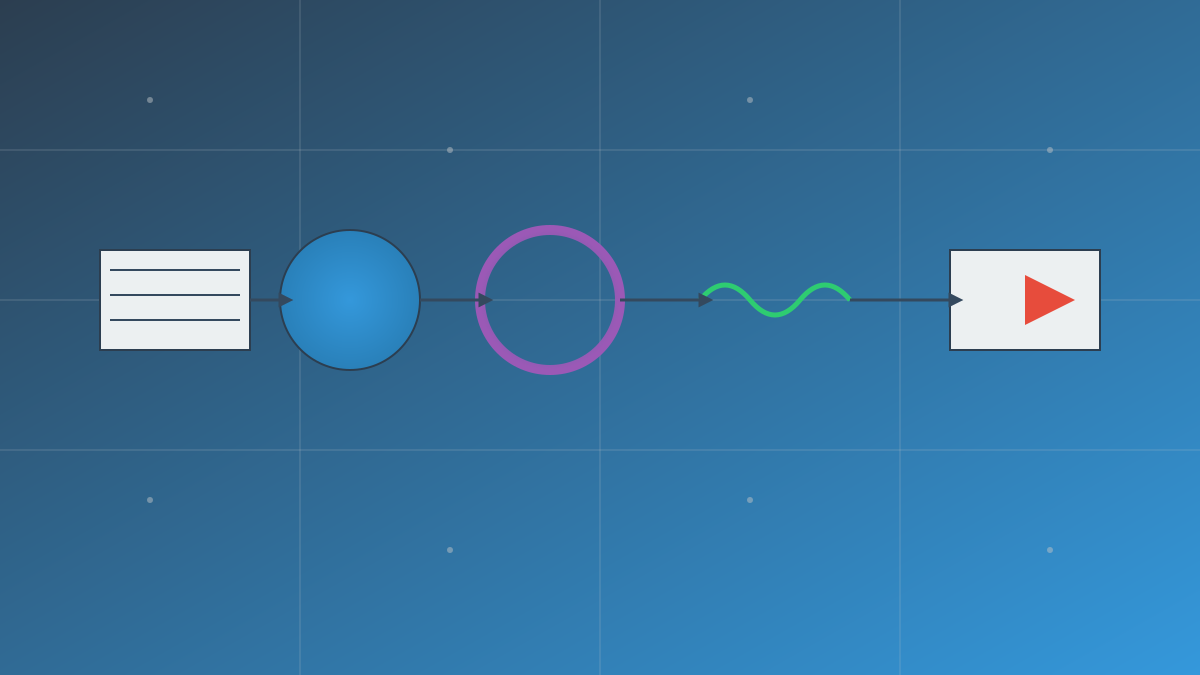
The framework integrates mature technologies and adopts a modular pipeline:

  1. Story Parsing and Scene Generation: Structurally process text and decompose it into scenes containing visual elements and narrative text;
  2. Image Generation: Use Stable Diffusion to generate high-quality, style-consistent image sequences;
  3. Speech Synthesis: Convert narrative text into smooth voiceover via gTTS (easy deployment and fast response);
  4. Video Synthesis: Use the MoviePy library to synthesize image sequences and audio into the final video.
4

Section 04

Project Structure and Usage Flow

The project has a concise directory structure:

  • code/: Main Python scripts;
  • dataset/: JSON-formatted story files;
  • outputs/: Stores generated audio and video files (already .gitignore'd). Usage steps:
  1. Install dependencies: pip install -r requirements.txt;
  2. Prepare story data and place it in the dataset;
  3. Run the main program: python code/main.py;
  4. Check the video in the outputs directory.
5

Section 05

Technical Value and Application Scenarios

Although the framework is an academic tool, it has wide practical value:

  • Education field: Quickly convert textbooks/historical stories into animations to enhance teaching effectiveness;
  • Content creation: Enable self-media to batch-generate story short videos and reduce costs;
  • Auxiliary tool: Help visual narrative creators verify story rhythm and visual presentation;
  • Technical learning: Covers a complete tech stack of NLP, CV, and audio-video processing, suitable for beginners in multimodal AI development.
6

Section 06

Limitations and Future Improvement Directions

The early version of the project has room for improvement:

  1. Character Consistency: Currently, frame-by-frame generation makes it hard to ensure character consistency; ControlNet or IP-Adapter can be introduced;
  2. Animation Effects: Static images with panning and zooming lack real animation; AnimateDiff can be integrated;
  3. Speech Performance: gTTS has a single voice; Bark, StyleTTS2, etc., which support multi-role and emotion, can be integrated;
  4. Story Understanding: Simple parsing needs to introduce LLM for deep understanding and storyboard planning to improve quality.
7

Section 07

Project Summary and Address

This framework achieves an end-to-end functional closed loop through reasonable module combination, exploring a feasible path for AI-generated story-to-video. For researchers and developers, it is a noteworthy open-source project that provides code implementation and technical references. Project address: https://github.com/zmarashdeh/story-to-video-diffusion-framework

