Zing Forum

Reading

Hybrid AI Medical Diagnosis Expert System: The Synergy of Rules, Retrieval, and Large Models

A hybrid medical diagnosis system integrating rule engines, Retrieval-Augmented Generation (RAG), and large language model reasoning, exploring how to balance AI's intelligence with interpretability and reliability in the high-risk field of healthcare.

医疗AI专家系统混合智能RAG大语言模型医疗诊断规则引擎可解释AI
Published 2026-03-29 20:09Recent activity 2026-03-29 20:27Estimated read 6 min
Hybrid AI Medical Diagnosis Expert System: The Synergy of Rules, Retrieval, and Large Models
1

Section 01

Hybrid AI Medical Diagnosis Expert System: The Synergy of Rules, Retrieval, and Large Models (Main Floor Introduction)

This article explores a hybrid medical diagnosis system integrating rule engines, Retrieval-Augmented Generation (RAG), and Large Language Models (LLMs), aiming to address the balance between AI's intelligence, interpretability, and reliability in the high-risk field of medical diagnosis, while analyzing its architectural design, safeguard mechanisms, and application prospects.


2

Section 02

Opportunities and Challenges of AI in Medical Diagnosis (Background)

Unique Characteristics of Diagnosis

Medical diagnosis has unique attributes such as high stakes (severe consequences of misdiagnosis), high interpretability requirements, knowledge intensity, strong uncertainty, and strict regulation.

Limitations of Pure Data-Driven Approaches

Direct application of large language models to medical diagnosis has risks such as hallucination issues, poor knowledge timeliness, lack of citations, and black-box characteristics.

3

Section 03

Three Pillars of the Hybrid Architecture (Methodology)

The hybrid system integrates three AI paradigms:

  1. Rule Engine: Encodes explicit if-then rules. Advantages: interpretable, deterministic behavior, regulatory compliance; Limitations: high maintenance cost, difficulty covering edge cases.
  2. Retrieval-Augmented Generation (RAG): Combines external knowledge bases. Advantages: dynamic knowledge updates, traceable sources, reduced hallucinations; Limitations: depends on knowledge base quality and retrieval relevance.
  3. LLM Reasoning: Provides semantic understanding and complex reasoning. Advantages: handles unstructured text, integrates multimodal information; Limitations: presence of hallucinations and lack of interpretability.
4

Section 04

System Architecture and Key Component Design

Data Flow Process

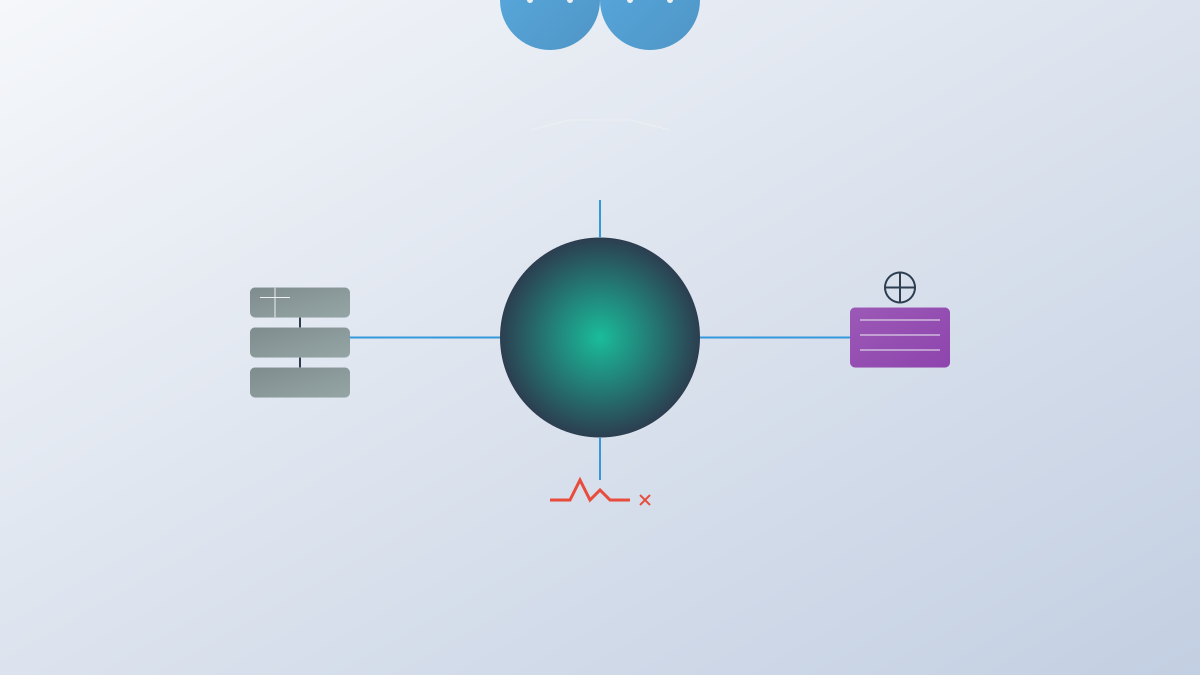
Patient input → Rule engine layer (rapid screening, application of clinical guidelines) → Retrieval layer (acquire literature/guidelines/cases) → LLM reasoning layer (comprehensive decision-making and report generation) → Output diagnosis recommendations.

Key Components

  • Rule Engine: Hierarchical rules (emergency/standard/recommendation), conflict resolution, version management.
  • Retrieval System: Medical term standardization (e.g., SNOMED CT), multi-source knowledge integration, privacy protection.
  • LLM Integration: Constrained generation, self-verification, confidence estimation, manual review trigger.
5

Section 05

Reliability Safeguard Mechanisms

Multi-Level Verification

Rule layer verification (no violation of hard rules), knowledge layer verification (literature-supported), logic layer verification (LLM self-check), cross-validation (comparing results of three methods).

Human-Machine Collaboration

Assist doctor decision-making, integrate information, generate documents, continuous learning.

Safety Boundaries

Scope limitation, uncertainty disclosure, emergency identification, drug safety check.

6

Section 06

Technical Implementation and Ethical Regulatory Considerations

Technology Stack Selection

Rule engines (e.g., Drools), vector databases (e.g., Pinecone), LLMs (e.g., GPT-4/Med-PaLM), knowledge graphs (e.g., Neo4j).

Data Preparation

Medical knowledge bases, de-identified case data, expert-written rule bases.

Ethics and Regulation

  • Ethical Principles: Patient benefit first, transparency and interpretability, fairness and non-bias, privacy protection.
  • Regulatory Compliance: FDA/NMPA approval, clinical evidence, ISO 13485 quality system, post-market monitoring.
7

Section 07

Future Outlook and Conclusion

Future Directions

Multimodal fusion, personalized medicine, continuous learning, global collaboration.

Social Impact

Alleviate uneven distribution of medical resources, improve diagnosis efficiency, promote medical education, support medical research.

Conclusion

The hybrid system balances intelligence and reliability, and its core concepts are worth learning for high-risk AI fields: technology serves people, intelligence and transparency coexist, innovation and safety go hand in hand.

