Zing Forum

Reading

AI-Powered Editing and Review Workflow: Local Large Models Reshape Manuscript Quality Inspection Processes

An open-source workflow based on n8n and Ollama that uses the local Qwen 14B model to automate manuscript review, reducing manual review time per chapter from 45-60 minutes to 2-5 minutes.

n8nOllamaQwen本地大模型文稿审阅工作流自动化编辑工具LLM应用
Published 2026-06-13 01:45Recent activity 2026-06-13 01:48Estimated read 6 min
AI-Powered Editing and Review Workflow: Local Large Models Reshape Manuscript Quality Inspection Processes
1

Section 01

Introduction: AI-Powered Local Large Model Editing and Review Workflow

This article introduces an open-source workflow project based on n8n and Ollama. It uses the local Qwen 14B model to automate manuscript review, reducing manual review time per chapter from 45-60 minutes to 2-5 minutes. It also protects sensitive data privacy and addresses core pain points of traditional manuscript review.


2

Section 02

Background: Pain Points of Traditional Manuscript Review

Traditional manual developmental editing faces many challenges:

  • Huge time consumption: Each chapter requires 45-60 minutes of focused review
  • Difficulty ensuring consistency: Declining attention easily leads to missed issues
  • Repetitive labor: Multiple rounds of review require repeated comparison with reference documents
  • Risk of continuity errors: Conflicts in character settings, timeline confusion, etc., are easily overlooked These issues limit creators' ability to focus on creative work.
3

Section 03

Solutions and Technical Architecture

Core Idea

Integrate workflow orchestration, document processing, and local large models. Retrieve manuscripts and reference documents from Google Docs, analyze continuity issues and editing focus points chapter by chapter, and run entirely locally to protect intellectual property rights.

Tech Stack

  • Workflow orchestration: n8n (open-source visual tool)
  • AI inference: Ollama-deployed Qwen3 14B model (excellent in Chinese understanding and long text processing)
  • Data source: Google Docs API for retrieving reference documents
  • Processing logic: JavaScript for document parsing and prompt engineering
4

Section 04

Workflow Execution Process

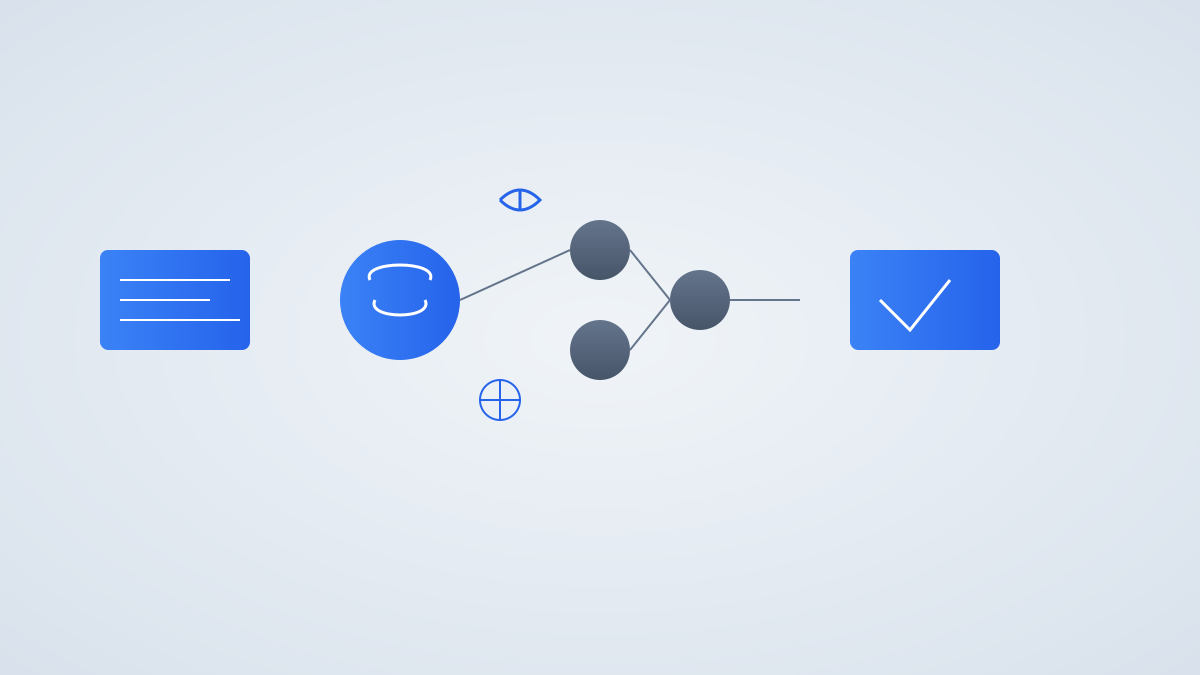
  1. Retrieve reference materials: Search for character setting sheets, story outlines, style guides, and manuscripts
  2. Merge context: Integrate all reference documents into an analysis package
  3. Parse chapters: Automatically split the manuscript into independent chapters
  4. Analyze chapter by chapter: Multi-dimensional evaluation (character continuity, outline compliance, style adherence, narrative structure, AI text detection)
  5. Generate editing notes: Structured report including continuity issues, editing suggestions, etc.
  6. Integrate results: Compile into a complete editing report
5

Section 05

Practical Effects and Performance Improvements

Metric Manual Review Automated Review Improvement
Per-chapter processing time 45-60 minutes 2-5 minutes ~90% time saved
Consistency guarantee Depends on reviewer's state Standardized output Significant improvement
Privacy protection Requires trust in third-party services Fully local operation Data never leaves the country
The efficiency improvement allows editors to handle more manuscripts or focus on creative work.
6

Section 06

Application Scenarios and Expansion Possibilities

Applicable Scenarios:

  • Academic publishing: Paper citation consistency, terminology standard review
  • Technical documentation: API document and code consistency verification
  • Legal contracts: Clause compliance check
  • Marketing copy: Brand tone and information consistency Expansion Ways: Replace local models (e.g., Llama3, Mistral) or adjust prompt templates to adapt to different needs.
7

Section 07

Summary and Outlook

The core advantages of this project are: full localization, modular design, open-source ecosystem, and quantifiable efficiency improvement. It does not replace human judgment but frees humans from repetitive labor to focus on creativity. In the future, with the development of local large models and open-source tools, more automated solutions for vertical fields will emerge.

