Zing Forum

Reading

AgentX: Design and Implementation of a High-Performance Agent Workflow Engine

AgentX is a high-performance AI workflow engine inspired by modern agent architectures, providing CLI tools and programmable interfaces to support multi-step autonomous execution and orchestration of complex tasks.

AgentAI workflowagentic architectureLLMtool callingmemory systemCLI
Published 2026-04-30 02:15Recent activity 2026-04-30 02:19Estimated read 6 min
AgentX: Design and Implementation of a High-Performance Agent Workflow Engine
1

Section 01

AgentX: High-Performance AI Workflow Engine for Complex Agent Tasks

AgentX is a high-performance AI workflow engine inspired by modern agent architectures. It provides CLI tools and programmable interfaces, supporting multi-step autonomous execution and orchestration of complex tasks. As a production-grade tool, it serves as a solid foundation for developers to build complex AI applications.

2

Section 02

Evolution Background of Agent Architecture

Traditional LLM applications mostly use a 'one-question-one-answer' interaction mode. However, real-world tasks often require multi-step planning, tool calling, intermediate result processing, and dynamic strategy adjustment based on feedback. AgentX's design is deeply influenced by modern agent research paradigms like ReAct (Reasoning + Action), Plan-and-Solve, and multi-agent collaboration, translating these academic ideas into production-ready code.

3

Section 03

Core Architecture & Key Technical Features

Workflow Engine Design

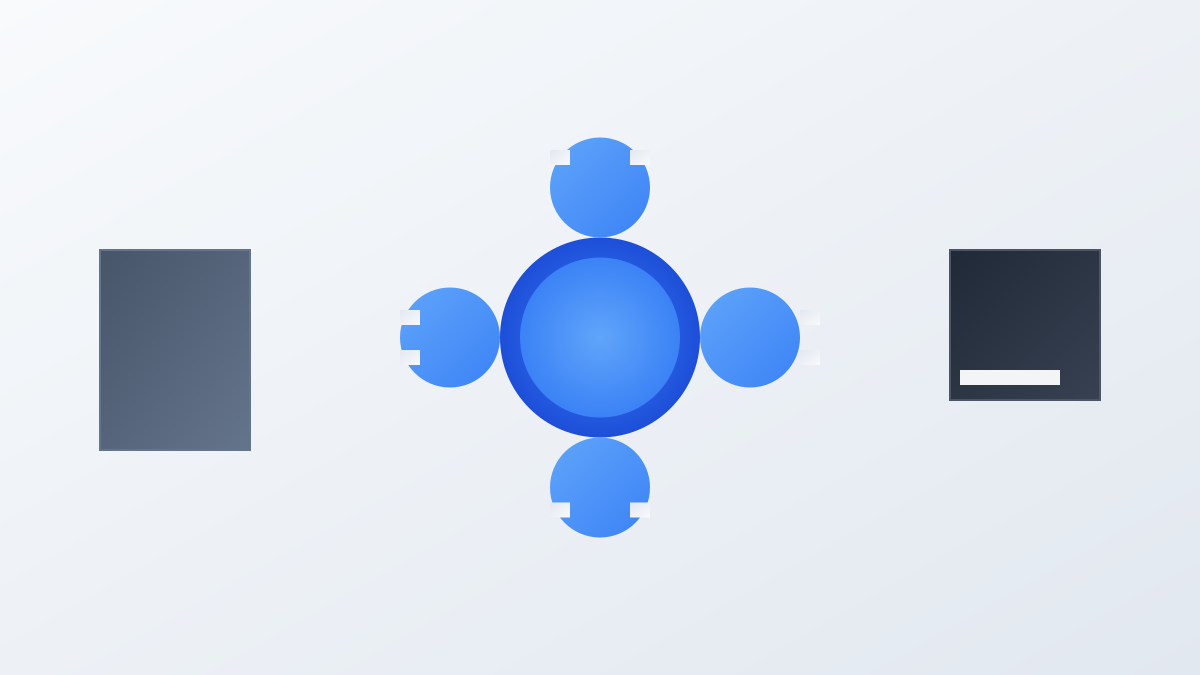
AgentX's core is a high-performance workflow engine supporting complex control flows (condition branches, loops, parallel execution, error retries) and asynchronous architecture for efficient concurrency.

Tool Calling & Extension Mechanism

It offers a complete tool registration/calling system with declarative Schema, supporting REST API, local functions, etc. Built-in common tools (web search, code execution) and hot-plug design allow dynamic updates.

Memory & Context Management

A multi-level memory system (working/short/long-term) supports various backends (memory cache, Redis, vector DBs) with semantic + keyword search for accurate recall.

CLI & Programmable Interfaces

Features a rich CLI for workflow definition/execution/debugging (YAML/JSON configs) and provides Python SDK + REST API for deep integration.

4

Section 04

Performance Optimization & Production Readiness

Streaming Response & Latency Optimization

Supports streaming output for real-time feedback, improving perceived performance. Implements request-level timeout control and circuit breaker mechanisms, plus async execution for heavy tasks.

Observability & Debugging Support

Built-in execution tracking (recording step inputs/outputs, time, resources) and integrates with Prometheus/Grafana via structured logs and metrics, facilitating production operation and maintenance.

5

Section 05

Application Scenarios & Practical Recommendations

Application Scenarios

  • Automation office assistant: Email classification, schedule arrangement, document generation.
  • Data analysis agent: Natural language query processing, data extraction/cleaning/analysis/visualization.
  • Code auxiliary tool: Intelligent completion, refactoring suggestions, bug fixes.
  • Customer service system: Query handling, knowledge base access, order operations.

Practical Suggestions

  • Start with simple single-step tasks, gradually increase complexity.
  • Use CLI debugging to verify logic before production deployment.
  • Pay attention to tool permission control to avoid risky operations.
6

Section 06

Tech Stack Compatibility & Ecosystem Integration

AgentX supports multiple LLM APIs (OpenAI, Anthropic, Google) and local open-source models via a unified interface, enabling flexible model switching. It supports Docker containerization and Kubernetes deployment with Helm Chart, ensuring compatibility with existing tech stacks.

7

Section 07

Conclusion & Significance of AgentX

AgentX is an important engineering tool driving the transformation of agent technology. By providing a high-performance, scalable, and easy-to-use workflow engine, it lowers the threshold for building complex AI applications, allowing more developers to participate in the agent ecosystem. For developers exploring agent applications, AgentX is a valuable reference implementation that demonstrates how to translate academic concepts into production systems.


