Zing Forum

Reading

Agents-K1: Building an Agent-native Scientific Knowledge Graph System

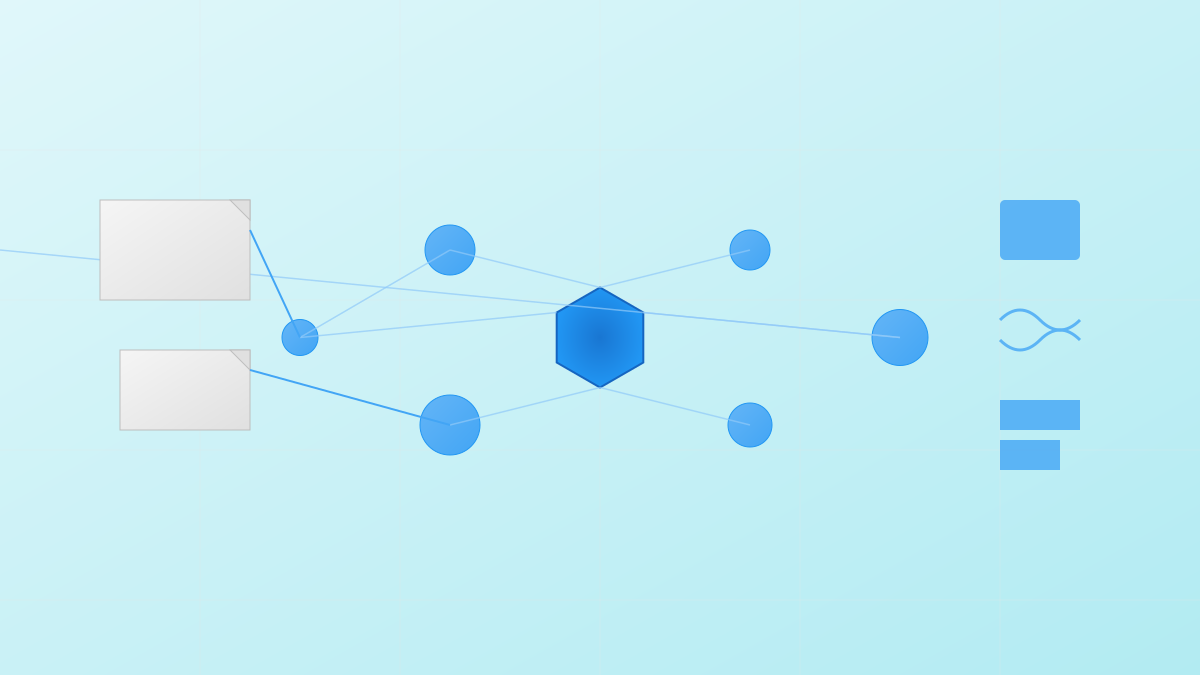
This article introduces Agents-K1, an end-to-end knowledge orchestration pipeline that converts raw documents into agent-native scientific knowledge graphs. The system includes a multimodal parser, a 4B-parameter information extraction model, and a unified retrieval interface.

知识图谱科学文献信息抽取智能体多模态解析Scholar-KGAgents-K1
Published 2026-06-12 01:58Recent activity 2026-06-12 18:27Estimated read 7 min
Agents-K1: Building an Agent-native Scientific Knowledge Graph System
1

Section 01

Introduction: Agents-K1—An Agent-native Scientific Knowledge Graph System

This article introduces Agents-K1—an end-to-end knowledge orchestration pipeline designed to convert raw scientific documents into agent-native knowledge graphs. The system addresses the shortcomings of current LLM-based research agents in scientific knowledge orchestration, with core components including a multimodal parser, a 4-billion-parameter information extraction model, and a unified retrieval interface. Based on this, it has built Scholar-KG, a large-scale knowledge graph covering 2.46 million cross-disciplinary papers, laying the foundation for the scientific reasoning capabilities of intelligent agents. Source: Published on arXiv in June 2026, original title: Agents-K1: Towards Agent-native Knowledge Orchestration.


2

Section 02

Research Background: Gaps in Scientific Knowledge Orchestration

Current LLM-based research agents have made significant progress in task orchestration, but there are obvious gaps in scientific knowledge orchestration: existing methods often simplify academic papers into abstracts, surface mentions, and flat citation relationships, ignoring entities, claims, evidence, mechanisms, and method lineages necessary for scientific reasoning. This prevents agents from understanding the deep structure of literature (such as conceptual causal relationships, strength of evidence support, and methodological inheritance), severely limiting their utility in scenarios like research assistance and literature review.

3

Section 03

Agents-K1 System Architecture: Three Core Components

The Agents-K1 system architecture integrates three core components:

  1. Multimodal Parser: Processes full paper texts, including five modules: entity recognition, multimodal evidence extraction, citation relationship analysis, inter-entity relationship recognition, and cross-document alignment;
  2. 4B-parameter Information Extraction Model: Trained using the GRPO algorithm, combining rule-based reward mechanisms and multi-task learning to improve extraction quality and reasoning efficiency;
  3. GraphAnything CLI Unified Retrieval Interface: Supports web search, multimodal graph retrieval, and cross-document traversal to enable interactive knowledge exploration.
4

Section 04

Scholar-KG: Large-scale Scientific Knowledge Graph Achievement

Scholar-KG, built based on the Agents-K1 pipeline, has the following features:

  • Scale: Covers 2.46 million cross-disciplinary papers across 6 fields including computer science, physics, and biology; a 1 million subset is publicly available;
  • Features: Fine-grained entity representation (including methods, datasets, etc.), multimodal evidence association, dynamic update mechanism, and explainable reasoning paths (each claim traces back to original evidence).
5

Section 05

Experimental Evaluation: Performance of Agents-K1

Experimental evaluations show that Agents-K1 outperforms others:

  • Metrics: Excellent performance in entity recognition accuracy, F1 score for complex relation extraction, evidence location precision, and cross-document alignment;
  • Comparison: Full-text parsing provides significant information gain compared to abstract-only methods; fine-grained relation extraction improves graph connectivity; multimodal processing effectively utilizes non-text information.
6

Section 06

Application Prospects: Scalability and Potential Scenarios

Agents-K1 has good scalability and application prospects:

  • Scalability: Supports general domain adaptation, user-defined extraction patterns, and synthetic data generation;
  • Potential Scenarios: Intelligent literature review, research trend analysis, cross-disciplinary knowledge discovery, and research assistants (precision retrieval and evidence support).
7

Section 07

Limitations and Future Directions

Current limitations and future directions:

  • Limitations: Mainly processes English literature, has knowledge update delays, and limited complex multi-hop reasoning capabilities;
  • Future: Introduce stronger base models to improve extraction quality, explore neuro-symbolic integration to enhance reasoning interpretability, and develop interactive knowledge completion mechanisms combining human feedback to improve the graph.
8

Section 08

Conclusion: Significance and Outlook of Agents-K1

Agents-K1 represents an important progress in the knowledgeization of scientific literature. Through fine-grained multimodal parsing, efficient extraction models, and a unified retrieval interface, it provides scientific knowledge infrastructure for intelligent agents. The openness of Scholar-KG is expected to promote the practical application of intelligent agents in research assistance, education, decision support, and other fields, marking a key shift from 'agent orchestration' to 'knowledge orchestration'.

