Zing Forum

Reading

Agents Configuration Repository: A Cross-Device Configuration Solution for Unified Management of Claude Code and Codex

Introduces a unified configuration source for managing Claude Code and Codex configurations across multiple machines, enabling consistency and portability of development environments.

Claude CodeCodexconfiguration managementdotfilesdeveloper toolsAI assistantscross-device syncGitHubshell scripts
Published 2026-04-07 04:15Recent activity 2026-04-07 04:20Estimated read 6 min
Agents Configuration Repository: A Cross-Device Configuration Solution for Unified Management of Claude Code and Codex
1

Section 01

Agents Configuration Repository: A Cross-Device Configuration Solution for Unified Management of Claude Code and Codex (Introduction)

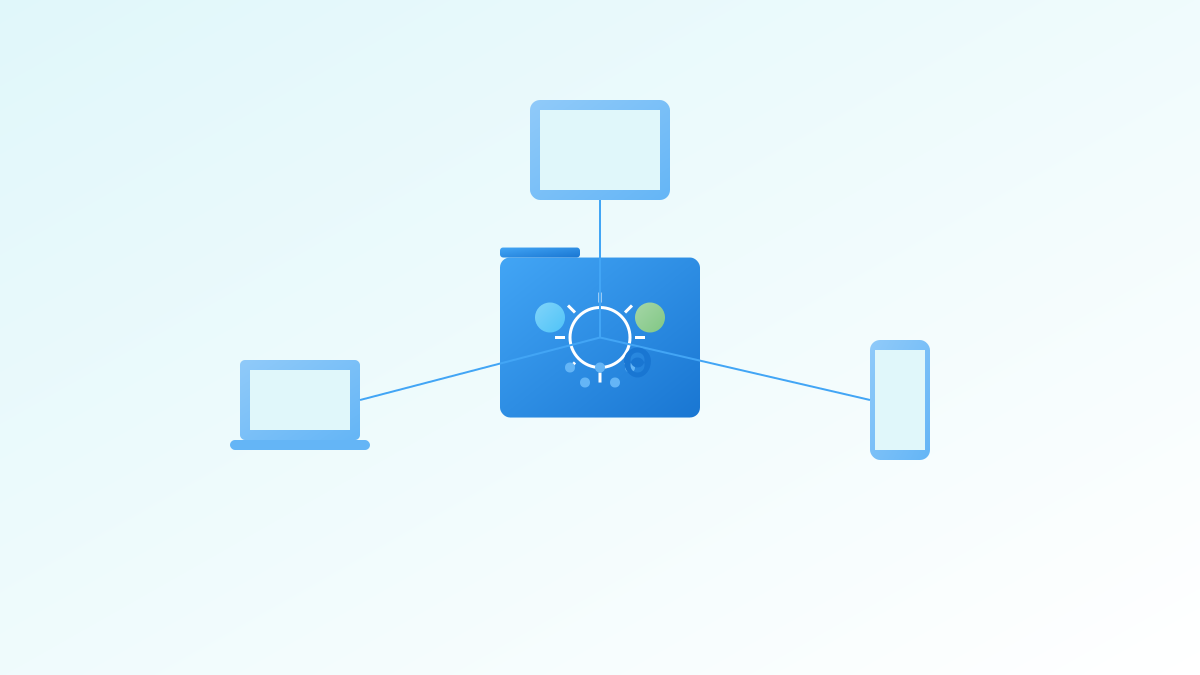
Introduces a unified configuration source for managing Claude Code and Codex configurations across multiple machines, solving the problem of tedious and error-prone manual synchronization, and achieving consistency and portability of development environments. The core value lies in enabling more efficient multi-device configuration synchronization and team sharing through version control and automated scripts.


2

Section 02

Project Background: Pain Points of Multi-Device AI Tool Configuration

Modern developers often need to switch between multiple devices such as desktops, laptops, and servers while maintaining a consistent AI-assisted development experience with Claude Code and Codex configurations. Manual configuration synchronization is both tedious and error-prone, and this repository provides an elegant solution.

3

Section 03

Core Methods and Workflow

Includes three core workflows:

  1. New device initialization: Clone the repository + run install-all.sh for one-click deployment;
  2. New project configuration: Generate project-level configuration files (e.g., CLAUDE.md, project-rules.md, etc.) via new-project-claude.sh;
  3. Existing device update: Pull repository updates + re-run the installation script to synchronize configurations. Additionally, modular installers (install-all.sh, claude-config/install.sh, codex-config/install.sh) are provided to support selecting the installation scope on demand.
4

Section 04

Configuration,Package Structure and Local-Only Files

The repository separates configurations by tool:

  • Claude configuration package (claude-config/): Contains global settings, system rules, templates, and initialization scripts;
  • Codex configuration package (codex-config/): Contains global settings, rule sets, and authentication templates;
  • Documentation resources (docs/): Guides such as CONFIG-BOOTSTRAP.md. Local-only files (not shared): For example, Claude's conversation history (history.jsonl), Codex's authentication,token (auth.json), etc., to avoid sensitive information leakage.
5

Section 05

Design Philosophy

Follows three core principles:

  1. Configuration as code: Included in version control to enable auditability, rollback, collaboration, and documentation;
  2. Layered configuration architecture: Global layer (cross-device universal), project layer (specific project rules), local layer (device runtime state);
  3. Minimize manual steps: Automated deployment via scripts—new device initialization only requires cloning + running the script.
6

Section 06

Practical Application Scenarios (Evidence)

Applicable to multiple scenarios:

  • Multi-device developers: Maintain consistent AI experience across different devices;
  • Team configuration sharing: New members quickly get a unified environment;
  • Configuration experimentation and rollback: Test new configurations via branches and roll back if not satisfied;
  • Disaster recovery: Clone the repository on a new device to restore core configurations and workflows.
7

Section 07

Expansion Suggestions and Limitations

Expansion directions: Add custom rules, expand project templates (support multiple tech stacks), integrate Git hooks; Limitations to note: Avoid hardcoding sensitive information in configurations (use environment variables), pay attention to platform differences (need to detect OS for adjustments), and focus on tool version compatibility (,record tested versions).

8

Section 08

Conclusion

This repository embodies the practice of Infrastructure as Code, solving problems such as multi-device synchronization, team collaboration, and configuration auditability. As AI-assisted tools become more popular, this configuration management model will become a standard in developers' toolchains. It is recommended that developers/teams who take AI-assisted development seriously establish a similar system.

