Zing Forum

Reading

AgentOS: A Lightweight OS Kernel That Runs Large Language Models as Independent Processes

AgentOS is a proof-of-concept operating system kernel written in Go. It treats Large Language Models (LLMs) as independent long-running processes, interacts with the environment via strict JSON system calls, and implements an agent runtime architecture similar to traditional OS process management.

AgentOSLLM大语言模型智能体操作系统Go语言系统调用进程管理Agent架构AI基础设施
Published 2026-06-12 22:14Recent activity 2026-06-12 22:49Estimated read 10 min
AgentOS: A Lightweight OS Kernel That Runs Large Language Models as Independent Processes
1

Section 01

AgentOS: Guide to the Lightweight OS Kernel That Runs LLMs as Independent Processes

AgentOS: Guide to the Lightweight OS Kernel That Runs LLMs as Independent Processes

Core Concept: AgentOS is a proof-of-concept operating system kernel written in Go. It treats Large Language Models (LLMs) as independent long-running processes, interacts with the environment via strict JSON system calls, and implements an agent architecture similar to traditional OS process management.

Original Author and Source:

  • Maintainer: pipelinelord
  • Source: GitHub (Link)
  • Release Time: 2026-06-12

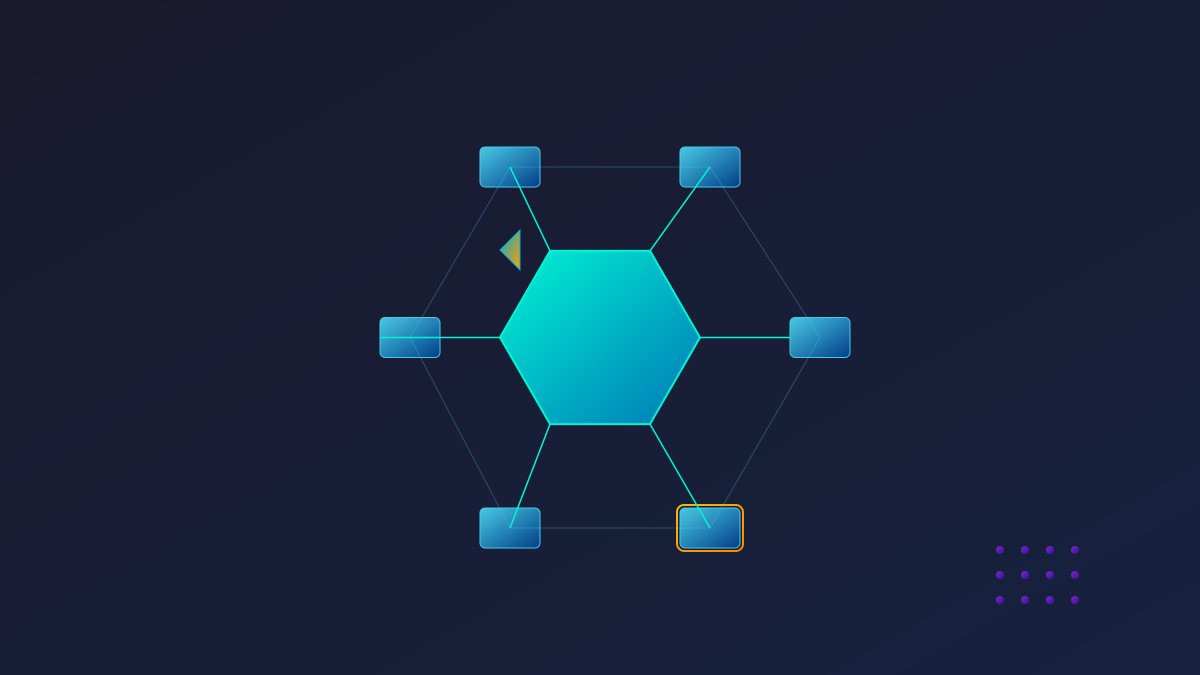
Core Architecture Overview: Drawing on traditional OS architecture, it replaces CPU threads with LLM context windows. Core components include the process manager, scheduler, system call dispatcher, and hardware driver layer.


2

Section 02

Background: Why Do We Need AgentOS?

Background: Why Do We Need AgentOS?

Most current LLMs use a request-response mode (user sends a prompt → model returns text → conversation ends). This mode is simple and straightforward, but it's difficult to support continuous operation and continuous interaction with the environment in agent scenarios:

  • For example: Long-term monitoring of file system changes, periodic network information queries, collaboration with other AI processes to complete tasks, etc.

AgentOS is designed precisely to address the needs of these scenarios.

3

Section 03

Core Architecture and Execution Loop Analysis

Core Architecture and Execution Loop Analysis

Core Architecture Components

  • Process Manager: Maintains the Agent Process Control Block (AgentPCB), recording information such as PID, status, and memory pointers.
  • Scheduler: Background loop that evaluates process status and triggers LLM inference (when the process is running).
  • System Call Dispatcher: Parses JSON commands generated by LLMs and routes them to corresponding hardware drivers.
  • Hardware Driver Layer: Encapsulates host system interfaces (Docker, file system, network, vector database, etc.).

Execution Loop Steps

  1. Context Construction: Collects system instructions, role definitions, and historical records (communication messages, events, system call results).
  2. LLM Inference: Sends prompts to LLMs (e.g., Gemini 1.5 Flash) to generate responses containing [SYS_CALL::...] JSON blocks.
  3. Distribution Phase: Parses JSON; if invalid, injects error information into the context; if valid, routes to the processor.
  4. Execution Phase: The processor interacts with drivers/internal components to complete hardware operations.
  5. Status Update: Injects execution results into the context and restarts the loop.

This design transforms LLMs from one-time tools into continuously running "processes".

4

Section 04

System Calls: Detailed Explanation of the Agent's "Instruction Set"

System Calls: Detailed Explanation of the Agent's "Instruction Set"

AgentOS provides multiple types of system call interfaces:

  • Execution Lifecycle:
    • SPAWN_AGENT: Spawns child processes (supports permission restrictions and output routing);
    • EXEC_CMD: Executes bash/powershell commands;
    • SYS_EXIT: Terminates the agent.
  • File System: Sandboxed (restricted to /workspace/ directory), FS_READ/FS_WRITE for file reading/writing (prevents path traversal).
  • Network: Only supports NET_FETCH (HTTP GET requests, response ≤5MB, timeout mechanism).
  • Memory: Implemented via ChromaDB, MEM_WRITE for embedding storage of knowledge, MEM_READ for semantic retrieval (long-term memory).
  • IPC: SEND_MSG/RECV_MSG for asynchronous peer-to-peer communication; SYS_WRITE_STDOUT/SYS_READ_STDIN for standard IO; the pipe_to parameter can route output to the target process.
  • Others: Timers (SLEEP/SYS_SCHEDULE), Webhook support (responds to external events).
5

Section 05

Security Protection: Multi-Layer Isolation and Error Recovery

Security Protection: Multi-Layer Isolation and Error Recovery

AgentOS's security mechanisms include:

  1. RBAC Permission Control: Child agents are created with the least privilege principle, restricting disk/network access.
  2. File System Isolation: Automatically strips path traversal symbols (e.g., ../), and operations are locked to the sandbox directory.
  3. Network Restrictions: Only allows GET requests to prevent modifying external system states.
  4. Structured Error Recovery: When LLMs generate invalid JSON, decoding errors are captured and friendly prompts are injected, allowing LLMs to self-correct in the next cycle.

These mechanisms grant AI capabilities while maintaining behavioral controllability.

6

Section 06

CLI Tools: Operation and Management of AgentOS

CLI Tools: Operation and Management of AgentOS

AgentOS is compiled into aos.exe via the Cobra framework, providing the following commands:

  • aos spawn: Starts the OS and bootstraps the root process (can specify model/role prompts);
  • aos ps: Lists all active processes and their PIDs;
  • aos top: Displays real-time telemetry (token consumption, number of system calls);
  • aos logs [PID]: Streams the thought process and output of a specific agent;
  • aos kill [PID]: Forcibly terminates an agent.

These commands simplify the daily management of AgentOS.

7

Section 07

Technical Significance and Future Development Directions

Technical Significance and Future Development Directions

Technical Significance

AgentOS represents a paradigm shift in LLM applications: it elevates LLMs from API endpoints to "computing units" (similar to traditional OS processes), supporting continuous operation and interaction.

Potential Application Scenarios

  • Long-term monitoring agents;
  • Complex task automation (multi-step collaboration);
  • Personal assistants with memory;
  • Agent collaboration networks.

Current Limitations and Future

Currently in the proof-of-concept stage: network only supports GET, file system is strictly sandboxed, and LLM providers are limited. More features can be expanded in the future, but controllability must be maintained.

Developer Value

Provides a reference implementation for exploring agent architectures. The Go code is concise and clear, drawing on traditional OS design and optimized for LLMs.

