Zing Forum

Reading

AgentLayer: An Intelligent Agent Workflow Middle Layer for Local Large Language Models

AgentLayer is an open-source project designed to provide intelligent agent tools and workflow support for locally deployed large language models (such as Nemotron-3-Nano), enabling developers to build AI-driven automation processes in local environments.

AgentLayer本地大模型Nemotron-3-Nano智能代理工作流编排开源项目AI中间层
Published 2026-05-16 02:14Recent activity 2026-05-16 02:18Estimated read 5 min
AgentLayer: An Intelligent Agent Workflow Middle Layer for Local Large Language Models
1

Section 01

AgentLayer: An Open-Source Middle Layer for Local LLM Smart Agents

AgentLayer is an open-source project designed as an intelligent agent workflow middle layer for locally deployed large language models (e.g., Nemotron-3-Nano). Its core goal is to bridge the gap between lightweight local LLMs and complex agent workflows, enabling developers to build AI-driven automation processes without relying on cloud APIs. Key benefits include data privacy, cost-effectiveness, low latency, and customizability.


2

Section 02

Background: Rise of Local LLMs & Their Challenges

Local LLMs are gaining traction due to several factors:

  • Data Privacy: Avoids sending sensitive data to cloud APIs.
  • Cost Efficiency: No per-token charges after deployment.
  • Low Latency & Availability: No network dependency, no API limits or outages.
  • Customizability: Allows fine-tuning for specific tasks. However, local models (smaller in parameter size) face challenges in complex reasoning and tool usage—AgentLayer addresses this gap.
3

Section 03

Target Model: Nemotron-3-Nano

AgentLayer is optimized for NVIDIA's Nemotron-3-Nano, a 4-billion-parameter local model. It runs smoothly on consumer GPUs or high-end CPUs, making it accessible to individual developers and small teams. Despite its small size, it performs well in instruction following, code generation, and reasoning tasks.

4

Section 04

Architecture Design of AgentLayer

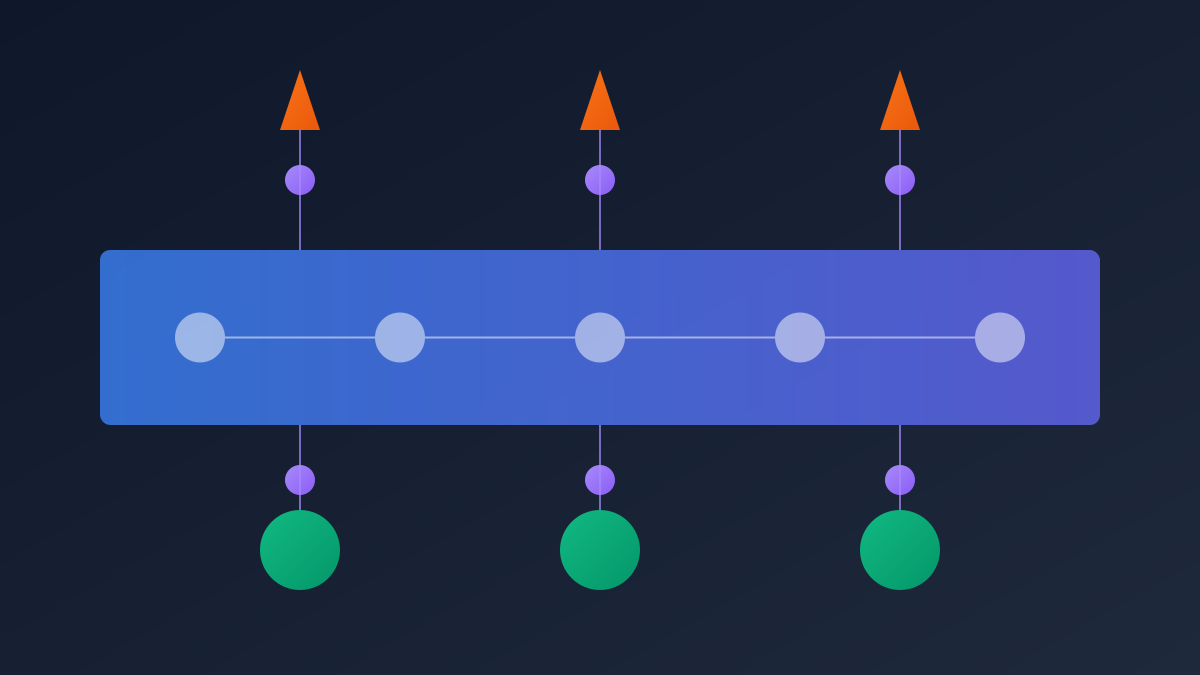
AgentLayer uses a layered architecture:

  1. Tool Abstraction Layer: Standardizes tool interfaces (system, network, compute, external services) for unified access.
  2. Workflow Orchestration Engine: Supports sequential, conditional, loop, and parallel execution modes.
  3. Context Management: Maintains session history, working memory, and long-term persistence.
  4. Model Adaptation Layer: Handles prompt format conversion, parameter tuning, and output parsing for different local models.
5

Section 05

Use Cases & Technical Highlights

Typical Scenarios:

  • Automation workflows (e.g., code quality analysis + report generation).
  • Local smart assistants (managing schedules, private data access).
  • Development aids (code completion, error diagnosis).
  • Data processing pipelines (cleaning, classification, translation). Technical Highlights: Lightweight design, modular architecture, high scalability, robust error handling.
6

Section 06

Comparison & Getting Started Guide

Comparison with Other Frameworks:

  • Focuses on local models (vs. cloud-centric LangChain/AutoGPT).
  • More lightweight (suitable for resource-limited environments).
  • Simplified API (lower usage threshold). Getting Started:
  1. Install dependencies.
  2. Prepare Nemotron-3-Nano or compatible local models.
  3. Define tools (predefined or custom).
  4. Build workflows via API.
  5. Run the agent.
7

Section 07

Future Outlook & Conclusion

Future Plans:

  • Support more local models (Llama, Mistral series).
  • Expand tool ecosystem with ready-to-use tools.
  • Add visual workflow editor for non-technical users.
  • Enable multi-agent collaboration. Conclusion: AgentLayer demonstrates that small local models can perform meaningful tasks with proper architecture. It's a valuable solution for users prioritizing privacy, cost control, or offline availability, and will play an increasingly important role in the AI ecosystem.

