Zing Forum

Reading

AgenticAI QA Workflow: A New Paradigm of AI-Driven End-to-End Test Automation

An end-to-end QA workflow automation project based on MCP, Playwright, and AI agents, enabling full-process automation of requirement analysis, test planning, exploratory testing, script generation, test self-healing, and report generation via natural language prompts.

AIQAtestingPlaywrightMCPautomationCI/CD
Published 2026-05-27 19:45Recent activity 2026-05-27 20:00Estimated read 6 min
AgenticAI QA Workflow: A New Paradigm of AI-Driven End-to-End Test Automation
1

Section 01

AgenticAI QA Workflow: Guide to the New Paradigm of AI-Driven End-to-End Test Automation

This project is an AI-driven end-to-end test automation solution open-sourced by puneetsharma9607 on GitHub. Its core vision is to achieve full lifecycle automation of QA via natural language prompts. It integrates MCP (Model Context Protocol), Playwright, and AI agent technologies, covering requirement analysis, test planning, exploratory testing, script generation, test self-healing, report generation, and CI/CD integration, aiming to address the bottlenecks of labor-intensive and low-efficiency in traditional QA processes.


2

Section 02

Background: Bottlenecks of Traditional QA and Opportunities for AI Transformation

Traditional QA processes rely on manual requirement analysis, test case design, script writing, etc., which are time-consuming and easily become bottlenecks, making it difficult to adapt to the pace of agile development and continuous delivery. The rise of LLM in recent years has brought new possibilities for QA automation. The AgenticAI QA Workflow project is an embodiment of this trend, attempting to reconstruct the entire QA workflow with AI agents to achieve end-to-end intelligence.

3

Section 03

Core Tech Stack and End-to-End Workflow Analysis

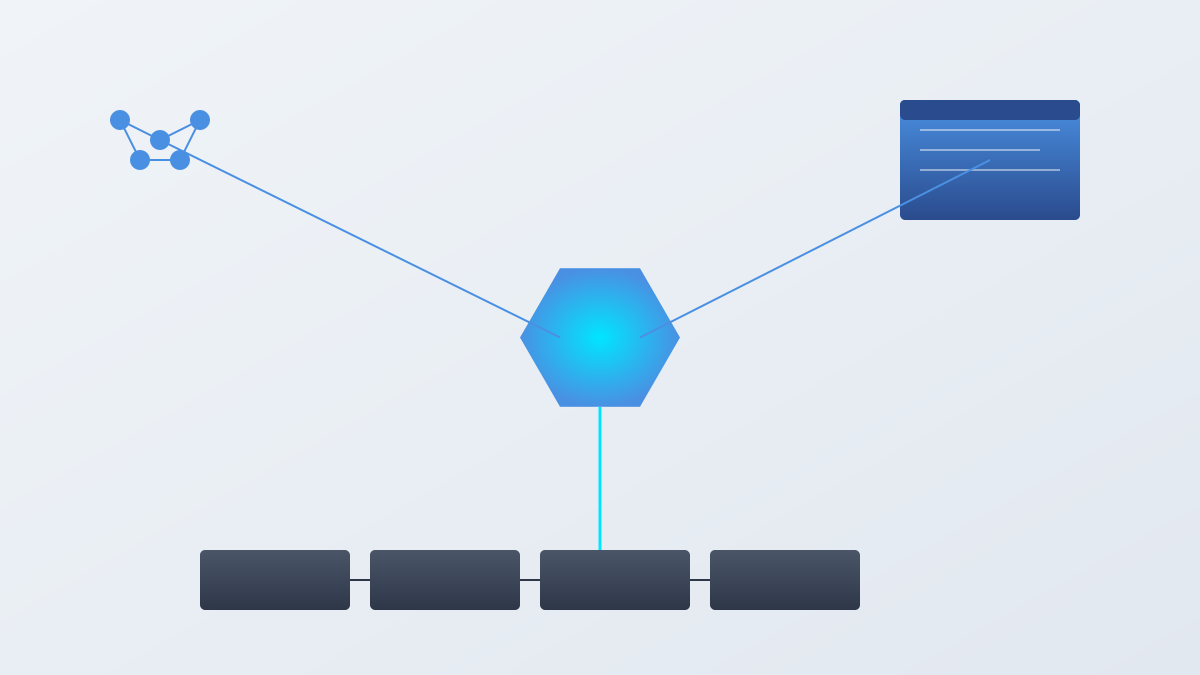
Core Tech Stack: 1. MCP: Standardizes the interaction between AI and external tools, providing a unified interface, context transfer, and security boundaries; 2. Playwright: Features like multi-browser support, automatic waiting, recording and debugging, providing reliable browser operation capabilities for AI decision-making; 3. AI Agents: Possess planning, tool usage, memory management, and reflection capabilities.

Workflow: Intelligent Requirement Parsing (document ingestion, NLP extraction, test point identification) → Intelligent Test Planning (type selection, data design, environment configuration) → Exploratory Test Automation (application map construction, boundary exploration) → Script Generation (locator generation, assertion design) → Test Self-Healing (locator repair, process adaptation) → Intelligent Report Generation (execution summary, defect analysis).

4

Section 04

GitHub Workflow Integration Practice

The project is deeply integrated with GitHub Actions:

CI/CD Triggers: PR submission, scheduled (nightly), manual test triggering; Result Feedback: PR comments showing results, status checks as merge conditions, automatic defect Issue creation; Collaboration Enhancement: Supports manual review of AI-generated tests and accumulation of test templates.

5

Section 05

Technical Challenges and Solutions

Challenge 1: AI Decision Reliability → Solutions: Human-machine collaboration for key decision confirmation, rule-constrained decision space, verification loops, confidence scoring; Challenge 2: Test Coverage Completeness → Solutions: Combination of AI and manual exploration, feedback learning, coverage monitoring; Challenge 3: Test Maintenance Cost → Solutions: Generate readable code, modular design, self-healing mechanism.

6

Section 06

Application Scenarios and Value

Rapid Iteration Teams: Quickly generate regression tests, reduce maintenance investment, get quality feedback early; Legacy System Modernization: Automatically generate baseline tests, progressive coverage, reduce manual regression burden; Complex Business Systems: Extract business rules, cover key paths, ensure compliance verification.

7

Section 07

Summary and Outlook

AgenticAI QA Workflow represents the direction of the testing field from manual writing to AI-generated and maintained tests. Although fully autonomous agents are still to mature, it provides a reference implementation and architectural ideas. With the improvement of LLM capabilities and the maturity of the MCP ecosystem, it is expected to move from experimental to production-ready mainstream solutions.

