Zing Forum

Reading

Agentic Registry: A Neutral Infrastructure for Building the AI Agent Ecosystem

Explore the tesserix/agentic-registry project, a gateway-neutral agent artifact registry that provides a unified management and discovery mechanism for AI skills, tools, MCPs, prompts, workflows, and blueprints.

agentic airegistrymcpai toolsgateway-neutral智能体注册中心模型上下文协议
Published 2026-06-16 22:17Recent activity 2026-06-16 22:25Estimated read 7 min
Agentic Registry: A Neutral Infrastructure for Building the AI Agent Ecosystem
1

Section 01

Introduction: Agentic Registry—A Neutral Infrastructure for Building the AI Agent Ecosystem

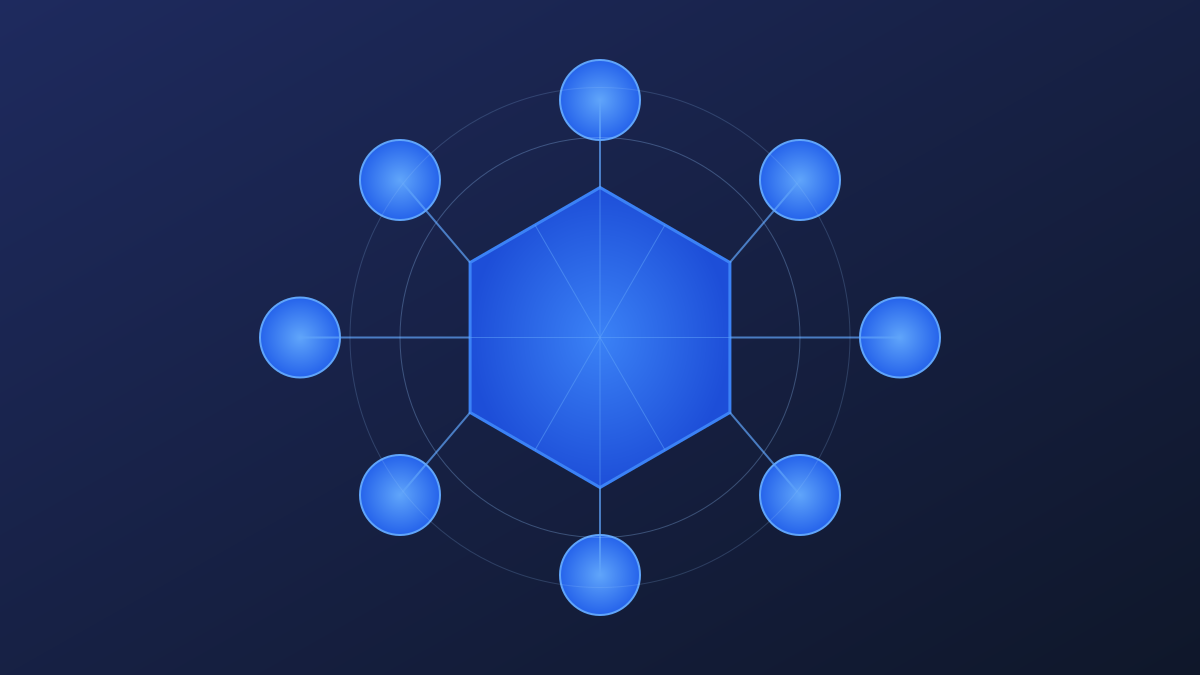
This article introduces the agentic-registry project maintained by tesserix, a gateway-neutral agent artifact registry. It aims to address the fragmentation issue in the AI agent ecosystem by providing a unified management and discovery mechanism for six categories of artifacts: skills, tools, MCPs, prompts, workflows, and blueprints, enabling cross-platform reuse. The project is hosted on GitHub and was released on June 16, 2026.


2

Section 02

Project Background and Motivation

As LLM capabilities improve, AI agents are moving toward practical applications, but the ecosystem fragmentation problem is prominent: different frameworks operate independently, resources like skills and tools are scattered, developers have to switch between multiple systems, and there's a lot of redundant work. Agentic Registry was born in this context, with the core goal of providing a neutral, open, and interoperable agent artifact registry without binding to specific gateways or frameworks.

3

Section 03

Core Concepts and Gateway-Neutral Design

Agentic Artifact Categories

  1. Skills: Capability units for agents to perform specific tasks (e.g., file operations, API calls)
  2. Tools: Callable external function interfaces (in the form of functions/APIs)
  3. MCPs: Model Context Protocols, which define standard ways for agents to interact with the environment
  4. Prompts: Optimized instruction templates
  5. Workflows: Definitions for multi-step task orchestration
  6. Blueprints: Complete AI agent application architecture templates

Significance of Gateway Neutrality

Traditional platforms deeply bind resource registration to specific inference gateways, leading to high migration costs. Agentic Registry uses an abstraction layer design to enable seamless migration of artifacts between different gateways, achieving "write once, run anywhere."

4

Section 04

Technical Architecture and Implementation Key Points

Unified Metadata Model

Define a standardized artifact description format, including type identifiers, version information, input/output schemas (JSON Schema), dependencies, runtime environment requirements, author and license information, etc.

Discovery and Retrieval Mechanism

Possible directions: Semantic vector similarity search, tag classification system, usage statistics and community ratings, reverse dependency query.

Version Management and Compatibility

Drawing on the experience of package managers, it supports semantic versioning (SemVer), version compatibility matrices, and migration guides for breaking changes.

5

Section 05

Application Scenarios and Practical Value

Value for Developers

  1. Reduce redundant development: Reuse community-shared artifacts and focus on business logic
  2. Improve interoperability: Artifacts developed with standard protocols are naturally cross-platform
  3. Accelerate prototype validation: Blueprint libraries shorten the startup time of new projects

Value for Organizations

  1. Knowledge precipitation: Convert individual capabilities into organizational assets
  2. Governance and compliance: A unified registry facilitates security reviews and compliance checks
  3. Vendor unbinding: Gateway neutrality avoids lock-in to a single AI vendor
6

Section 06

Ecosystem Significance and Future Outlook

Agentic Registry marks the transition of the AI agent field from "wild growth" to "standardized development". Future possibilities include:

  • Standardized protocols becoming the foundation for interoperability (similar to HTTP for the Web)
  • Artifact markets spawning new business models
  • Enterprise-level features (private deployment, access control, audit logs) gradually improving

The project's success depends on community adoption and participation from mainstream frameworks (e.g., LangChain, AutoGen). If it becomes a de facto standard, its influence will be immeasurable.

7

Section 07

Key Insights

While pursuing breakthroughs in model capabilities, infrastructure construction is equally important. A healthy and open agent ecosystem requires standardized interfaces, reusable artifacts, and efficient collaboration mechanisms, and Agentic Registry is trying to fill this gap.

