Zing Forum

Reading

Agentic Engineers: An Efficient Software Development Framework Based on Agent Orchestration

Agentic Engineers is an innovative open-source framework that collaborates with an engineer team via an Agent Orchestrator, integrating SDLC-CICD workflows to reduce token usage by approximately 50% while improving development quality and speed.

智能体Agentic WorkflowSDLCCICDToken优化软件开发GitHub
Published 2026-06-08 18:45Recent activity 2026-06-08 18:51Estimated read 6 min
Agentic Engineers: An Efficient Software Development Framework Based on Agent Orchestration
1

Section 01

Introduction: Core Highlights of the Agentic Engineers Framework

Agentic Engineers is an innovative open-source framework maintained by niallyoung, with its source code hosted on GitHub (link: https://github.com/niallyoung/agentic-engineers). This framework collaborates with a team of specialized AI engineers through an agent orchestrator and integrates SDLC-CICD workflows, achieving a reduction in token usage by approximately 50% while enhancing development quality and speed.


2

Section 02

Project Background: Efficiency Dilemmas in AI-Assisted Development

With the widespread application of large language models in software development, relying solely on AI for code generation faces two major bottlenecks: first, high token consumption costs; second, inconsistent quality of AI-generated code, requiring extensive manual review and correction. How to balance the utilization of AI capabilities with cost and quality control has become a core issue in the field of AI-assisted development. Agentic Engineers was born in this context, proposing a new approach combining multi-agent collaboration and complete workflows.

3

Section 03

Core Architecture: Multi-Agent Collaboration System

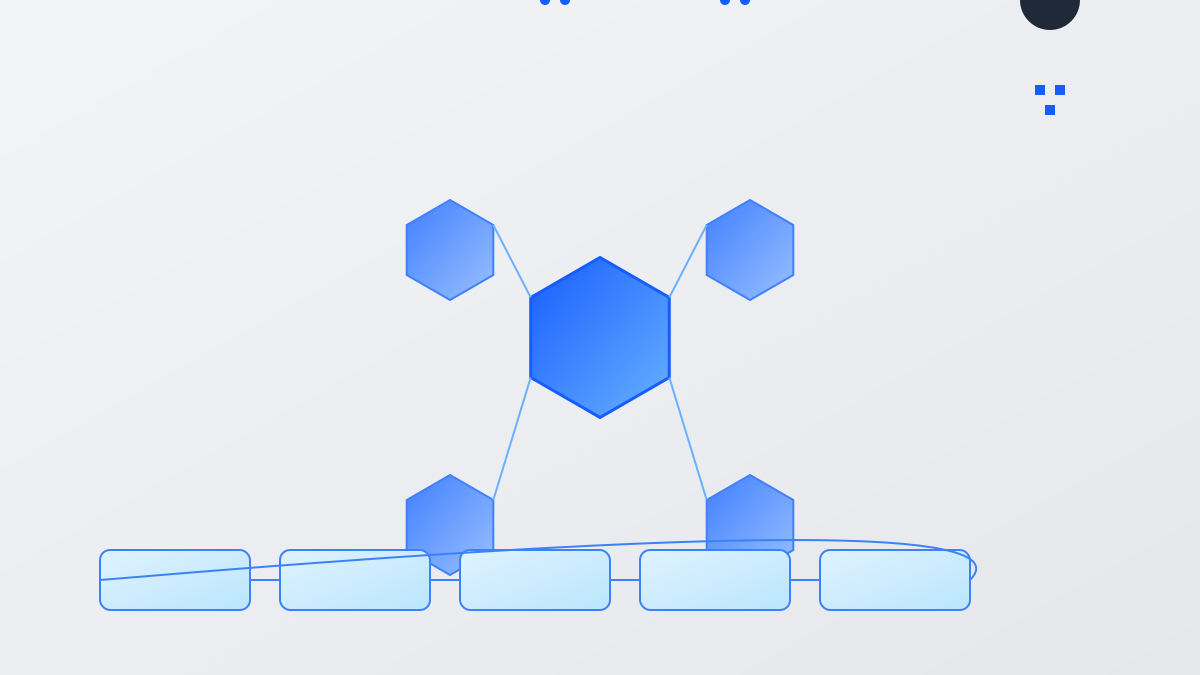
The core architecture of Agentic Engineers consists of three parts: 1. Agent Orchestrator: The core of system scheduling, responsible for receiving tasks, analyzing requirements, and assigning them to appropriate agents; 2. Engineer Team: Composed of specialized AI agents in fields such as front-end, back-end, and databases, each focusing on their specialized subtasks; 3. SDLC-CICD Integration: Integrates traditional software lifecycle and DevOps practices into AI workflows, automatically executing code review, testing, build and deployment processes to ensure outputs meet production standards.

4

Section 04

Technical Highlights: Token Optimization and Quality Assurance

The framework achieves approximately 50% reduction in token usage while improving quality and speed, relying on three key strategies: 1. Task Decomposition and Specialization: Split complex tasks into subtasks, handled by specialized agents to reduce redundant token consumption of general models; 2. Intelligent Context Management: The orchestrator only transmits necessary information, avoiding token waste from redundant content; 3. Iterative Optimization Feedback Loop: After code generation, automatic testing and review are performed, and issues are returned to agents for correction, ensuring quality while avoiding repeated generation of low-quality code.

5

Section 05

Practical Features: Multi-Platform Support and Engineering Structure

The project supports multiple AI programming assistant CLI tools, including OpenCode, Pi, Copilot, and Claude, lowering the adoption threshold for developers. The codebase structure reflects engineering best practices: it includes directories such as .githooks (code submission quality control), .github/workflows (GitHub Actions configuration), config (configuration files), docs (documentation), src (core code), and tests (testing), facilitating community contributions.

6

Section 06

Application Prospects: Paradigm Evolution of AI-Assisted Development

Agentic Engineers represents a new paradigm in AI-assisted development: AI is no longer a simple code generation tool but an intelligent collaborator participating in the complete SDLC. For enterprises: it controls costs while improving efficiency and quality; for individual developers: it helps complete complex projects with the aid of an AI team; for the industry: it marks the evolution of AI-assisted development from an experimental tool to a production-grade solution.

