Zing Forum

Reading

Agentic Dev System: A Local-First Agent-Driven Development Workflow System

Agentic Dev System is a local-first agent-driven development workflow system that provides story workspaces, prompt packages, review packages, quality gates, and CI/CD integration, using LangGraph's secure workflow phase design.

代理驱动开发LangGraph本地优先CI/CD代码审查工作流编排AI协作质量门禁
Published 2026-06-11 03:15Recent activity 2026-06-11 03:25Estimated read 6 min
Agentic Dev System: A Local-First Agent-Driven Development Workflow System
1

Section 01

Agentic Dev System: Introduction to the Local-First Agent-Driven Development Workflow System

Agentic Dev System is a local-first agent-driven development workflow system designed to seamlessly integrate AI agents into professional software development processes. Its core features include story workspaces, prompt packages, review packages, quality gates, and CI/CD integration. It adopts LangGraph's secure workflow phase design to ensure developers have full control over code and data, addressing challenges in AI agent integration such as predictability, context management, quality control, and integration issues.


2

Section 02

Project Background and Motivation

As the capabilities of AI coding agents improve, traditional development workflows face challenges in integrating AI agents: unpredictable behavior, complex context management, difficulty in quality control, and challenges in integrating with CI/CD pipelines. Agentic Dev System emerged to provide a structured framework, following the 'local-first' principle to allow developers to enjoy the convenience of AI while maintaining full control over code and data.

3

Section 03

Analysis of Core Concepts

Core Concepts

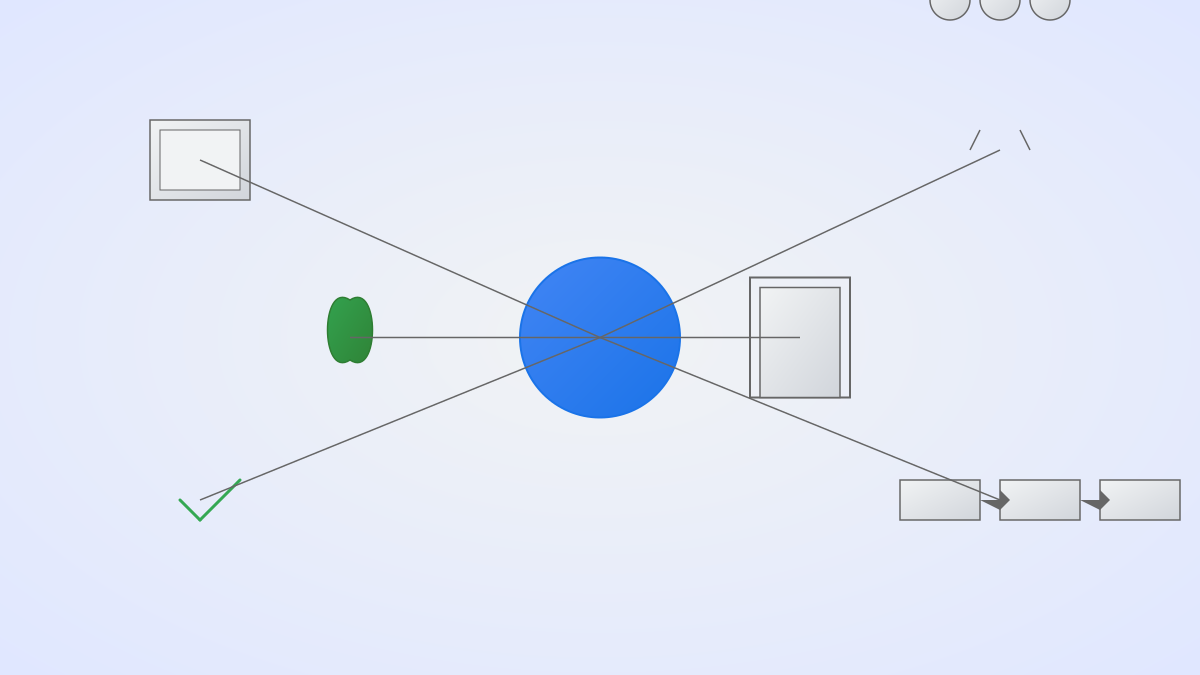
  • Story Workspace: Organizes development around user stories, with context isolation, lifecycle management, traceability, and suitability for AI agent collaboration.
  • Prompt Packages: Collections of reusable prompt templates, featuring domain specificity, version control, composability, and context awareness to enhance agent behavior predictability.
  • Review Packages: Structured code review units that support incremental reviews, multi-dimensional evaluation, automated checks, and human-machine collaboration.
  • Quality Gates: Key checkpoints in the workflow, including phase gates, configurable rules, automatic execution, and failure handling mechanisms.
4

Section 04

LangGraph-Safe Workflow and CI/CD Integration

LangGraph-Safe Workflow Phases

  • Phase Isolation: Independent retryable units with clear states, idempotency, error recovery, and parallel execution potential.
  • Workflow Orchestration: Supports sequential execution, conditional branching, loop iteration, and parallel processing.

CI/CD Integration

  • Local-Remote Collaboration: Local development with AI collaboration, pre-commit checks, remote builds, and feedback loops.
  • Pipeline Phases: Story planning → Code generation → Local validation → Review preparation → Manual review → Integration testing → Deployment preparation.
5

Section 05

Features of Local-First Architecture

Local-First Architecture

  • Data Sovereignty: Local code storage, local agent execution, local configuration management, and optional cloud interaction.
  • Offline Capability: Full offline work support, delayed synchronization, and compatibility with local open-source models.
6

Section 06

Practical Application Scenarios

Practical Application Scenarios

  • Enterprise Development: Audit trails, standard enforcement, and combined security reviews.
  • Open Source Collaboration: Contributor guidance, AI pre-reviews to improve efficiency, and quality consistency guarantees.
  • Individual Developers: AI accelerates repetitive tasks, automated checks to avoid low-level errors, and story workspaces to organize projects.
7

Section 07

Key Technical Implementation Points and Summary Outlook

Key Technical Implementation Points

  • LangGraph Integration: State management, persistent checkpoints, and human-machine interaction nodes.
  • Extensibility Design: Plugin architecture, API interfaces, and event-driven mechanisms.

Summary and Outlook

Agentic Dev System represents the evolution of development workflows from 'humans using tools' to 'humans collaborating with AI agents', transforming AI agents into predictable, auditable, and integrable partners. As AI coding capabilities improve, such systems will become increasingly important—building trust between humans and AI, enhancing efficiency while maintaining quality control.

