Zing Forum

Reading

Agentic Customer Service Robot: An Enterprise-Grade Customer Support Solution Based on Multi-Agent Architecture

An intelligent customer service system built on Microsoft Agents Framework and .NET 10, adopting a six-agent collaborative architecture that supports structured reasoning, real-time streaming responses, and human-machine collaborative approval processes.

智能客服多智能体系统Microsoft Agents Framework人机协同企业AI客户支持自动化结构化推理审批工作流
Published 2026-05-08 11:16Recent activity 2026-05-08 11:20Estimated read 7 min
Agentic Customer Service Robot: An Enterprise-Grade Customer Support Solution Based on Multi-Agent Architecture
1

Section 01

[Introduction] Agentic Customer Service Robot: An Enterprise-Grade Customer Support Solution with Multi-Agent Architecture

This article introduces the Agentic customer service robot built on Microsoft Agents Framework and .NET 10, which adopts a six-agent collaborative architecture. Its core features include structured reasoning, real-time streaming responses, and a human-machine collaborative approval mechanism. It aims to balance customer support efficiency and service quality, providing a practical path for enterprise-level AI applications.


2

Section 02

Background: Evolution from Traditional Customer Service Robots to Multi-Agent Systems

Traditional customer service robots often rely on simple Q&A matching or single LLM calls, making it difficult to handle complex multi-step inquiries. With the maturity of large language models and agent architectures, the new generation of customer service systems is moving toward the direction of "multi-agent collaboration". This project is a typical representative of this trend, solving complex customer support tasks through division of labor and collaboration.

3

Section 03

Core Architecture: Six-Agent Collaborative Design

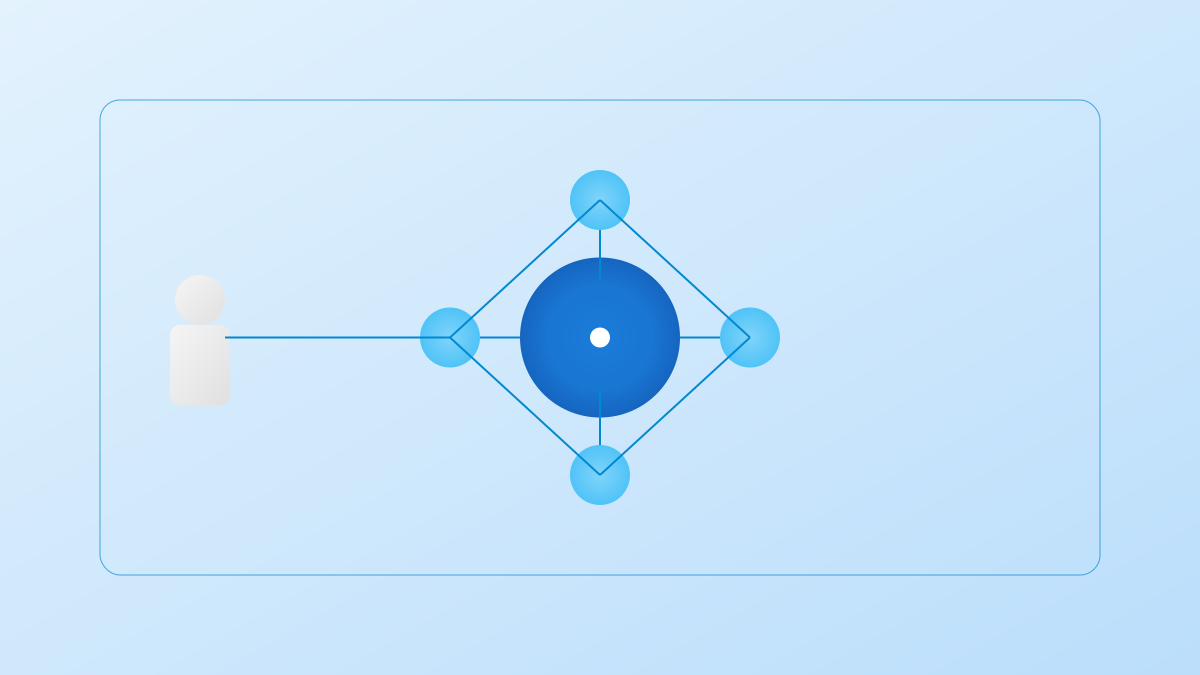
The system breaks down the customer support process into six specialized agent roles:

  1. Planning Agent: Analyzes requirements and decomposes them into a sequence of subtasks;
  2. Classification Agent: Identifies the type of inquiry (technical, billing, etc.);
  3. Research Agent: Retrieves knowledge bases and historical cases;
  4. Response Generation Agent: Integrates results to generate a professional draft reply;
  5. Approval Agent: Pauses the process to wait for manual review (approve/modify/reject);
  6. Observation Agent: Records reasoning trajectories to support auditing and optimization.
4

Section 04

Tech Stack and System Requirements

Core Technologies: Based on Microsoft Agents Framework (agent orchestration) and .NET 10 (cross-platform and asynchronous processing); Deployment: Natively supports Windows 10/11 (64-bit); Hardware Requirements: Intel Core i5/AMD Ryzen 5 or higher processor, 8GB+ RAM, 500MB storage, stable network; Architecture: Hybrid mode (local inference + cloud calls for complex tasks), balancing speed and capability.

5

Section 05

Human-Machine Collaboration: Key Value of Manual Approval

The system follows the concept of "AI assistance, human decision-making": After AI generates a draft reply, manual approval is required before sending. This mechanism brings multiple values:

  • Quality assurance: Avoids inappropriate content generated by AI;
  • Compliance and responsibility: Enterprises control the final communication content;
  • Continuous learning: Human feedback optimizes the model;
  • Trust enhancement: Customers perceive that replies are reviewed by humans. The approval interface provides a view of reasoning trajectories to enhance transparency.
6

Section 06

Key Features: Real-Time Response and Data Security

Real-Time Streaming Response: Supports gradual content presentation (typewriter effect), simulates human interaction, and improves user experience; Data Security:

  • Local priority processing for sensitive data;
  • Cloud calls use TLS encryption;
  • Role-based permission management and audit logs;
  • Customer data isolation to prevent cross-contamination.
7

Section 07

Application Scenarios and Deployment Best Practices

Typical Scenarios: High-value services (finance/medical), complex technical support, multilingual customer service, peak traffic offloading, new employee training; Deployment Suggestions:

  1. Regularly update project versions;
  2. Monitor the approval queue and respond promptly;
  3. Ensure stable network; 4.Train reviewers to understand system logic;
  4. Establish a feedback loop and fine-tune the model with manually modified data.
8

Section 08

Limitations and Conclusion

Current Limitations: Windows platform dependency, limited offline functions, steep learning curve, delays in complex queries; Future Improvements: Enhance local inference, expand cross-platform support, intelligent automatic approval thresholds; Conclusion: This project demonstrates a practical path for enterprise AI implementation—building a human-machine collaborative "gray box" system where AI acts as an intelligent assistant rather than a replacement, which is the optimal solution under current technical conditions.

