Zing Forum

Reading

Agentic AI Task Orchestrator: An Event-Driven Autonomous Agent Task Orchestration System

An open-source autonomous agent task orchestration system that solves complex tasks through dynamic task decomposition and parallel execution. It adopts an event-driven architecture, integrating FastAPI, Redis queues, WebSocket real-time communication, and Ollama local LLM inference to provide a scalable distributed solution for AI applications.

AI Agent任务编排事件驱动架构FastAPIRedisOllama并行执行大语言模型智能体系统分布式系统
Published 2026-06-08 02:15Recent activity 2026-06-08 02:20Estimated read 9 min
Agentic AI Task Orchestrator: An Event-Driven Autonomous Agent Task Orchestration System
1

Section 01

Agentic AI Task Orchestrator: Core Overview

Agentic AI Task Orchestrator is an open-source autonomous agent task orchestration system that solves complex tasks through dynamic task decomposition and parallel execution. It uses an event-driven architecture, combining FastAPI, Redis queues, WebSocket real-time communication, and Ollama local LLM inference to provide a scalable distributed solution for AI applications. Its core goal is to address the limitations of single agents in handling complex scenarios, enabling efficient multi-step reasoning, parallel computing, and dynamic coordination.


2

Section 02

Project Background and Motivation

With the improvement of large language model (LLM) capabilities, AI agents have evolved into autonomous systems capable of executing complex tasks. However, a single agent struggles to handle scenarios involving multi-step reasoning, parallel computing, and dynamic coordination. The traditional synchronous call mode is inefficient for long-running tasks, and simple task queues lack intelligent decomposition capabilities. This system, as a complete agent orchestration framework, aims to address these pain points and enable dynamic decomposition and asynchronous coordination of complex tasks.

3

Section 03

Core Architecture Design

Event-Driven Architecture

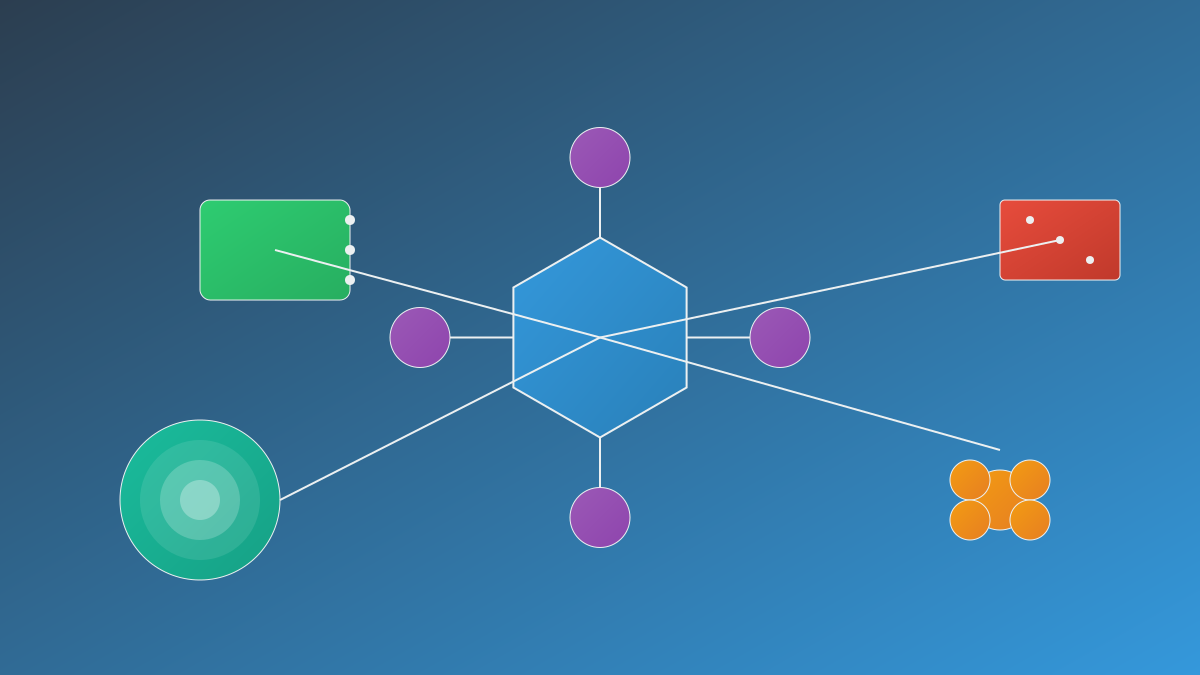
Adopting an event-driven architecture, components communicate via publish/subscribe events, bringing decoupling (components can be developed and deployed independently), scalability (adding executor instances enables automatic load balancing), and fault tolerance (tasks are retained in queues, and other executors take over after a crash).

Dynamic Task Decomposition Mechanism

Subtasks are dynamically generated by the LLM based on task content, not static rules. For example, when analyzing financial reports, it decomposes into data extraction, ratio calculation, trend analysis, chart rendering, etc., and automatically builds a dependency graph to ensure sequential execution.

Parallel Execution and Result Aggregation

Independent subtasks are executed in parallel to improve speed, with Redis queues distributing tasks. After subtasks are completed, the result aggregator collects and integrates them (deduplication, conflict resolution, formatting) to output a complete and coherent result.

4

Section 04

Detailed Tech Stack

FastAPI

A high-performance asynchronous API framework with native support for async/await, handling a large number of concurrent connections. It provides automatic OpenAPI documentation, Pydantic data validation, and dependency injection, reducing development costs.

Redis

Used as a task queue to store subtasks, publish/subscribe channels to broadcast real-time events, cache intermediate results, store dependency graphs and execution states. In-memory storage ensures low latency.

WebSocket

Persistent bidirectional connection, where the server actively pushes task statuses (running, completed, error, remaining time) to enhance user experience.

Ollama

A local LLM inference engine that supports models like Llama and Mistral. It ensures privacy (sensitive data is not sent to third parties), controls costs (more economical for high-frequency calls), and reduces latency (no network round trips). It also supports switching to backends like the OpenAI API.

5

Section 05

Application Scenarios and Value

  • Automated Workflow Orchestration: In DevOps, multi-step tasks for application deployment (code pulling, testing, building, etc.) are modeled as task graphs, and parallel execution shortens deployment time.
  • Complex Data Analysis: Decompose steps like data cleaning, feature engineering, and model training, then aggregate the results after parallel processing to generate reports.
  • Intelligent Customer Service and Ticket Handling: Decompose subtasks like information retrieval and knowledge base querying, then generate complete responses after parallel processing.
  • Multi-Agent Collaboration Simulation: Used in scenarios like multi-robot coordination and distributed AI research, where agents coordinate actions via an event bus.
6

Section 06

Design Philosophy and Best Practices

  • Fault Isolation and Graceful Degradation: The event-driven architecture supports fault isolation. When a subtask fails, errors are logged, users are notified, or retries are attempted to avoid cascading failures.
  • Observability and Debugging: Event logs record the full task trajectory (creation, assignment, execution, completion). Combined with WebSocket real-time status, this facilitates debugging and monitoring.
  • Modularity and Scalability: Task decomposition strategies, executors, and aggregation logic can be extended independently, supporting the insertion of custom algorithms or domain-specific models.
7

Section 07

Summary and Outlook

Agentic AI Task Orchestrator represents the evolution direction of AI application architecture from single agents to multi-agent collaboration. It solves complex workflow orchestration challenges through event-driven design, dynamic decomposition, and parallel execution. Its value lies in combining traditional software engineering patterns (event-driven, microservices, asynchronous processing) with AI capabilities to build reliable and scalable intelligent systems. In the future, as AI capabilities improve, orchestration frameworks will become more important, and AI applications will be collaborations of multiple specialized agents.
