Zing Forum

Reading

Agentic AI Research Platform: A Multi-Agent Collaborative Research Automation System

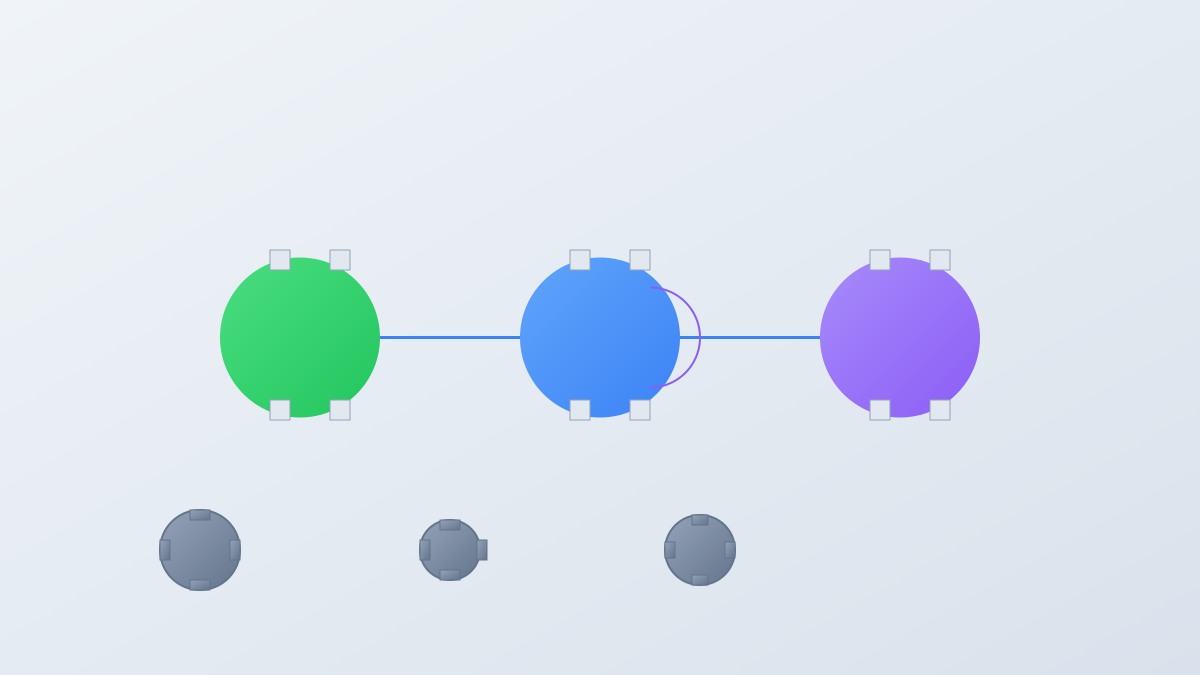
This is an advanced multi-agent AI research platform built with FastAPI and React, supporting agent workflows, reflection mechanisms, tool integrations (arXiv, Tavily, Wikipedia), and intelligent orchestration, providing a complete solution for automated research tasks.

多智能体研究自动化FastAPIReactAgentic Workflow反思机制工具集成AI研究
Published 2026-05-23 22:15Recent activity 2026-05-23 22:24Estimated read 7 min
Agentic AI Research Platform: A Multi-Agent Collaborative Research Automation System
1

Section 01

Introduction to the Agentic AI Research Platform

This is a GitHub project maintained by asall94 (link: https://github.com/asall94/agentic-ai-research-platform), a multi-agent AI research platform built with FastAPI and React. It supports agent workflows, reflection mechanisms, tool integrations (arXiv, Tavily, Wikipedia), and intelligent orchestration, aiming to address the challenges of research automation under information overload and provide a complete solution for research tasks.


2

Section 02

Project Background and Challenges of Research Automation

In the era of information explosion, researchers face information overload, and traditional methods are inefficient. Large Language Models (LLMs) bring new possibilities for research automation, but a single model struggles to handle complex tasks. Multi-agent systems are suitable for multi-step reasoning, multi-angle verification, and multi-source information integration, so this project was designed to address this challenge.

3

Section 03

System Architecture and Core Technical Approaches

Technology Stack

  • Backend: FastAPI (high-performance asynchronous support, type safety, automatic documentation generation, WebSocket support)
  • Frontend: React (component-based architecture, state management, real-time updates)

Agent Framework

Supports agent lifecycle management, message passing coordination, tool call handling, state persistence and recovery

Core Features

  1. Multi-agent workflow: Division of labor among research planning, information retrieval, analysis and synthesis, report generation agents
  2. Reflection mechanism: Self-assessment (checking information completeness, reasoning rationality, conclusion evidence support), iterative improvement, quality control
  3. Tool integrations: arXiv (academic paper search), Tavily (AI search engine), Wikipedia (basic knowledge acquisition)
  4. Intelligent orchestration: Dynamic task allocation, dependency management, resource scheduling
4

Section 04

Typical Application Scenarios and Scheme Comparison

Typical Application Scenarios

  • Literature review automation: Input a topic to automatically search papers, analyze content, and generate structured reports
  • Competitor analysis: Input a competitor name to automatically search information, analyze strengths and weaknesses, and generate comparison reports
  • Technical research: Input a selection question to automatically research technologies, compare schemes, and generate recommendations
  • News monitoring and summarization: Input a topic to automatically monitor news, extract key information, and generate regular summaries

Comparison with Existing Solutions

Feature This Platform Traditional Search Single LLM
Multi-step Reasoning ⚠️
Multi-source Integration ⚠️ ⚠️
Quality Self-correction ⚠️
Real-time Info Acquisition
Structured Output ⚠️
Interpretability
5

Section 05

Project Summary

The agentic-ai-research-platform project demonstrates the great potential of multi-agent AI in the field of research automation. Through the FastAPI+React tech stack, reflection mechanisms, multi-tool integrations, and intelligent orchestration, it provides researchers with a powerful automated assistant. Although it cannot fully replace the judgment and creativity of human researchers, it can take on heavy information collection and preliminary analysis work, allowing researchers to focus on higher-level thinking and decision-making.

6

Section 06

Limitations and Future Development Directions

Limitations

  • Information accuracy: May misinterpret information, produce incorrect inferences, or cite inaccurate/outdated information
  • Complex reasoning boundaries: Limited ability for deep domain knowledge or creative thinking tasks
  • API dependency: External service availability and costs affect system stability

Future Development Directions

  • Integrate more professional databases and APIs
  • Support local deployment of open-source models to reduce costs
  • Add multi-user collaboration features
  • Develop a visual workflow editor
  • Establish a system output quality evaluation framework

